When Loving Your Work Keeps You from Leaving: The Quiet Crisis of Therapist Retirement

Jenna, a clinical social worker in private practice, was sixty-five, the average retirement age in the U.S. Yet every time her husband raised the topic of retirement, she felt herself cringe.
Happily retired, he imagined downsizing, traveling, and spending more time with their grandchildren. “After forty years of work, aren’t you ready for the next phase?” he asked. “Isn’t it time to take care of yourself instead of caring so much for others?”
Jenna’s response was immediate and heartfelt. In her peer-supervision group, she explained that she loved her work. She’d spent decades refining her clinical skills, built a thriving practice, and felt deeply connected to her clients and colleagues. Closing the door on all of that felt unthinkable.
Jenna isn’t avoiding retirement because she lacks options. She’s avoiding it because her work still matters—deeply.
The Work Is Meaningful. And That’s the Problem
Therapy is a uniquely fulfilling profession. It’s intellectually engaging, emotionally meaningful, and grounded in deep human connection. It’s also exhausting. Paradoxically, that combination often makes retirement harder, not easier.
Many therapists quietly ask themselves: How do I age out of a profession that still gives me purpose? Why would I leave voluntarily when the work still feels alive? And how do I even begin this conversation before illness, burnout, or crisis forces it?
These questions are rarely addressed in training, supervision, or professional culture. As a result, many therapists postpone retirement planning until circumstances make the decision unavoidable.
“I’ll Think About It Next Year”: A Familiar Pattern
Consider Michael, a 70-year-old psychologist who tells colleagues he plans to retire “soon.” Each year, however, he renews his office lease and maintains a full caseload. His health is mostly good, but he’s more fatigued than he admits. When asked what’s holding him back, he shrugs. “My clients still need me. And honestly, I don’t know who I’d be without this work.”
Michael isn’t stuck because he hasn’t thought about retirement. He’s stuck because he has. To him, the losses feel enormous.
Identity, Attachment, and the Pull to Stay
In our research, one theme emerged again and again: therapists often define themselves primarily by their professional role. Many introduce themselves first and sometimes only as “a therapist,” before naming other identities such as partner, parent, artist, or volunteer.
Therapists also spoke about the emotional residue of the work: carrying clients’ stories, traumas, hopes, and transformations over decades. Several described the powerful and sometimes addictive affirmation that comes from helping. When that source of meaning disappears, something essential can feel lost.
Retirement, then, isn’t just about stopping work. It requires finding new ways to express compassion, purpose, and contribution.
When the Practice Is You
For therapists in private practice, retirement often means letting go of a business that carries their name, reputation, and life’s work. Many told us this loss felt even harder than releasing their caseload.
Private practice offers autonomy, pride, and financial independence, but it’s rarely transferable. When therapists retire, they often must simply close the doors on decades of effort. That loss deserves recognition and grief, not minimization.
What Changes the Outcome
Retiring well doesn’t happen by accident. Without a plan, retirement can feel like quitting—or worse, abandoning clients. With preparation, it becomes a thoughtful developmental transition.
Readiness means attending to countertransference, considering client needs, and honoring your own limits and desires. It means planning endings that are ethical, relational, and humane for clients and for yourself.
Retirement is not simply the end of a career. It is a profound life transition. When approached with care, clarity, and intention, it can become not a collapse of purpose, but the beginning of a new, meaningful chapter.
Want to read more? See Letting Go of the Work You Love: A Workbook for Therapists to Prepare for Retirement, Close a Practice, and End a Career with Integrity by Lynn Grodzki and Margaret Wehrenberg (PESI 2025).
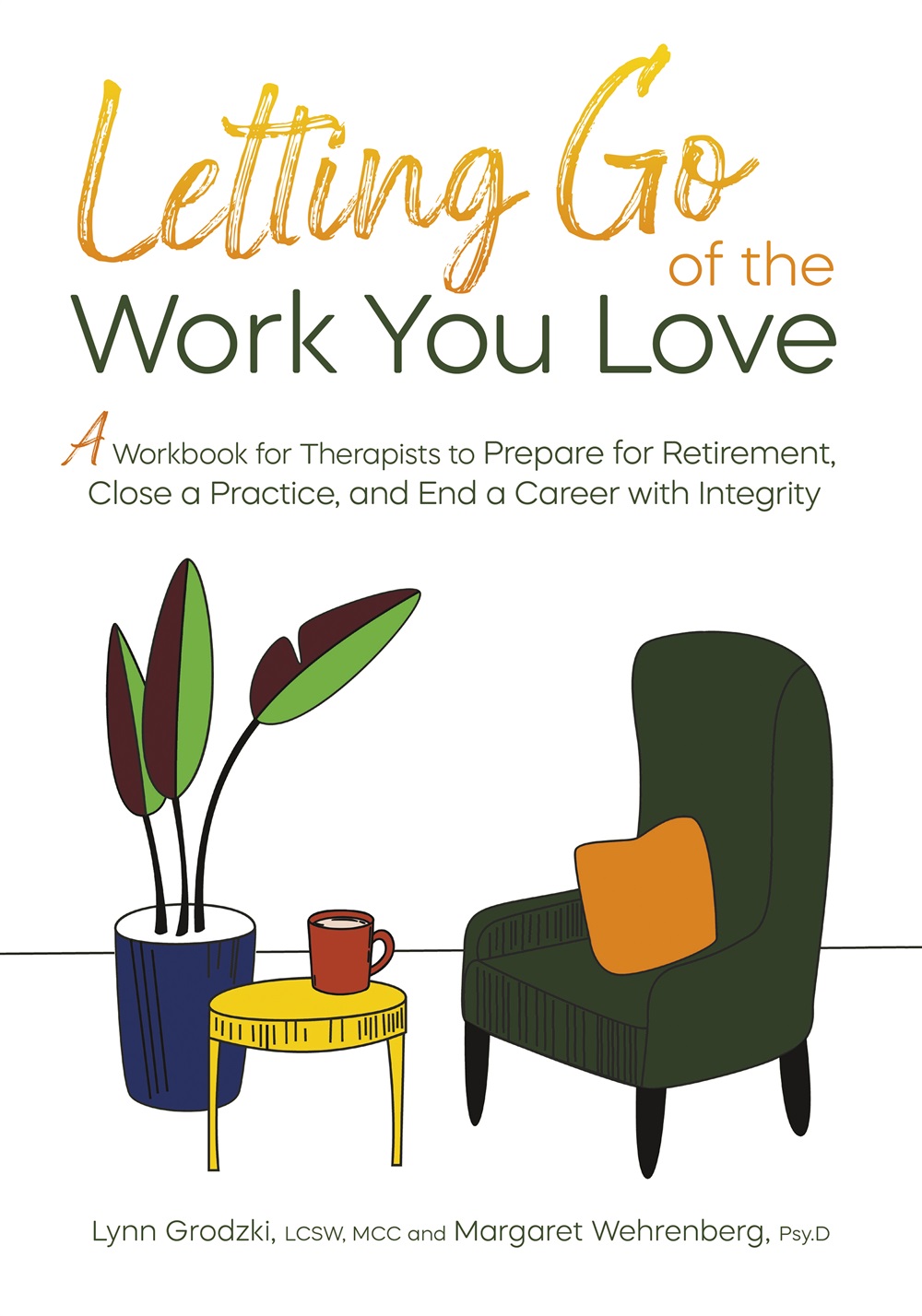
In Letting Go of the Work You Love, authors and therapists Lynn Grodzki and Margaret Wehrenberg offer a groundbreaking roadmap for therapists preparing to step away from their professional roles, whether by choice, necessity, or life change.


Margaret Wehrenberg, PsyD, a licensed clinical psychologist, is the author of nine books on the treatment of anxiety and depression, including her most recent e-book, Pandemic Anxiety: Fear, Stress, and Loss in Traumatic Times (January, 2021), bestselling book, The 10 Best-Ever Anxiety Management Techniques (W.W. Norton, 2018), and You Can Handle It: 10 Steps to Shift Stress from Problem to Possibility (PESI, 2017). She has also written a book for the general public, The 10 Best Anxiety Busters.
An expert on the treatment of anxiety and depression, she also has extensive training and expertise in the neurobiology of psychological disorders. In addition to clinical work, she coaches business professionals on managing anxiety and has contributed articles for the Psychotherapy Networker magazine. She has produced Relaxation for Tension and Worry, audio soundtracks for breathing, muscle relaxation and imagery to use with anxious clients. Margaret blogs on depression for Psychology Today. Noted for humor, pragmatic treatment approaches, and her interactive teaching style, Dr. Wehrenberg is a sought-after speaker for conferences and trainings, consistently getting the highest ratings for her dynamic presentation and high-quality content. She is one of PESI’s most highly rated speakers and her evaluation from the most seasoned professionals often rank her training “as among the best I have ever attended.”
Speaker Disclosures:
Financial: Dr. Margaret Wehrenberg maintains a private practice. She receives royalties as a published author. She is an international presenter and receives compensation. Dr. Wehrenberg receives a speaking honorarium, book royalties, and recording royalties from Psychotherapy Networker and PESI, Inc. She has no relevant financial relationships with ineligible organizations.
Non-financial: Dr. Margaret Wehrenberg is a member of the Anxiety Disorder Association of America.
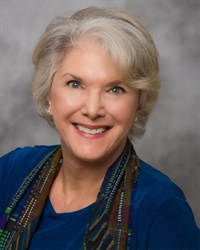
Lynn Grodzki, LCSW, MCC, is a psychotherapist in private practice, a master certified coach, and the author of Therapy with a Coaching Edge: Partnership, Action and Possibility in Every Session and Building Your Ideal Private Practice.
Speaker Disclosures:
Financial: Lynn Grodzki maintains a private practice and receives royalties as a published author. Lynn Grodzki receives a speaking honorarium from Psychotherapy Networker and PESI, Inc. She has no relevant financial relationships with ineligible organizations.
Non-financial: Lynn Grodzki has no relevant non-financial relationships.


