Social Media & Anxious Teens: Helping Young Clients Evaluate Their Time Spent Online


Your clients might not fully understand what causes them to avoid social situations. They likely become anxious automatically before certain situations occur, such as attending parties, going on a date, or just talking to others. If this social anxiety gets too overwhelming, they might even avoid social situations all together and become isolated. With social media as an acceptable way of communicating 24/7, younger clients now have even more ways and more excuses to avoid being around other people.
There are benefits to social media—information and photo sharing, venting feelings, getting support, and more. But clients with social anxiety are prone to hiding out on social media, which can be a form of escaping real life. Oddly enough, the increase in the use of social media can actually increase anxiety. Depression and anxiety, especially among teens, are associated with spending too much time online. Young clients may measure their self-esteem by the “likes” and comments they receive or believe that the more followers they have, the more successful they are. These comparisons to others can be a recipe for increased anxiety.
Encouraging your clients to limit their device time has several benefits. Because the use of technology can be a coping mechanism for social anxiety, it may also cause anxiety to worsen because it isn’t being dealt with. Getting them off the screen and practicing their social skills can eventually help to alleviate some of their social anxiety. With breaks from social media, young people will also have less opportunity to make those harmful comparisons to others. Less device time means more time for other activities, such as hanging out with friends, getting some exercise, or even meditating.
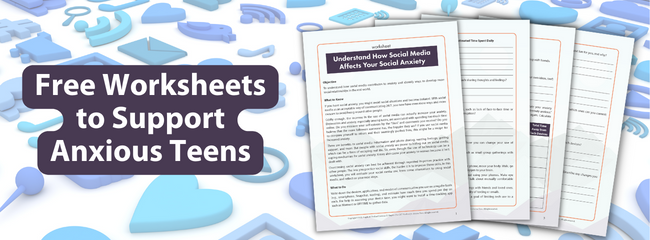
Have your client write down the devices, applications, and modes of communication they use on a regular basis (e.g., Instagram, Snapchat, texting), and estimate how much time they spend per day on each. This free worksheet can help your teenage clients evaluate their social media use, learn some alternatives to using social media, and reflect on their next steps.
For more worksheets like this, check out The CBT Workbook for Anxious Teens: 57 Exercises to Find Relief from Worry, Panic, Negative Thinking & Perfectionism from Angela M. Doel, MS, and Lawrence E. Shapiro, PhD.
There are benefits to social media—information and photo sharing, venting feelings, getting support, and more. But clients with social anxiety are prone to hiding out on social media, which can be a form of escaping real life. Oddly enough, the increase in the use of social media can actually increase anxiety. Depression and anxiety, especially among teens, are associated with spending too much time online. Young clients may measure their self-esteem by the “likes” and comments they receive or believe that the more followers they have, the more successful they are. These comparisons to others can be a recipe for increased anxiety.
Encouraging your clients to limit their device time has several benefits. Because the use of technology can be a coping mechanism for social anxiety, it may also cause anxiety to worsen because it isn’t being dealt with. Getting them off the screen and practicing their social skills can eventually help to alleviate some of their social anxiety. With breaks from social media, young people will also have less opportunity to make those harmful comparisons to others. Less device time means more time for other activities, such as hanging out with friends, getting some exercise, or even meditating.
Have your client write down the devices, applications, and modes of communication they use on a regular basis (e.g., Instagram, Snapchat, texting), and estimate how much time they spend per day on each. This free worksheet can help your teenage clients evaluate their social media use, learn some alternatives to using social media, and reflect on their next steps.
For more worksheets like this, check out The CBT Workbook for Anxious Teens: 57 Exercises to Find Relief from Worry, Panic, Negative Thinking & Perfectionism from Angela M. Doel, MS, and Lawrence E. Shapiro, PhD.
Discover 57 Exercises to Find Relief from Worry, Panic, Negative Thinking & Perfectionism

Filled with cognitive behavioral therapy (CBT) interventions and worksheets crafted just for teenagers, The CBT Workbook for Anxious Teens is the clinical resource you need to help get teens out of their heads – and into their lives.
When emotions get in the way of a teenager’s daily life and disrupt their routine, CBT is an effective and developmentally appropriate treatment for a wide range of anxiety symptoms. The simple and practical worksheets in this workbook will help teen clients develop confidence and empower themselves to manage their distress and anxious thoughts in healthier ways as they move toward adulthood.
The CBT Workbook for Anxious Teens will help adolescents:
When emotions get in the way of a teenager’s daily life and disrupt their routine, CBT is an effective and developmentally appropriate treatment for a wide range of anxiety symptoms. The simple and practical worksheets in this workbook will help teen clients develop confidence and empower themselves to manage their distress and anxious thoughts in healthier ways as they move toward adulthood.
The CBT Workbook for Anxious Teens will help adolescents:
- Understand the root causes of their anxiety
- Learn how anxious thoughts control their body and mind
- Develop a toolbox of strategies to handle academic pressure and test taking
- Ditch avoidant behaviors and become more confident in social settings
- Cope with intrusive thoughts and all-or-nothing thinking
- Reduce overstimulation through mindfulness techniques
- Create lifestyle changes and habits to reduce anxiety
Topics:


Lawrence Shapiro PhD
Lawrence E. Shapiro, PhD, is a prolific author of self-help books and the inventor of more than 100 therapeutic games. Dr. Shapiro is known for his practical approach to helping others. He has written workbooks, storybooks, card games, board games, and smartphone apps. His work has been translated into 27 languages.
Speaker Disclosures:
Financial: Dr. Lawrence E. Shapiro is the President and CEO of Between Sessions Resources. He is a published author and receives royalties.
Non-financial: Dr. Lawrence Shapiro has no relevant non-financial relationships.
You May Also Be Interested In These Related Blog Posts


