Trauma Survivors and Self-Care
As a mental health practitioner, you may relate to the idea of giving your clients “homework assignments” throughout the course of therapy. Your intention might be to build a bridge of continuity between sessions, to highlight a new insight, help your client practice a new behavior, decrease isolation, or strengthen a positive thought that’s been re-framed from well-entrenched negative beliefs. If you work with clients who grew up with trauma, abuse, or neglect, you might agree that the most challenging assignment is anything that relates to practicing and enhancing self-care. This is partly because messages from childhood unfairly equated self-care with being “selfish.” As a result, taking time to attend to their emotional or physical needs feels “wrong.” It’s also hard to buy into the idea that they’re deserving of self-care when it wasn’t modeled or reinforced by loving, nurturing caretakers.
As you well know, despite distorted messages or a lack of good modeling, everyone needs to engage in self-care. Clients’ energy levels, productivity, ability to be self-protective, their physical and mental wellbeing, sense of satisfaction in the workplace, and fulfillment in personal relationships are all impacted by the extent to which they do or don't engage in self-care.
When I talk about self-care with clients, I define it as a conscious decision to think, feel, and behave in ways that promote wellbeing in all arenas; emotionally, mentally, physically, spiritually, and psychologically. It requires both an inward focus, so they can assess what they need at any given time, and then a commitment to act on those needs so they can ensure that they are met. It’s a willingness to sometimes put themselves first rather than constantly putting their needs to the side to take care of others.
However, for trauma survivors, childhood survival is often contingent upon focusing on the needs of others. Being hyper-vigilant, compliant, or accommodating is a way to stay safe. This is especially true when caretakers are narcissistic or abusive. The decision to focus on just oneself can feel counter-intuitive and uncomfortable. However, it’s important to teach clients that it feels weird because it’s new and unfamiliar—not because it’s wrong!
So how can you help your clients work on increasing acts of self-care? Keeping in mind that self-care can manifest in different ways, consider suggesting these 11 practices as "homework assignments" to promote wellbeing:
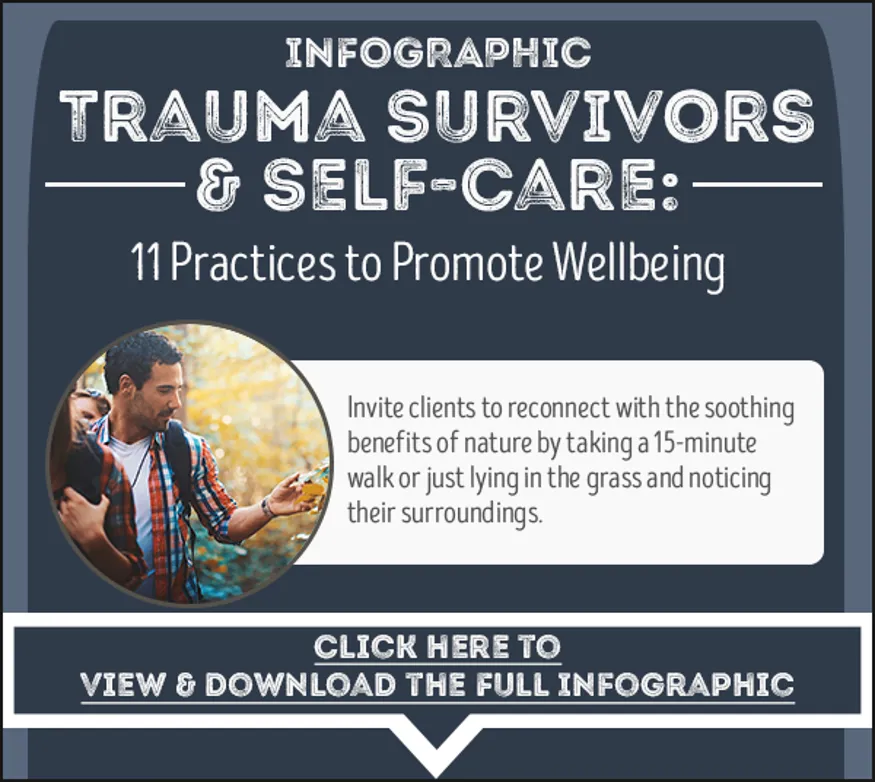
- Invite clients to reconnect with the soothing benefits of nature by taking a 15-minute walk or just lying in the grass and noticing their surroundings.
- Encourage clients to talk to themselves in front of the mirror, saying things that are positive and kind rather than critical or perfectionistic.
- Discuss concrete ways to slowly create a better work/life balance. They can start by committing to leaving work on time at least twice a week, rather than working overtime everyday.
- If their workplace is unsupportive or toxic, invite them to write up a description of what their ideal workplace would look and feel like, and then walk them through a guided imagery that allows them to visualize it.
- Invite clients to make healthy choices related to nutrition, exercise, adequate rest and sleep, and have them document their successes and then process them in session.
- Encourage clients to identify one concrete way to improve their medical or mental wellbeing and put it into practice.
- For one hour a day, ask clients to commit to powering down from digital technology and social media to reduce over-stimulation or emotional upset. Have them use that time for quiet contemplation, reading positive affirmations, strengthening a spiritual connection, or pursuing a mindfulness or meditation practice.
- Invite clients to brainstorm about reducing social isolation by connecting face to face with people they love and care about. Ask clients to revisit boundaries in relationships with people who are crisis-driven, overly demanding, or unsupportive.
- Suggest that clients give themselves the gift of spending time with a baby or a pet. It’s the most unconditional affection they can get!
- Invite clients to put aside prescribed time to journal or draw. This will increase an inward focus, help them process thoughts and emotions, and strengthen their creative side.
- Encourage clients to take time, everyday, to do something that brings them joy or makes them laugh.
Although it can take time for acts of self-care to resonant and become second nature, the best way for our clients to get there is through practice and repetition. Doing things that feel loving and nurturing, and talking to themselves in ways that are supportive and positive, are inherently reinforcing because they feel good! In time, it will become easier and more natural to take care of themselves than it will to mistreat themselves or ignore their basic needs. For people who have grown up with trauma, abuse, or neglect, re-claiming the right to be treated with love and respect is an important part of the healing process. It’s empowering to discover that despite a history of pain, it’s never too late to learn how to engage in self-care. The positive ripple effects will translate into every aspect of life, profoundly enhancing a sense of wellbeing, inner peace, and self-worth. And no one deserve less than that.
 |

Esther Perel has devoted her entire professional life to helping people build thriving relationships. She believes that the quality of our relationships determines the quality of our lives. Since arriving as a graduate student in the United States, Perel has examined the concept from myriad angles: the nature of cultural and religious identity, the negotiation between tradition and modernity, the ebb and flow between individualism and collectivism. She observed interracial and interreligious couples; the cultural forces that affect gender roles; practices of childrearing; and ultimately, the tensions, obstacles, and anxieties that arise when our quest for love and security conflicts with our pursuit of adventure and freedom.
Today, Perel is best known as the host of the wildly popular podcast Where Should We Begin? This fascinating, inside look at Perel’s sessions with real-life couples has unlocked a deep-seated cultural interest in hashing these issues out openly in order to live better lives. However, it has also unlocked within Perel the understanding that her years of study and practice go beyond the romantic, and that the lessons she has learned can be applied to relationships of all kinds, in all environments. The same principles used to create an open, balanced relationship with one’s significant other can be applied to our co-workers, our bosses, and our world at large.
New York Times best-selling author Esther Perel is recognized as one of today’s most insightful and original voices on modern relationships. As a psychotherapist, Perel has helmed a therapy practice in New York City for more than 35 years. In parallel, she serves as an organizational consultant for Fortune 500 companies around the world. Fluent in nine languages, Perel’s celebrated TED talks have garnered more than 40 million views and her best-selling books have been translated into 31 languages. Perel is an executive producer and host of the award-winning podcast Where Should We Begin? Her new podcast How’s Work? focuses on workplace dynamics and can be enjoyed on Spotify or other podcast providers.
Speaker Disclosures:
Financial: Esther Perel maintains a private practice. She has employment relationships with Columbia University, Ackerman Institute for the Family, Norwegian Institute for the Expressive Arts Therapies, The Minuchin center for the Family, and 92nd Street Y. She receives royalties as a published author. Esther Perel receives a speaking honorarium and recording royalties from Psychotherapy Networker and PESI, Inc. She has no relevant financial relationships with ineligible organizations.
Non-financial: Esther Perel is a member of the American Family Therapy Academy, The Society for Sex Therapy and Research, and the American Association for Sex Educators, Counsellors and Therapists.

Lisa Ferentz, LCSW-C, DAPA, is a recognized expert in the strengths-based, de-pathologized treatment of trauma and has been in private practice for over 40 years. She has been an adjunct faculty member at several universities, and is the founder of The Ferentz Institute, now in its seventeenth year of providing continuing education to mental health professionals and graduating several thousand clinicians from her two certificate programs in advanced trauma treatment. In 2009 she was voted the “Social Worker of the Year” by the Maryland Society for Clinical Social Work. She is the author of Treating Self-Destructive Behaviors in Trauma Survivors: A Clinician’s Guide, now in its second edition, Letting Go of Self-Destructive Behaviors: A Workbook of Hope and Healing and Finding Your Ruby Slippers: Transformative Life Lessons from the Therapist’s Couch.
Speaker Disclosures:
Financial: Lisa Ferentz maintains a private practice and is the Founder and President of the Ferentz Institute. She receives royalties as a published author and is a consultant for Northwest Hospital. Lisa Ferentz receives a speaking honorarium and product royalties from Psychotherapy Networker and PESI, Inc. She has no relevant financial relationships with ineligible organizations.
Non-financial: Lisa Ferentz is a member of the National Association of Social Workers and the American Psychotherapy Association.


