Why Your ADHD Clients Keep Getting Stuck (And What Actually Helps)

ADHD is ultimately a disorder of productivity. It impacts clients’ ability to get things done in a consistent and predictable way. This has significant impacts on not only school and work, but also on self-esteem, self-care, and relationships as others need to fill in the gaps. These struggles with doing the right things at the right times can even impact our therapy work, as clients forget appointments, run late, or don’t complete homework between sessions. This can be disappointing and disheartening for both the client and the therapist.
Probably most people can benefit from standard therapy techniques, but clients with ADHD need more targeted interventions on top of those good therapy skills.
Nudge the Neurology
Medication for ADHD can help clients close the gap between intentions and actions. It can make it easier to get started on tasks, to focus and follow through, and remember all the necessary details. Medication isn’t magic, but it raises their batting average. This can have a big impact on self-esteem and perceptions of effectiveness and agency. It can also raise a lot of questions of what it means to take a medication like this which makes for some fascinating and important therapy discussions.
It’s also important to explicitly address sleep, diet, and exercise to help clients bring more of their best to their work and also bring better mood regulation to their relationships. ADHD can make these healthy habits more elusive, so problem-solving barriers and providing some cheerleading is often helpful.
Edit the Environment
Because ADHD makes it harder to filter out less important stimuli, a lot of managing ADHD involves managing the environment. This is much more effective than trying to not be distracted by distractions and tempted by temptations. How can you make the distractions quieter and less frequent? How can you make temptations further away and less compelling? How can you make the more important tasks stand out more and be smoother to enter into?
Free will works much better when we use it to set things up better ahead of time than it does to resist something more interesting in the moment. This means knowing oneself well and planning ahead. It also involves really feeling, in their belly, how their life will be better if they take those wiser steps to set things up beforehand. This is bigger than just getting this one task done—it’s also about what kind of a person you want to be and feeling good about yourself for investing the effort.
Manage the Mindset
A lifetime of ADHD struggles can make it easy to be pessimistic—your client has tried all sorts of strategies in the past and none really stuck. Some skepticism is warranted. So, you need to have some direct conversations about why this time can be different, why specifically addressing their ADHD makes it reasonable to invest some hope and expect some different results. Part of this work involves addressing some of the common mindset traps that interfere with productivity.
For example, you may need to work on being assertive enough to clarify others’ expectations, even when they feel self-conscious about possibly having forgotten what they were told the first time. Or maybe asking for appropriate help when a better end result would make everyone happier. You may need to explore why your client feels like they can’t say no to others due to their inconsistent track record and far too many experiences of falling short. Then you may need to discuss how taking too much on sets them up to fall short again.
Bring It All Together
Productivity can feel like a mystery to many clients with ADHD. Sometimes it works out, but too often it doesn’t, and it isn’t clear what makes the difference. Therapists who really understand how ADHD affects clients’ ability to get things done, how to adapt the environment, and how to create a resilient mindset can show their clients that there is indeed a roadmap. There is a process we can use to help you create a better life.
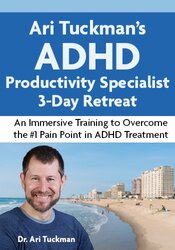
Join us at the beautiful Embassy Suites Virginia Beach Oceanfront Resort in Virginia Beach, VA or virtually online where you’ll spend 3 days filled with skills-building and personal transformation. PLUS, earn up to 15 CE Hours!


You’ll get TEN incredible self-study modules organized into three easy sections that cover integral areas you’ll face with clients of any age or stage of their treatment. PLUS, register now to get printable handouts, client exercises and case studies you can't get anywhere else so you can provide transformational change immediately!

Ari Tuckman, PsyD, MBA, is a psychologist, international presenter, author, and ADHD expert. He is the author of five books on adult ADHD – one for clinicians and four for the general public. He has also written several book chapters and is a frequent author for ADHD-related publications, including ADDitude Magazine and Attention Magazine.
He is a popular and dynamic presenter who routinely earns excellent reviews for his ability to make complex concepts understandable and useful. He has given more than 850 presentations and podcast interviews for professionals and members of the public, across America and Sweden, Turkey, Greece, Mexico, England, Spain, Denmark, Canada, and Iceland.
He has appeared on CNN, National Public Radio, and XM Radio and has been quoted in The New York Times, USA Today, The Washington Post, The Boston Globe, USnews.com, The Philadelphia Inquirer, Men’s Health and many other media outlets. He is a former board member and current conference committee chair for CHADD and is the 2023 recipient of their Hall of Fame award for his significant contributions to the field.
Speaker Disclosures:
Financial: Ari Tuckman maintains a private practice. He receives royalties as a published author. Ari Tuckman receives a speaking honorarium and recording royalties from PESI, Inc. He has no relevant financial relationships with ineligible organizations.
Non-financial: Ari Tuckman is the National Conference Committee co-chair for CHAAD.


