Tools for Resilience: How Somatic Experiencing Transforms Trauma Treatment


At its core, SE is based on the observation that trauma is not in the event but in the body’s response. By studying how animals in the wild recover from threats, Dr. Levine developed a model that highlights the critical role of the autonomic nervous system (ANS) in trauma resolution. Trauma occurs when the ANS becomes stuck in a state of dysregulation, often manifesting as hyperarousal, freeze responses, or chronic stress symptoms.
The Science Behind SE
SE is grounded in neuroscience and physiology, particularly in its work with the ANS:- Sympathetic Nervous System (SNS): Responsible for mobilizing the body for fight or flight.
- Parasympathetic Nervous System (PNS): Enables rest, recovery, and restoration.
Practical SE Tools for Therapists
- Grounding Exercises
- Help clients connect with their body through awareness of contact points, such as feet on the floor or their seated posture.
- Encourage them to sense the weight of their body or their breath’s rhythm to foster calm and stability.
- Tracking Sensations
- Ask clients to notice subtle body sensations without judgment. Use prompts like, “What do you feel in your body right now?”
- This practice connects clients to the present moment and helps process physical and emotional experiences.
- Pendulation
- Guide clients between states of activation and calm to build nervous system resilience.
- Example: After addressing a distressing memory, redirect attention to a grounding or soothing resource.
- Resourcing and Self-Contact
- Identify external and internal resources that evoke feelings of safety and comfort (e.g., holding one’s own hands or touching the chest gently).
- Encourage clients to notice how these actions affect their emotional and physical state.
- Orienting
- Invite clients to look around their environment, allowing their eyes and head to move naturally. This can foster feelings of safety and presence.
- Visual, auditory, or tactile exploration can shift focus away from distressing sensations.
- Discharge and Completion
- Facilitate the release of unresolved survival energy through natural movements like shaking, stretching, or deep breaths.
- Support clients in recognizing and completing physical responses that were interrupted during the traumatic event.
Join world-leading somatic therapy experts and master skills to truly overcome deep trauma wounds by addressing it within the body.

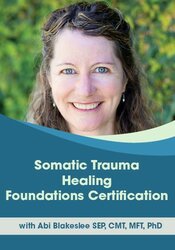
Learn how to use simple body-based, polyvagal, neurobiological interventions - including, movement, breathing, visualization and other exercises to heal trauma.

Dr. Abi Blakeslee world renowned trainer in trauma recovery and the founder of Implicit Psychotherapy. She is senior faculty at Somatic Experiencing International. Dr. Blakeslee holds a PhD in clinical and somatic psychology and an MA in counseling and depth psychology. Dr. Blakeslee integrates the study of implicit memory and psychophysiology in clinical research, primary and secondary trauma interventions, neuro-consulting, and the psychobiological principles of attachment and shock trauma.
Speaker Disclosures:
Financial: Dr. Abi Blakeslee maintains a private practice and is the founder of Implicit Psychotherapy, co-founder of Relationship Repair and maintains a private practice. She has employment relationships with Somatic Experiencing International and Ergos Institute for Somatic Education. Dr. Blakeslee receives a speaking honorarium and product royalties from Psychotherapy Networker and PESI, Inc. She has no relevant financial relationships with ineligible organizations.
Non-financial: Dr. Abi Blakeslee is a member of the American Association for Marriage Family Therapists, the United States Association for Body Psychotherapy, the Women in Neuroscience, and the Society for Neuroscience.


