The Gottmans on Mastering the Brain’s 7 Pathways to Emotional Connection


In our research, we’ve found that successful couples turned toward their partner’s bids for connection 86 percent of the time. A bid can be something as simple as saying to a partner, “Wow, look at that beautiful boat out the window.” Then the partner can turn away by either ignoring the bid or responding, “Would you stop interrupting me? I’m trying to read.” Or the partner can turn toward the bid with even a simple acknowledgement, like “Huh, look at that.” Every time people turn toward each other in relationships, they’re building up an emotional bank account.
Jaak Panksepp, who wrote Affective Neuroscience, detailed the seven different emotional command systems in the brain. We’ve found that when you’re helping couples turn toward each other, you have to help them do so in all seven of the emotional command systems that are hard-wired into the brain.
So let me describe each one of these in our terms. The first is The Sentry, which is all about the fear system. When one partner feels afraid to go to the grocery store, for example—maybe a shooting just happened near there—what does the partner do? Does the partner turn toward them and say, “Okay, I’ll go instead,” or “I’ll go with you”? Or does the partner say, “Get over it” or “Just go to another store,” essentially turning away. In other words, how do people respond to each other’s need for protection or help with fear?
The Nest Builder is all about nurturing: that’s when one partner needs warmth, connection, and nurturing. How does the other partner respond to that? The Explorer is about adventure, discovery, and The Jester is about having fun. John and I have a gigantic difference here, and that’s what you’ll see in many couples. My idea of fun and adventure is going to Antarctica, and John’s is sitting in his chair, reading about differential equations. So when he tries to explain these to me, I make an effort to turn toward him and say, “Tell me all about it,” which is a huge stretch for me. But it’s important that we help couples who have different ways of having fun turn toward each other’s preferences.
The Sensualist is all about passion, romance, physical intimacy, sexuality. So how are couples doing in terms of turning toward each other and speaking about their preferences, their fantasies, what they really love in the bedroom as well as on the kitchen table? It’s really helpful for us to support couples in turning toward each other in that arena as well.
The Commander in Chief is at the center: it’s about power struggles. Who’s going to have power? Who’s going to decide things? Are they going to share power, or are they comfortable with one person being more powerful in this area and another in that area? It’s important to help people create what they’re comfortable with. Finally, The Energy Czar is really about our own metabolism and basic needs for sleep, food, nutrition, exercise. In this arena, it’s all about partners supporting each other’s energy needs.
Now let’s talk a bit more about turning toward bids in the sensual system. There’s a fabulous book called The Normal Bar, in which the authors conducted a study with 70,000 people in 24 countries, asking what helps couples have a great sex life. The couples they asked were from all walks of life, all classes, all different socioeconomic statuses, all different ethnic and racial origins. What they found across the board were that people who have a great sex life say “I love you” to their partner every day and mean it. They kiss one another passionately for no reason at all, give compliments, give surprise romantic gifts, know what turns their partner on and do it often, are affectionate in public, play together, have fun—and they cuddle, cuddle, cuddle. Cuddling is good; nurturing is good for sex. These people make sex a priority, talk about their sex life, have weekly romantic dates, take romantic vacations.
In contrast, the Sloan center at UCLA found that couples who have a bad sex life spend very little time together with each other: they become job- and child-centered. They talk mostly about their huge to-do lists during the 35 minutes they spend together a week. Think about that: they talk 35 minutes a week on average. They make everything else a priority, rather than their relationship, and they drift apart, live parallel lives, and are terribly lonely.
So the keys to great sex aren’t rocket science, right? Although a few differing theories are floating around out there, these keys are pretty much what you’d expect: warmth, building trust, attunement, talking about preferences, and lots and lots of connection.
This blog first appeared in Psychotherapy Networker as an excerpted from “The New Science of Couples Therapy,” by John and Julie Gottman. The full version is available in the May/June 2018 issue, Men and #MeToo: What Are They Thinking?

You’ll gain powerful knowledge and strategies you can use to guide your couples in building great relationships that are filled with life-long committed love and affection — plus you’ll earn 1 Free CE hour!
Watch this free video now!
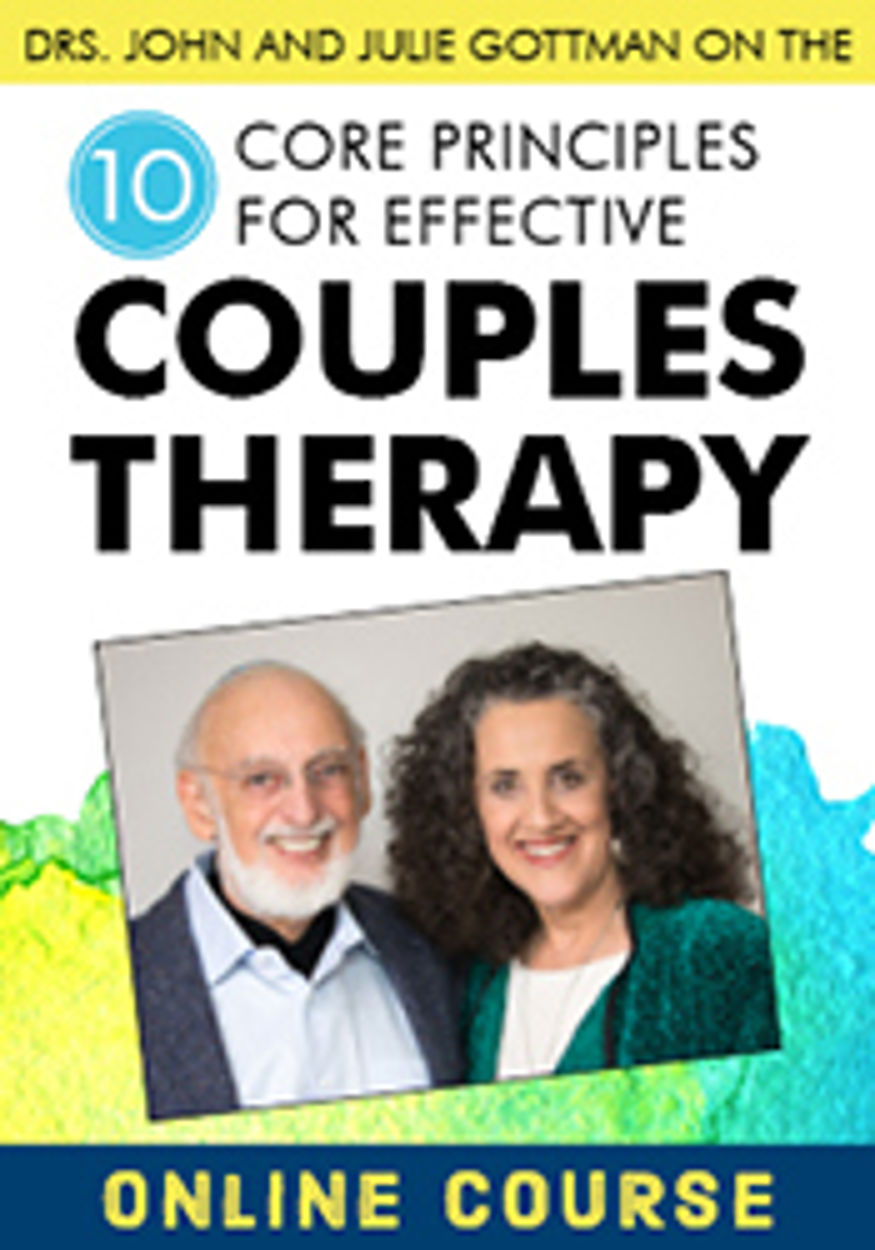
Watch as they bring this groundbreaking clinical map to life in an engaging, comprehensive online course that will transform your approach to couples therapy, and help your couples build lasting relationships that thrive.
Discover how each of the Gottman ten principles apply to successful couples work—and how you can implement these evidence-based principles in your practice to bring greater healing to your clients.
Drs. John and Julie Gottman on the 10 Core Principles for Effective Couples Therapy
John Gottman, Ph.D., is Professor Emeritus of Psychology at the University of Washington, where he established what the media called, "The Love Lab," and conducted much of his award-winning research on couple interaction and treatment. Dr. Gottman has studied marriage, couples and parent relationships for nearly four decades. He has authored or co-authored 119 published articles as well as 44 books, including: The Seven Principles for Making Marriage Work, The Relationship Cure, Why Marriages Succeed or Fail, and How You Can Make Yours Last, Raising an Emotionally Intelligent Child: The Heart of Parenting, And Baby Makes Three and The Marriage Clinic.
World renown for his work on marital stability and divorce prediction, Dr. Gottman's research has earned him numerous national awards, including: Four five-year-long National Institute of Mental Health Research Scientist Awards; The American Association for Marriage and Family Therapy Distinguished Research Scientist Award; The American Psychological Association Division of Family Psychology Presidential Citation for Outstanding Lifetime Research Contribution; The National Council of Family Relations 1994 Burgess Award for Outstanding Career in Theory and Research.
Dr. Gottman, together with his wife, Dr. Julie Schwartz Gottman, is the co-founder of The Gottman Institute, which provides clinical training, workshops, services, and educational materials for mental health professionals, couples, and families. He is also the co-founder and Executive Director of the Relationship Research Institute which has created treatments for couples transitioning to parenthood and couples suffering from minor domestic violence.
Dr. Gottman has presented hundreds of invited keynote addresses, workshops, and scientific presentations, to avid audiences around the world including Switzerland, Italy, France, England, Israel, Turkey, South Korea, Australia, Canada, Sweden and Norway. A wonderful story-teller and expert, Dr. Gottman has also appeared on many TV shows, including Good Morning America, Today, CBS Morning News, and Oprah, and he has been written up in numerous print articles, including Newsweek, The New York Times, The Washington Post, Los Angeles Times, Ladies Home Journal, Redbook, Glamour, Woman's Day, Men's Health, People, Self, Reader's Digest, and Psychology Today.
Drs. John and Julie Gottman currently live on Orcas Island, near Seattle, Washington. They conduct weekly and intensive couples therapy sessions, provide small group retreats, teach workshops and clinical trainings and give presentations and training workshops around the world.
Speaker Disclosures:
Financial: Dr. John Gottman is the co-founder of The Gottman Institute and co-founder and Chief Scientist of Gottman, Inc., as well as the Executive Director of the Relationship Research Institute. He receives grant funding from the National Institute of Mental Health (NIMH) and the Kirlin Foundation. Dr. Gottman also receives royalties from his published works. Additionally, he receives speaking honoraria, book royalties, and recording royalties from Psychotherapy Networker and PESI, Inc. He has no relevant financial relationships with ineligible organizations.
Non-financial: Dr. John Gottman is a member of the American Association for Marriage and Family Therapy, the American Psychological Association, and the American Psychological Society National.
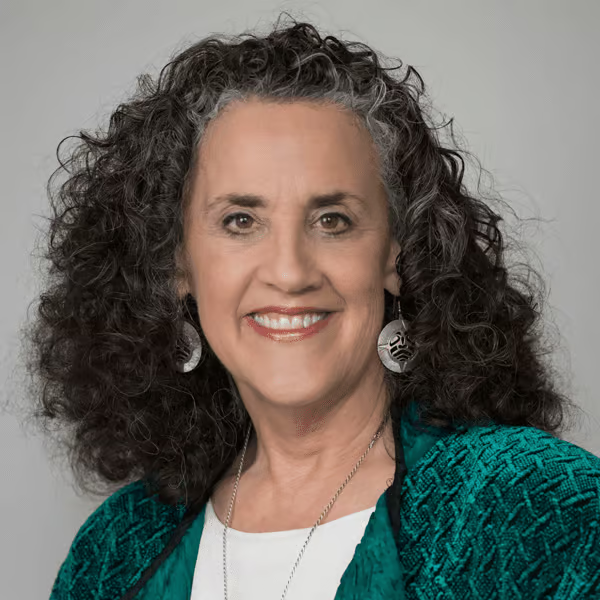
Julie Schwartz Gottman, Ph.D., is the co-founder and President of The Gottman Institute, and Clinical Supervisor for the Couples Together Against Violence study. A highly respected clinical psychologist, she is sought internationally by media and organizations as an expert advisor on marriage, sexual harassment and rape, domestic violence, gay and lesbian adoption, same-sex marriage, and parenting issues. Creator of the immensely popular The Art and Science of Love weekend workshops for couples, she also designed and leads the national certification program in Gottman Method Couples Therapy for clinicians. Her other achievements include: Washington State Psychologist of the Year; Author/co-author of five books, including, Ten Lessons to Transform Your Marriage, And Baby Makes Three, The Marriage Clinical Casebook, 10 Principles for Doing Effective Couples Therapy, and The Man’s Guide to Women; Wide recognition for her clinical psychotherapy treatment, with specialization in distressed couples, abuse and trauma survivors, substance abusers and their partners, and cancer patients and their families.
Inspiring, empowering, respectful, and kind, Julie’s leadership of The Gottman Institute has made it possible to identify and integrate the expertise of her staff, therapists, and the wider research and therapeutic community. Her commitment to excellence and integrity assures that as The Gottman Institute grows, it continues to maintain the highest ethical and scientific standards.
She is in private practice in the Seattle area, providing intensive marathon therapy sessions for couples. She specializes in working with distressed couples, abuse and trauma survivors, those with substance abuse problems and their partners, as well as cancer patients and their families.
Drs. John and Julie Gottman currently live on Orcas Island, near Seattle, Washington. They conduct weekly and intensive couples therapy sessions, provide small group retreats, teach workshops and clinical trainings, and give keynote presentations around the world.
Speaker Disclosures:
Financial: Dr. Julie Schwartz Gottman is the co-founder of the Gottman Institute and Affective Software, Inc. She is the clinical director of The Relationship Research Institute, and she maintains a private practice. Dr. Schwartz Gottman is the owner of Gottman Couples' Retreat. She receives compensation as an international speaker. She is a published author and receives royalties, and she receives a speaking honorarium, recording royalties, and book royalties from PESI, Inc. She has no relevant financial relationships with ineligible organizations.
Non-financial: Dr. Julie Schwartz Gottman is a member of the American Psychological Association.


