How Post-Traumatic Symptoms Reflect Our Trauma History


Years later, the parasympathetic system may still be dominant, robbing individuals of energy, drive, and confidence. Not knowing that their brains and bodies are causing these feelings and reactions, not knowing that traumatic events have conditioned their nervous systems to react in these ways, trauma survivors blame themselves and think, “I’m depressed—even though I have nothing to be depressed about” or “I’m just an angry person” or “I don’t know why I’m afraid of everything—I’m just a chicken.”
But blaming ourselves is also triggering, and it can propel many individuals to try to fix these problems in ways that further worsen the situation. Even if we now live in a world that is rarely dangerous, we have a traumatized nervous system adapted to threat, and that adaptation keeps the living legacy of trauma mobilized in our bodies even when we do not need it anymore.
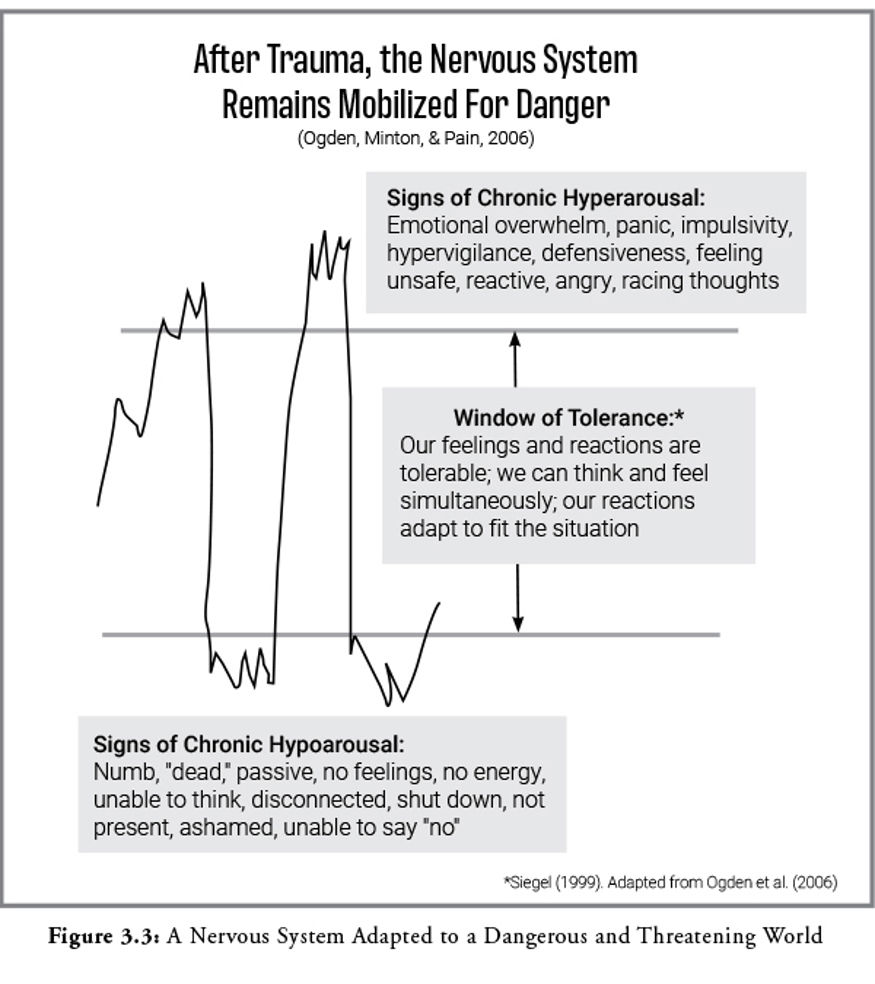
The figure shown here depicts the most common patterns of autonomic activation that develop as a response to chronic or repeated threat. As you look at the diagram, notice which patterns of arousal are most familiar to you. The pattern of nervous system responses to the environment and to ordinary stress that you notice in your life today tells the story of your survival, reflecting how your brain and body adapted to the traumatic conditions you once faced. Did you survive by being constantly on guard, tense, fearful, and reactive? Or did you survive by shutting down, going numb, and spacing out? Was it better for you to run or fight? Or was it better to collapse and go passive? Your body is actually telling you what was safest then, even if it is not helpful now. This diagram can also serve as a reminder to keep an eye on your nervous system so you can slow it down or speed it up as needed.
In addition, the following “Trauma and the Window of Tolerance” worksheet can help you become aware of how your sympathetic and parasympathetic nervous systems still react after the trauma has passed, how the nervous system still affects your feelings and behavior, and when you need to cultivate a wider window of tolerance.
Remember you had no control over how your nervous system responded at the time. The brain reacts long before we have conscious awareness of the situation, and we cannot control our instinctive reactions any more than a lizard can. Increasing awareness of these reactions as nervous system memories or survival responses often helps them to feel more tolerable. When we do not understand why we are going numb or jumping out of our skins, we feel more alarmed and ashamed of our reactions.
For more information on how to understand and increase awareness of these nervous system reactions—and to heal from trauma—click here to order my new book, Transforming the Living Legacy of Trauma.
______
*This is an adapted excerpt from Transforming the Living Legacy of Trauma by Janina Fisher. Copyright © 2021, Janina Fisher. PESI Publishing & Media.

In Transforming the Living Legacy of Trauma, Janina shows how the legacy of symptoms helped them survive and offers:
- Step-by-step strategies that can be used on their own or in collaboration with a therapist
- Simple diagrams that make sense of the confusing feelings and physical reactions survivors experience
- Worksheets to practice the skills that bring relief and ultimately healing
Transforming the Living Legacy of Trauma is a workbook and guide to the journey to healing. As a ‘guidebook,’ it describes the terrain to be explored, and it provides maps to help travelers find the best routes to a life beyond trauma. Get your copy on Amazon today!

Janina Fisher, PhD, is a licensed clinical psychologist and former instructor at The Trauma Center, a research and treatment center founded by Bessel van der Kolk. Known as an expert on the treatment of trauma, Dr. Fisher has also been treating individuals, couples, and families since 1980.
She is past president of the New England Society for the Treatment of Trauma and Dissociation, an EMDR International Association Credit Provider, Assistant Educational Director of the Sensorimotor Psychotherapy Institute, and a former Instructor, at Harvard Medical School. Dr. Fisher lectures and teaches nationally and internationally on topics related to the integration of the neurobiological research and newer trauma treatment paradigms into traditional therapeutic modalities.
She is co-author with Pat Ogden of Sensorimotor Psychotherapy: Interventions for Attachment and Trauma (2015) and author of Healing the Fragmented Selves of Trauma Survivors: Overcoming Internal Self-Alienation (2017) and the forthcoming book, Working with the Neurobiological Legacy of Trauma (in press).
Speaker Disclosures:
Financial: Dr. Janina Fisher is an international expert and consultant on Trauma and Dissociation. She is a consultant for Khiron House Clinics and the Massachusetts Department of MH Restraint and Seclusion Initiative. Dr. Fisher receives royalties as a published author. She receives a speaking honorarium, recording royalties and book royalties from Psychotherapy Networker and PESI, Inc. Dr. Fisher has no relevant financial relationships with ineligible organizations.
Non-financial: Dr. Janina Fisher is on the advisory board for the Trauma Research Foundation. She is a patron of the Bowlby Center.


