Beyond Behaviors: A Story from the Frontlines of Therapy

As I prepare to launch the second edition of Beyond Behaviors, I find myself transported back to the moment I knew I had to write this book.
I was observing in a classroom, watching a patient I knew well. He sat there, tapping his aide's shoulder with growing intensity. From our work together in my office and at his home, I recognized this immediately. It was his way of asking for help, a signal that anxiety was building in his nervous system. But the school had labeled it as noncompliant behavior.
What happened next still haunts me. He was escorted to the "calm down room" at the back of the classroom, essentially a closet with a one-way window. According to his IEP, the adult wasn't supposed to interact with him while he was there. So I watched as he sat on the floor, kicking the wall, while the aide deliberately ignored him.
As an observer, I couldn't intervene. I'll never forget the forlorn, sad expression on his face, that blank stare I knew signaled his nervous system had shifted into what I call the "blue state" of shutdown. All he needed was human connection and compassionate co-regulation. Instead, outdated behavioral methods that ignore children's pleas for help were in full force.
In that moment, I made a vow. I would write about these harmful approaches. I would educate parents and professionals about how understanding the nervous system can help us recognize what children truly need. I would report from the frontlines about how countless autistic and neurodivergent children's behaviors become targets rather than being seen as the valuable signals they actually are.
The Response Has Been Overwhelming
When Beyond Behaviors first published, we quickly realized it was meeting a profound need for both professionals and parents. The early reviews moved me deeply.
A child psychiatrist called it "an elegant tour de force" and wrote: "This is a call to action to get beneath the surface and understand disruptive and challenging behaviors as adaptive and related to survival mechanisms driven by stress responses in the autonomic nervous system. The role of the adult as co-regulator of the child's nervous system is spot on and why we cannot 'fix' children by seeing them as the problem independent of the adults in their lives."
A child therapist shared: "This book encourages a complete paradigm shift in our assessment and treatment of child behavior problems. Each page is filled with so much information that I must take time to digest. I have been referencing it daily in my work as well as personal life as a mother."
But perhaps most meaningful are the messages from parents. One mother wrote about her five-year-old son who experienced medical trauma: "This book gave me so much VALIDATION. It put into words instincts I've felt as a mother... Every chapter, I sat back and reflected and cried. Cried for the validation it gave me. Cried for the knowledge it gave me... His behaviors don't feel overwhelming anymore. We are already reaping the benefits. It's been life changing."
An educational advocate told me the book "has been a game changer for me, my kids, our family, my advocacy. It's given me the language and the tools to help my teen with ADHD and anxiety manage school, his social world, and conflict at home. It's helped me to be taken seriously in IEP meetings."
What Makes This Approach Different
Beyond Behaviors integrates polyvagal theory with sensory systems and neuroscience to offer a compassionate, scientifically grounded framework for understanding children. Rather than viewing challenging behaviors as problems to eliminate, we learn to see them as adaptive responses: signals from a stressed nervous system seeking safety and connection.
The book emphasizes that we cannot "fix" children in isolation. Adults must first regulate our own nervous systems so we can serve as co-regulators for the children in our care. This compassionate approach extends not just to children, but to their caregivers as well: the parents, teachers, and therapists working so hard to support them.
Throughout the book, I've included practical worksheets and checklists to help readers move from theory to action, creating concrete plans for supporting the children in their lives.
Why a Second Edition Matters
The need for this paradigm shift has only grown stronger. Too many children are still being misunderstood, their behaviors pathologized rather than decoded. Too many parents are being told to ignore their instincts. Too many professionals lack the tools to look beneath surface behaviors and address what children truly need.
This second edition allows me to refine and expand on these crucial ideas, offering even more guidance for the parents, teachers, pediatricians, child psychiatrists, therapists, speech-language pathologists, occupational therapists, and all those who work with behaviorally complex children.
Because every child deserves adults who understand that their behaviors are not the problem. They're the solution their nervous system has found to cope with a world that feels unsafe or overwhelming. And every adult working with these children deserves the science, the language, and the practical tools to provide truly helpful support.
That's why I wrote Beyond Behaviors. And that's why I'm honored to bring you this second edition. Download your free excerpt here.
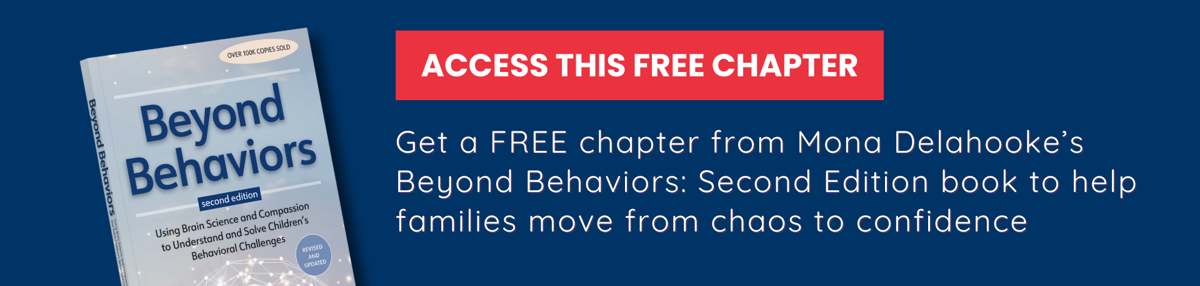

In her pioneering, paradigm-shifting book Beyond Behaviors, internationally known pediatric psychologist Dr. Mona Delahooke reshaped how we view and respond to children’s challenging behaviors. In this second edition, she reminds us that problem behaviors are just the tip of the iceberg – signaling deeper, unmet needs that are best addressed in the context of relational safety.

Join 25+ of today's leading clinicians and discover how you can talk with kids and teens about the traumatic nature of these uncertain times.

Mona M. Delahooke, PhD, is a clinical psychologist who’s worked with multi-disciplinary teams for over 30 years. A senior faculty member of the Profectum Foundation, she’s the author of the national bestseller Brain-Body Parenting, How to Stop Managing Behaviors and Start Raising Joyful, Resilient Kids,. and the award-winning Beyond Behaviors: Using Brain Science and Compassion to Understand and Solve Children’s Behavioral Challenges.
Speaker Disclosures:
Financial: Dr. Mona Delahooke maintains a private practice and has employment relationships with the Los Angeles Department of Mental Health, the Profectum Foundation, and Villa Esperanza Services. She receives royalties as a published author. Dr. Delahooke receives a speaking honorarium, recording, and book royalties from Psychotherapy Networker and PESI, Inc. She has no relevant financial relationships with ineligible organizations.
Non-financial: Dr. Mona Delahooke is a member of the American Psychological Association, the Zero to Three Foundation, the Infant Development Association of California, and the Partnership for Awareness.


