
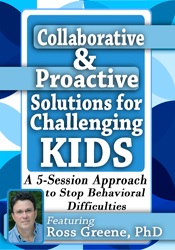
Collaborative & Proactive Solutions for Challenging Kids: A 5-Session Approach to Stop Behavioral Difficulties
- Speaker:
- Ross Greene, Ph.D.
- Duration:
- 7 Hours 10 Minutes
- Format:
- Audio and Video
- Copyright:
-
Jun 01, 2016
- Product Code:
- PPC049010
- Media Type:
- Download
Description
Volatile, reactive, and high-conflict families have worked with multiple therapists by the time they get to you. These families challenge the skills of even the most seasoned therapist. The parents are frustrated that things haven’t improved, and the kids are tired of showing up for therapy appointments.
Internationally renowned psychologist and New York Times bestselling author Dr. Ross Greene –the originator of the Collaborative & Proactive Solutions (CPS) model, as described in his books The Explosive Child, Lost at School, Lost & Found, and the recently released Raising Human Beings – will transform your approach with these most challenging families. In this unique video series, see Dr. Greene’s effective, empirically-supported CPS model in action.
In real sessions, watch Dr. Greene help actual parents and kids solve the problems that contribute to challenging episodes, rather than simply modifying the behaviors that kids exhibit in response to those problems. Dr. Greene masterfully describes and utilizes the key elements of his CPS model, and then steps back and explains the crucial strategies that make this model an effective approach to therapy. In addition, you will learn how to utilize Dr. Greene’s Assessment of Lagging Skills and Unsolved Problems, which sets the stage for and organizes your approach to helping families solve problems together. Dr. Greene shares his methodology for solving problems collaboratively, complete with extensive video examples of each step.
Dr. Greene’s empirically supported CPS model will help transform angry, explosive and punitive interactions between family members into collaborative and supportive exchanges in which problems can be solved and relationships rebuilt. By incorporating Dr. Greene’s CPS approach in your practice, you will not only improve kids’ behavior but also improve parent-child communication. Families will learn the problem-solving and emotion-regulation skills they’re often lacking. But the CPS model doesn’t just help kids and families…it will help you feel a renewed sense of passion and confidence when working with the most at-risk kids and families.
Ross W. Greene, Ph.D., consults extensively to families, general and special education schools, inpatient and residential facilities, and systems of juvenile detention, and lectures widely throughout the world. Dr. Greene is the originator of an empirically supported model of psychosocial treatment for challenging kids now called Collaborative & Proactive Solutions (CPS). He is author of the highly-acclaimed books The Explosive Child, Lost at School and Raising Human Beings, as well as numerous articles, chapters and scientific papers on the effectiveness of the CPS model, the classification of and outcomes in youth with social, emotional and behavioral challenges and student-teacher compatibility. He was on the faculty at Harvard Medical School for over 20 years, and is now the Founding Director of the non-profit Lives in the Balance (www.livesinthebalance.org) and on the adjunct faculty in the Department of Psychology at Virginia Tech and at University of Technology in Sydney, Australia.
OUTLINE
COLLABORATIVE AND PROACTIVE SOLUTIONS MODEL
Types of Sessions
- Investigator
- Instructor
- empathy
- define adult concerns
- invitation to a mutually satisfactory solution
- Demonstrator
- Coach
- Interference factors
KEYS TO COMPLETE CPS SESSIONS
1. Assessment of Lagging Skills and Unsolved Problems (Investigator Session)
- Strategies to turn the LSUP form into a ‘discussion guide’, not a ‘checklist’
- Tools to identify a specific lagging skill
- Guidelines to name the unsolved problems
- The unsolved problem should contain NO challenging behavior – replaced by the word “difficulty”
- The unsolved problem contains no ‘adult theories’ as to the cause of the problem
- The unsolved problem is split, not clumped make it much easier for the child to talk about unsolved problems.
- Make sure the unsolved problem is as specific as possible:
- Ask “W” questions: Who, What, Where, When (not Why)
- Ask parents what specific expectation the child is having difficulty meeting in the scenario they are describing
- In-Session Demonstration Videos: LSUP Sessions
2. Clinician/Parent Meeting (Instructor Session)
- Three approaches to handling an unsolved problem
- Plan A: Adult decides the solution
- Plan B: Adult and child collaborate to solve the problem
- Empathy step
- Define adult concerns step
- Invitation step
- Plan C: Unsolved problem prioritization
3. Clinician, Parent and Child Meeting (Demonstrator Session)
- Strategies to:
- Overcome competing solutions
- Identify when too many solutions and/or concerns are on the table
- Propose solutions that are realistic and satisfactory to all parties
- Foresee proposed solutions that will fail, and why
4. Follow-Up Sessions (Coaching & Interference Sessions)
- As the problem-solving facilitator, the clinician should aim to:
- Keep the session structured
- Keep the family focused on the unsolved problem
- Help the family stay on track
- Identify what part of the plan is difficult and coach the proper skills some more
- Troubleshoot other parts of the plan until the family achieves success – then move on to another high-priority unsolved problem
- Help the family become self-sufficient in carrying out the plan for future unsolved problems
OBJECTIVES
- Describe the main difference between the classical therapeutic approach to treating a child’s challenging behavior and the Collaborative & Proactive Solutions (CPS) approach to solving the same issue.
- Explain what a child is communicating when he/she displays challenging behavior.
- Discuss the clinician’s approach to treating a child’s challenging behavior within the CPS Model.
- List the five types of sessions in the CPS Model and how the role of the clinician changes for each of the five types.
- Describe the LSUP form and indicate how the clinician uses it to ascertain the child’s lagging skills and unsolved problems.
- Discuss the positives and negatives of all three approaches to handling an unsolved problem: Plan A, Plan B and Plan C.
- Explain how to involve the parent(s)/caregiver(s) AND the child in the collaborative approach (Plan B).
- List the three steps to the Plan B approach.
- Explain how the clinician can teach the parent(s)/caregiver(s) to ‘drill’ for more information from the child during the Empathy Step of the Plan B approach.
- Demonstrate sample wording for the Invitation Step of the Plan B approach.
- Discuss the importance of making sure that the unsolved problem(s) chosen for use in Plan B are specific, realistic and mutually acceptable to all parties involved.
Satisfaction Guarantee
Your satisfaction is our goal and our guarantee. Concerns should be addressed to PESI, Inc., PO Box 1000, Eau Claire, WI 54702-1000 or call 1-800-844-8260.
ADA Needs
PESI would be happy to accommodate your ADA needs; please call our Customer Service Department for more information at 800-844-8260.
Credit
NOTE: Tuition includes one free CE Certificate (participant will be able to print the certificate of completion after completing the on-line post-test (80% passing score) and completing the evaluation).
Continuing Education Information: Listed below are the continuing education credit(s) currently available for this non-interactive self-study package. Please note, your state licensing board dictates whether self-study is an acceptable form of continuing education, as well as which credit types are acceptable for continuing education hours. Please refer to your state rules and regulations. If your profession is not listed, please contact your licensing board to determine your continuing education requirements and check for reciprocal approval. For other credit inquiries not specified below, please contact cepesi@pesi.com or 800-844-8260 before the event.
Materials that are included in this course may include interventions and modalities that are beyond the authorized practice of your profession. As a licensed professional, you are responsible for reviewing the scope of practice, including activities that are defined in law as beyond the boundaries of practice in accordance with and in compliance with your profession's standards.
This self-study activity consists of 7.0 clock hours of continuing education instruction. Credit requirements and approvals vary per state board regulations. Please save the course outline, the certificate of completion you receive from the activity and contact your state board or organization to determine specific filing requirements.
PESI, Inc. has been approved as a continuing education sponsor through the Texas State Board of Examiners of Professional Counselors. Provider #: 2477. This self-study course qualifies for 7.0 continuing education credits.
This program has been approved for 7.0 continuing education hours by the South Carolina Board of Examiners for Licensure of Professional Counselors, Marriage and Family Therapists, and Psycho-Educational Specialists. Approval #4540.

PESI, Inc. is an approved provider with the Florida Board of Clinical Social Work, Marriage and Family Therapy and Mental Health Counseling. Provider Number #50-399. This self-study course qualifies for 7.0 continuing education credits.
PESI, Inc. is an approved provider with the State of Illinois, Department of Financial and Professional Regulation, Division of Professional Regulation. License #: 159-000154. Successful completion of this self-study activity qualifies for 7.0 contact hours.
PESI, Inc. is an approved provider with the Kansas Behavioral Sciences Regulatory Board. Provider #14-006. This self-study course has been approved for 7.0 continuing education hours.
PESI, Inc. is an approved provider with the State of Minnesota, Board of Social Work. Provider #: CEP-140. This self-study package has been approved for 7.0 continuing education hours. This certificate has been issued upon successful completion of a post-test.
PESI, Inc. is recognized by the New York State Education Department's (NYSED) State Board for Social Work as an approved provider of continuing education for licensed social workers #SW-0008. This self-study activity will qualify for 8.5 contact hours. Full attendance is required; no partial credits will be offered for partial attendance.
PESI, Inc. is an approved provider with the State of Ohio Counselor, Social Worker and Marriage & Family Therapist Board. Provider approval #: RCST071001. Successful completion of this self-study course meets the qualifications for 7.0 clock hours of continuing education credit.
PESI, Inc. is approved by the Canadian Psychological Association to offer continuing education for psychologists. PESI, Inc. maintains responsibility for the program. This program is approved for 7.0 self-study continuing education hours. Full credit statement at: www.pesi.com/cpa-statement
PESI, Inc., is an approved provider with the Florida Board of Psychology.Provider Number #50-399.This product qualifies for 7.1 self-study continuing education credits.
This self-study activity consists of 7.0 clock hours of continuing education instruction. Credit requirements and approvals vary per state board regulations. Please save this course outline, the certificate of completion you receive from this self-study activity and contact your state board or organization to determine specific filing requirements.
PESI, Inc. has been approved as a continuing education sponsor through the Texas State Board of Examiners of Marriage and Family Therapists. Provider # 503. This self-study package qualifies for 7.0 continuing education credits.
PESI, Inc. has been approved as a provider of continuing education by the State of Illinois, Department of Professional Regulation. Provider #:168-000156. Full attendance at this self-study activity qualifies for 7.0 credits.
PESI, Inc. is an approved provider by the CCAPP-EI, Provider #: OS-03-036-1227. This activity meets the qualifications for 7.0 CEH's (continuing education hours).
Provider #120924. This course has been approved as a CCB approved training and has been awarded 7.0 hours by the Connecticut Certification Board.

This self-study course has been approved by PESI, Inc., as a NAADAC Approved Education Provider, for 7.0 CE in the Counseling Services skill group(s). NAADAC Provider #77553. PESI, Inc. is responsible for all aspects of their programming. Full attendance is required; no partial credit will be awarded for partial attendance.
This self-study program has been approved for 7.0 continuing education hours by the South Carolina Board of Examiners for Licensure of Professional Counselors, Marriage and Family Therapists, and Psycho-Educational Specialists. Provider #4540.
This intermediate activity is approved for 7.0 clock hours of continuing education instruction. Credit requirements and approvals vary per state board regulations. Please contact your licensing board to determine if they accept programs or providers approved by other national or state licensing boards. A certificate of attendance will be awarded at the end of the program to participants who are in full attendance and who complete the program evaluation.
The State of California, Board of Behavioral Sciences will recognize and accept continuing education programs that are sponsored by providers approved by the APA and the ASWB. Full participation in this self-study course will qualify for 7.0 hours of continuing education credit.
This self-study activity qualifies for 7.0 continuing education clock hours as required by many national, state and local licensing boards and professional organizations. Save your activity advertisement and certificate of completion, and contact your own board or organization for specific requirements.
Handouts/Brochure
| File type | File name | Number of pages | |
|---|---|---|---|
| ALSUP (0.41 MB) | 7 Pages | Available after Purchase |
Speaker
Ross Greene, Ph.D. Related seminars and products
Ross W. Greene, Ph.D., is Associate Clinical Professor in the Department of Psychiatry at Harvard Medical School and the originator of a model of psychosocial treatment for challenging kids called Collaborative Problem Solving (CPS). He is author of the highly-acclaimed books The Explosive Child and Lost at School and has also authored numerous articles, chapters and scientific papers on the effectiveness of the CPS model, the classification of and outcomes in youth with social, emotional and behavioral challenges and student-teacher compatibility. Dr. Greene's research has been funded by, among others, the Stanley Research Institute, the National Institute on Drug Abuse/National Institutes of Mental Health, the U.S. Department of Education and the Maine Juvenile Justice Advisory Group. He consults extensively to general and special education schools, inpatient and residential facilities and systems of juvenile detention, and lectures widely throughout the world.
Reviews
| 5 |
|
| 4 |
|
| 3 |
|
| 2 |
|
| 1 |
|
Overall: 5
Total Reviews: 10
Satisfaction Guarantee
Your satisfaction is our goal and our guarantee. Concerns should be addressed to: PO Box 1000, Eau Claire, WI 54702-1000 or call 1-800-844-8260.
ADA Needs
We would be happy to accommodate your ADA needs; please call our Customer Service Department for more information at 1-800-844-8260.
PESI Mobile App
Access CE trainings on your phone or tablet through our free mobile app. Choose video or audio-only versions of online courses from the world’s best instructors, and complete your CE requirements anywhere, anytime, at your own pace.




Please wait ...