What Silence Taught Me: Six months with no voice
You know how people have that sexy whispering voice? Well, I woke up one day and sounded like that—sore throaty and sexy sounding. I’m thinking, "OK, I guess this is what laryngitis is," and of course I immediately wanted to change my answering machine.
"Hi… this is Susan…Oooooh…you know what to do…"
But as the day went on, I intuitively felt something was definitely wrong. By the end of the day I went from sounding like Lauren Bacall in "The Big Sleep" to Darth Vader, double reedy and very breathy.
Personally, I’m natural in my approach to life and not quick to run to Doctors, but given my foreboding sixth sense, I went straight to the Vatican: The ear, nose and throat specialist.
He checked my throat every which way. He finally looks up and says, "Your vocal chord is paralyzed."
I said, "_ _ _ _!" (By that time nothing was coming out.)
He looked at me grimly, "98% of people who have this kind of paralysis never get their voice back."
You know those moments in life where you get all hot and have that feeling in the pit of your stomach? This was definitely one of them. "Oh God," I thought. "_ _ _ _ _," I said.
Then something clicked inside of me. My whole being went, "No Way! How dare you tell me my voice won't come back! Just watch me!"
But this is not a "poor me" story. Believe me; compared to most, I’m a lucky pig. This was my first introduction to silence, which, coming from a New York Jewish background is more foreign than eating pork, hunting and buying retail combined.
It took almost 6 months, but I was finally able to speak, shout, and even sing (my dancing, not so good).
The experience of not being able to use my voice was stressful and frustrating to say the least, especially when I was outside. I felt vulnerable with no voice. Could I get help if I needed it? Asking directions was completely out of the question. So was a simple, "Hi" or "Good Morning." I perfected the guy nod, you know, slight jerk with the head and no eye contact. When I tried to speak, the little that did come out sounded hideous. People would respond by talking extra loud, like if they could hear it in the Philippines somehow I would too.
My heart cried with compassion for people that are handicapped in this society and raged at the stupidity of the rest of us. But as frustrated as I was, silence was becoming my teacher.
I began seeing that most of what came out of my mouth was about my discomfort with silence. It felt too naked. My incessant talking was a way to fill the void. I saw how my personality and jokes were most often coming from a place to get people to either like me or regard me in a certain way. I saw that talking was a way to control, to feel safe. I saw that words can actually push us apart, connecting us only from our heads, instead of full out with our hearts. As I accepted that I couldn’t sing, and I couldn’t speak, the voice in my head began to quiet.
One morning I woke up and realized: It was a relief!
Noise has taken over our lives. Instead of listening to our inner soul, to nature and each other, we are listening to a drone of 24-hour perky, news casting, talk-show experts pushing fast relief, cubic zirconium and pharmaceutical miracle cures.
All this noise is beside the point and leaves us emptier and emptier. If you are having trouble in your life or in your relationships, take the time to listen. In the space of silence you will find your answers. In stillness there is everything.
OPTIONAL ASSIGNMENT
Take one day out of your life and get silent.
Let it surround and enter you.
At first your mind will seem as noisy as a Chihuahua on amphetamines, but hang in there; just allow it.
In time the volume decreases, and you’ll find that you’ve become more present and more peaceful.
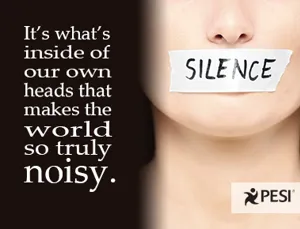
The bottom line: it’s what’s inside of our own heads that makes the world so truly noisy.
Susan Pomeranz, MFT, B.B.S.E., Certified Hypnotherapist, Certified Tai Chi Leader, Psychotherapist, has had over 20 years in private practice in Los Angeles. After a flourishing practice, Susan began experiencing the devastating and far reaching effects of burnout, and not having a framework for prevention nor treatment to draw from, spent five years researching and compiling evidence based practices that reduce stress and beneficially change the neurochemistry of the brain.

Susan Pomeranz, MFT, BBSE Certified Hypnotherapist, Certified Tai Chi Leader, Psychotherapist, has had over 20 years in private practice in Los Angeles. After a flourishing practice, Susan began experiencing the devastating and far-reaching effects of burnout, and not having a framework for prevention nor treatment to draw from, spent five years researching and compiling evidence-based practices that reduce stress and beneficially change the neurochemistry of the brain.
In addition to her private practice, she designed and ran the eating disorders out-patient programs at The Rader Institute in L.A. She also privately ran alternative treatment programs for the healing of addictions and addictive behavior.
She has studied with world-renown teachers of Tai Chi and Qigong, Dr. Roger Jahnke, the director and founder of the Institute of Integral Qigong and Tai Chi, in Santa Barbara, California, and Dr. Keith Jeffery, who has developed a modern approach to this classical art by synthesizing the Yang and Chen Style Tai Chi with basic Qigong exercises. Susan was also a private student of Sufi Master, Leo Mahsoud, for seven years in San Francisco, where she studied yoga, meditative dance, Sufi philosophy and nutrition.
Susan has extensively lectured and presented seminars throughout the United States including such institutions as the UCLA School of Psychology, University of Judaism and Antioch University. With her dynamic flair for speaking and an irreverent off-beat sense of humor, Susan provides not only great insight into those subjects that she teaches but seminars that are compelling and highly entertaining.
Speaker Disclosures:
Financial: Susan Pomeranz is a Mind and Body Wellness Seminar leader. She receives a speaking honorarium from PESI, Inc. She has no relevant financial relationships with ineligible organizations.
Non-financial: Susan Pomeranz has no relevant non-financial relationship to disclose.


