Using Drawing Interventions in Play Therapy


I was working with one of my clients who was struggling to get her thoughts out. Drawing allowed her to bypass her fears and get her brain past the roadblocks.
It is a useful tool that may feel less threatening and easier for young clients to complete compared to other types of psychotherapy exercises. And an eraser is all that is needed if the drawing is not going in the direction the client wants it to go!
Keep the activity simple and engaging. The simple use of a pencil and paper allows clients to not have to decide upon color choices. They can focus on just drawing. And while they are drawing, they’re accessing and moving past sticking points by focusing more on their inner expressions than the difficulties at the surface. Freely drawing can also be a more active activity for clients than simply coloring in a pre-made page. They get to explore, dream, plan, critically think and develop whatever their heart desires and aren’t limited by the predrawn outlines already on the page.
Keep the idea open-ended. Clients often have an idea in their heads of what they want to create, then become frustrated when their images don’t compare to their ideas. It is for this very reason that I include drawing interventions where actual objects are not being drawn. I have found it very beneficial to allow clients to experiment with pencils by scribbling, applying varying amounts of pressure, and creating circles. This cannot only provide relaxation to young clients, but give them the confidence to then tackle more detailed drawing interventions.
You can add drawing into your practice. I’ve been using drawing interventions in my practice for years and made some mistakes along the way with clients. I’ve put together this amazingly awesome coolest ever possible worksheet that you can use in your very next session to use drawing to bypass their roadblocks and unlock their mind.
Download the PDF of drawing interventions you can use with children here.
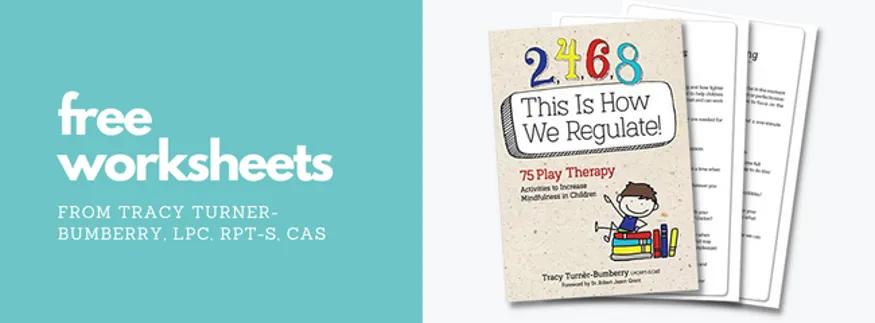
This blog is an excerpt from 2, 4, 6, 8 This Is How We Regulate: 75 Play Therapy Activities to Increase Mindfulness in Children. Learn more about the book here!

Our panel of experts will show you how to skillfully integrate fun, practical, and immediately useful play therapy interventions to meet the challenges you’re facing right now.
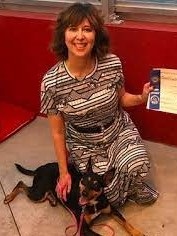
Tracy Turner-Bumberry, LPC, RPT-S, CAS., is the founder of KS Counseling LLC, a private practice located in St. Charles, MO. She has over 15 years of play therapy experience working with children and teens in school, hospital and private practice settings.
Tracy is the author of Finding Meaning with Mandalas-A Therapist’s Guide to Creating Mandalas with Children (Turner Phrase, 2015) and 2, 4, 6, 8 This is How We Regulate: 75 Play Therapy Activities to Increase Mindfulness in Children (PESI, 2018). In addition to her thriving private practice, she conducts play therapy trainings both locally and nationally focusing on mindfulness, regulation and therapist self-care. She also supervises licensed professionals towards reaching their certification in play therapy.
She received her BS in Education from the University of Missouri-Saint Louis, and her MA in School and Professional Counseling from Lindenwood University in St. Charles, MO. She obtained her Registered Play Therapist-Supervisor certification from the Association for Play Therapy, and her Certified Autism Specialist certification from IBCCES.
Speaker Disclosures:
Financial: Tracy Turner-Bumberry maintains a private practice. She receives royalties as a published author. Tracy Turner-Bumberry receives a speaking honorarium, recording royalties, and book royalties from PESI, Inc. She has no relevant financial relationships with ineligible organizations.
Non-financial: Tracy Turner-Bumberry is a member of the Association for Play Therapy.


