Staying Alive Is a Full-Time Job


My husband and I are not considered essential workers, so in the midst of the current global pandemic, we’ve both been fortunate enough to be able to work remotely. We’ve been able to do our work from home, collect a paycheck, and remain isolated and therefore healthy. I am the designated weekly grocery shopper, which I now do gleefully, simply to have an outing. But in reality, I don’t need to leave the house, even for groceries. (Thank you, Instacart.) This leads to me wonder where all my spare time is going. Shouldn’t I have several hours of extra time each day since I’m not commuting, have no social engagements, and am not visiting additional stores? I’m not that great at math, but things aren’t adding up. Why am I hearing from so many people—even from remote, non-essential workers who are in a similar enviable position to us—that we are all exhausted? What have we done with all our freed-up time?
Although there are probably many answers to these questions, I truly resonate with Richard Overton’s comment that staying alive is a full-time job. I would also add to this and say that staying alive and remaining physically, emotionally, and spiritually well is a full-time job. I figure it is my job to stay as healthy as I can within the realm of things I can control, which includes what I eat, how much I exercise, what sort of routine I have, what my online consumption consists of, and how many hours I spend in front of a screen. These are things over which I have personal agency to support my well-being or self-destruct. Knowing this, I have focused my efforts on getting enough sleep, eating the right foods, and performing regular exercise. I figure if these three are functional and healthy, I will be and feel functional and healthy.
You have this same personal agency when it comes to the things in your life. Are you aware of what you are doing to stay alive? Or do you just survive the day? Although there’s value in knowing how to simply survive the day, that M.O. may not be sustainable for the long haul. You also need to know what practices keep you alive, healthy, and well.
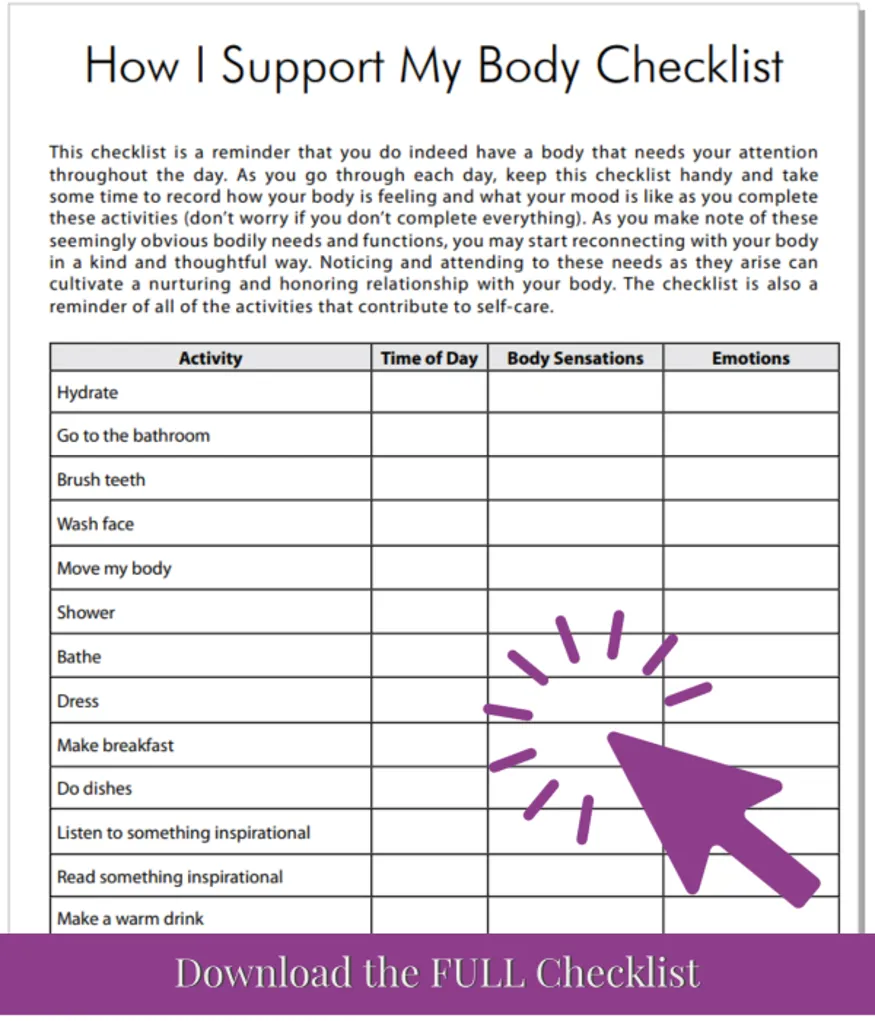
This worksheet might be a good starting point to help you better connect to yourself and find what supports your own well-being. Click here to download the worksheet How I Support My Body Checklist.

Designed with both mental health clinicians and clients in mind, Trauma-Informed Yoga offers 47 short, simple practices that regulate the autonomic nervous system, calm the racing mind, and center those of us living chaotic 21st century lives.
Drawing from over 20 years of teaching and clinical practice, Spence masterfully weaves together the ancient wisdom of yoga with modern neuroscience and clinical practice in an accessible and compassionate manner.
This how-to toolbox will arm you with knowledge and with powerful, yet simple, mind-body activities that reduce suffering and increase well-being.

Joanne Spence, MA, ERYT 500, C-IAYT, YACEP, is a recovering social worker and certified yoga therapist, and author of Trauma-Informed: A Toolbox for Therapists: 47 Simple Practices to Calm, Balance, and Restore the Nervous System (PESI Publishing, 2021). She is the founder and executive director of Yoga in Schools. Joanne trains and teaches all sorts of amazing people, both nationally and internationally, in yoga. She has taught yoga in prisons, hospitals, schools, churches, and sometimes on street corners. She specializes in working with adults and children who are experiencing chronic pain, trauma, depression, anxiety, ADHD, and insomnia.
Speaker Disclosures:
Financial: Joanne Spence is the founder and executive director of Yoga in Schools. She is an author for PESI Publishing and receives royalties.
Non-financial: Joanne Spence has no relevant non-financial relationship to disclose.


