Somatic Techniques to Support the Nervous Systems


As therapists, we can learn to read this nonverbal language of movement to understand what is beneath our clients’ stories. Movement can be a diagnostic and therapeutic tool we can use to intervene and help regulate a trauma activation or facilitate working through a stuck emotion. It can be something we utilize to explore, lead, mirror, and join.
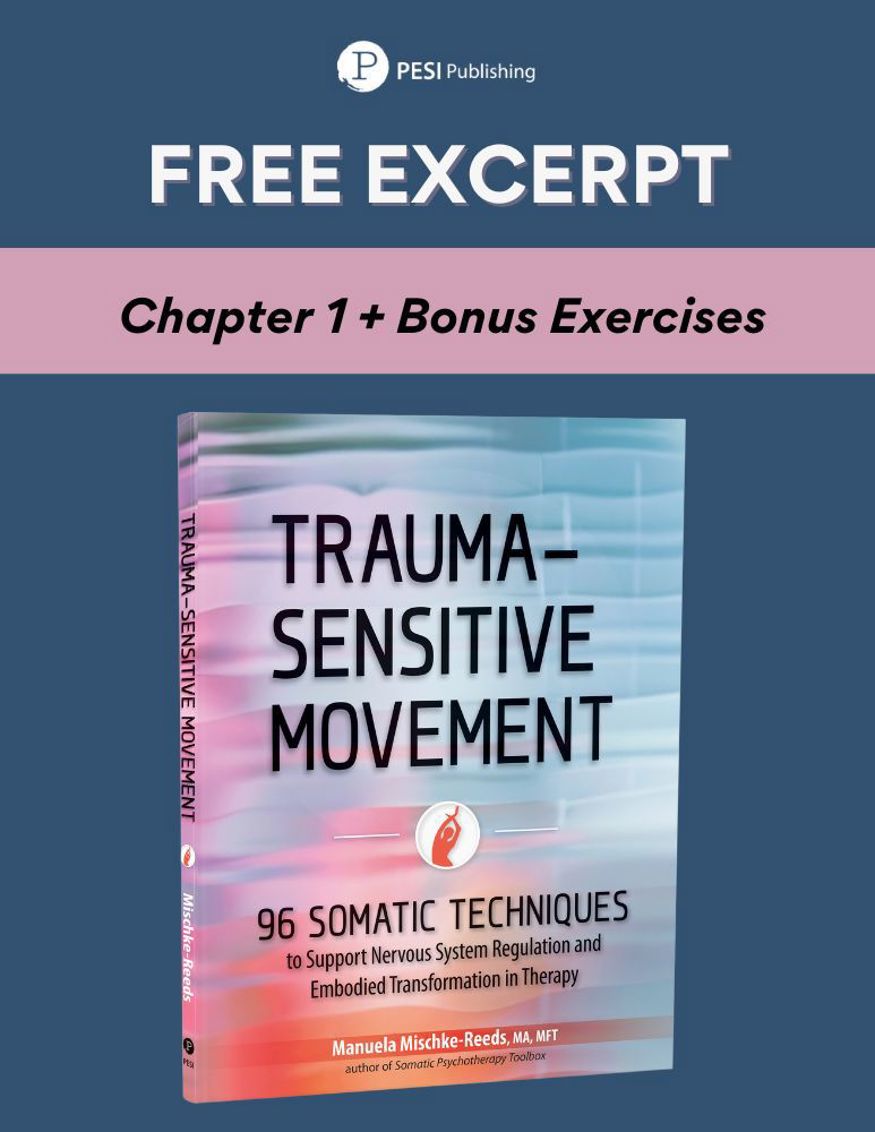
That’s why I wrote Trauma-Sensitive Movement: 96 Somatic Techniques to Support Nervous System Regulation and Embodied Transformation in Therapy—to help any therapist wanting to skillfully use movement as an intervention.
In the trauma field, there’s a large emphasis on “soothe and settle,” which is critical in establishing internal safety. What is less practiced is how to integrate the whole spectrum of our movement expressions. Big expressive emotions that are not easily soothed or settled need a different engagement, as do subtle intrinsic movements.
So, what’s the key to transformation?
From my decades of clinical experience, I believe that reading the body as being movement itself and learning how to meet the client’s range of expression is where the magic happens. When we can learn to read what the client needs and tailor exercises to work with the moving body as a gateway into emotions and deeply held beliefs, that’s where trauma recovery happens.
Seven Reasons to Bring Movement into Therapy
- You bring variation to your therapy work.
- You offer deeper somatic trauma-resolution techniques.
- Clients who are kinesthetic will feel met and valued.
- The work is more effective because you expand on your relational interventions.
- It’s diagnostic. You can literally read the moving body to identify where there is stuck, unprocessed trauma.
- You learn to track a moving body telling unspoken stories that offer clues as to how the client interacts in the world and how they perceive themselves, others, and their past.
- Movement makes us more empathic. Our mirror neurons begin firing when we see movement, and by being with movement we better understand the client’s inner world, which sometimes holds unexplainable, unspeakable horrors. Movement is a direct line of communication to these events—and to healing.



Manuela Mischke-Reeds, MA, LMFT, CHT, is a somatic psychotherapist, international teacher of Somatic Psychology, author and consultant. She is the founder of Embodywise and co-director of Hakomi California. She trains and consults professionals in varied fields, including health professionals and business leaders. Her trainings in the United States, Australia, Germany, China and Israel bring together 25 years in-depth clinical practice and teaching. She integrates Hakomi Mindful somatic Psychotherapy, Somatic trauma therapies, embodied mindfulness practices and movement therapies.
Manuela is the founder of ISITTA trauma training. Her trauma teachings are grounded in an inside-out approach that utilizes the depth of the body’s innate healing capacity.
Manuela is the author of several books, including 125 Somatic Psychotherapy tools for Trauma and Stress (PESI 2018), 8 Keys to Practicing Mindfulness: Practical Strategies for Emotional Health and Well Being (W.W. Norton 2015). Visit Manuela’s website to find out more about her work: www.embodywise.com.
Speaker Disclosures:
Financial: Manuela Mischke-Reeds is the founder of Embodywise and has an employment relationship with Embodylab. She receives compensation as a consultant and royalties as a published author. She receives a speaking honorarium, recording, and book royalties from PESI, Inc. She has no relevant financial relationships with ineligible organizations.
Non-financial: Manuel Mischke-Reeds has no relevant non-financial relationships.


