Five IFS Therapy Principles to Support Effective EMDR Trauma Reprocessing

Being a trauma therapist requires extensive knowledge about the complexities of trauma, along with specialized If you are trained in Eye Movement Desensitization and Reprocessing (EMDR), you are aware that the standard EMDR protocol is not a one-size-fits-all approach. You may often wonder how to prepare your clients for trauma reprocessing, how to identify which trauma target to start with, or how to help clients if they get stuck in the process. You may be familiar with parts models, such as Internal Family Systems (IFS) therapy, but you may be confused about what to actually do with parts in therapy or what that looks like within the eight phases of EMDR treatment.
EMDR and IFS therapy are both effective modalities for treating trauma. However, when used as stand-alone approaches, or when aspects of one or the other model are interjected into treatment without clear guidelines, they may not adequately address clients’ unique needs, particularly in cases of complex trauma. What’s needed, therefore, is an integrated approach, and that’s where the five IFS therapy principles to support effective EMDR trauma reprocessing comes into play.
Five IFS therapy principles can help guide the integration of IFS therapy interventions throughout the eight phases of EMDR. These principles will help guide you with direction and clinical decision-making throughout EMDR therapy so you can feel confident in applying IFS therapy case conceptualization and interventions.
Principle 1: We All Have Self and Parts
IFS therapy interventions provide the perspective that one part is not all of a client. This helps the traumatized client understand that they can have opposing and dialectal feelings and thoughts at the same time. This offers a nonpathological view of the client. This principle also provides an IFS therapy perspective on case conceptualization to use throughout EMDR therapy by inviting you to continually hold the questions “How much access does the client have to their Self?” “What part might this be?” and “What is this part’s job in the system?” Exploring parts’ roles in a client’s system by using IFS therapy interventions within the eight phases of EMDR therapy can help identify and untangle polarized parts and double binds. Parts can be befriended to help them soften, becoming less rigid, less defensive, and more open to the system changing internally. When parts soften, they can give consent for EMDR reprocessing, and trauma-related beliefs and feelings that parts are carrying can change in EMDR reprocessing, helping support a Self-led system.
Principle 2: All Parts Are Welcome
From an IFS therapy perspective, all parts have positive intentions for the system. This helps depathologize the client’s mental health symptoms and creates a therapeutic relationship that is inclusive and welcoming of all the client’s parts. This principle also reinforces that you are not trying to get rid of any given part, but offering parts an opportunity for transformation and releasing burdens they carry through EMDR reprocessing. If a part is emerging that prevents EMDR reprocessing, that is the system’s way of letting you know which part needs to be addressed next. Thus, rather than being seen as a problem or impediment to treatment, parts are relationally welcomed and valued within EMDR therapy. In applying IFS therapy interventions, you develop the skill to discern what type of part may be present and how much the client is functioning from a Self-led system.
Principle 3: Receive Consent from Protector Parts First
IFS therapy interventions respect the client’s protector parts. Before doing EMDR reprocessing or accessing the exile, you ask the client for consent from their protector parts. This provides consent-based trauma reprocessing. You must be attuned to the client’s pace and trust the pace their system needs for healing. IFS therapy slows down the pace of trauma reprocessing. EMDR speeds up the pace of trauma reprocessing.
Principle 4: The Self-to-Part Relationship Is Healing
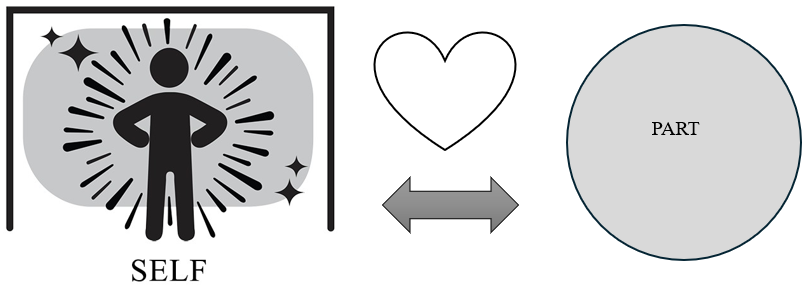
As the figure visually demonstrates, when a part receives connection to Self, it is innately healing. Throughout EMDR therapy, you are using IFS therapy interventions to ultimately support a Self-to-part relationship. Self-energy can be provided to parts from the client’s Self, the therapist’s Self, Self experienced through any relational resources (e.g., human, animal, nature, or spiritual), or Self-energy from being in community. In traumatized systems, some parts initially may only be able to take in the presence of Self through an integrative coping skill for co-regulation. Integrating coping skills can help parts to receive Self and can be used to strengthen the Self-to-part relationship for co-regulation. Thus, early on in phases 1 and 2, IFS therapy interventions help support the Self-to-part relationship. Phases 3 and 4 help strengthen the Self-to-part relationship through EMDR reprocessing. Throughout phases 4 through 8, IFS therapy interventions offer an opportunity for Self-to-part relationship as needed in EMDR therapy.
Principle 5: If Parts Feel Understood, They Will Soften
Parts get stuck in burdened roles (manager, firefighter, or exile) in the system due to trauma, legacy burdens (intergenerational trauma), and internal and external constraints. Parts can get stuck in the past, stuck in protecting vulnerable parts, or stuck due to a polarization (power struggle) in the internal system.
Any IFS therapy intervention is a relational invitation for parts to be understood. When parts feel safe, seen, soothed, and secure, this fosters secure attachment between Self and parts (Siegel, 2010). In any IFS therapy intervention, you guide the client not to get rid of or change their parts, but to understand their parts from a place of curiosity and nonjudgment. Resourcing parts through integrative coping skills and relational, cognitive, and somatic resources, in addition to restoring trust in Self-leadership, helps parts receive co-regulation and attachment repair with Self.
When parts feel understood, they will soften. Parts can be relocated to the present day or a healing place, and parts can receive adaptive current information through the relationship with Self and through EMDR reprocessing. When their stories are witnessed through EMDR reprocessing or IFS interventions, they will ultimately release trauma-related beliefs, personal and legacy burdens including trauma-related feelings, and physical reactivity in the body. This reorganizes the internal system of parts so that Self is the leader of the system.
Clients with complex trauma often struggle with avoidance, dissociation, and increased symptoms during EMDR, making it difficult to support their sense of control and safety across treatment. In these cases, slower is faster, but how do you slow things down when EMDR is designed as an accelerated approach? By integrating IFS into EMDR, which enhances your ability to target symptoms in a more attuned and scaffolded way.


Learn to simultaneously use EMDR and IFS therapy to heal trauma by processing memories and helping clients navigate their inner conflicts and relational pain.

Daphne Fatter, PhD, is a licensed psychologist, clinical consultant, author, and international speaker specializing in integrative trauma-informed therapies. She is the author of Integrating Internal Family Systems Interventions into EMDR Therapy and is widely recognized for her expertise in blending parts work with evidence-based trauma modalities. Dr. Fatter is EMDR certified, an EMDRIA approved consultant, and has over twenty years of experience providing trauma treatment. As a certified ancestral healing practitioner, she also supports clients and clinicians in addressing intergenerational and historical trauma. Dr. Fatter earned her Master of Arts in transpersonal counseling psychology from Naropa University and her doctorate in counseling psychology from Pennsylvania State University. She completed a postdoctoral fellowship in clinical psychology at The Trauma Center under the direct supervision of Dr. Bessel van der Kolk, MD. She previously served as the military sexual trauma coordinator at the Fort Worth VA Outpatient Clinic and has extensive experience providing training to mental health providers serving the military. Her published works span the areas of Internal Family Systems therapy, EMDR, countertransference, mindfulness, and ancestral healing.
Grounded in the understanding that traumatic stress is multilayered – relational, developmental, biological, cultural, systemic, collective, historical, and spiritual – Dr. Fatter brings a neuroscience-based, compassionate, humble, and skills-based approach to professional education. She offers engaging workshops, webinars, and trainings on a range of trauma-related topics, including PTSD, complex trauma, complicated grief, and divorce recovery. Dr. Fatter is based in Dallas Texas where she balances her clinical practice with parenting her three children. Learn more at www.daphnefatterphd.com.
Speaker Disclosures:
Financial: Dr. Daphne Fatter maintains a private practice. She receives a speaking honorarium and recording royalties from Psychotherapy Networker and PESI, Inc. She has no relevant financial relationships with ineligible organizations.
Non-financial: Dr. Daphne Fatter is a member of the American Psychological Association, the EMDR International Association, and the Texas Psychological Association.


