Ask The Expert: Q&A with Dr. Frank Sileo, PhD


Although our world is diverse, it is not always inclusive. To raise accepting, empathic, and open-minded children, it is important to instill the idea that differences are to be celebrated within families, communities, and throughout the world.
We sat down with Frank Sileo, licensed psychologist and author of The Small and Tall Ball, to get the scoop on what inspired him to write a children's book, the importance of having conversations around inclusivity and diversity, and suggestions on how to use The Small and Tall Ball in classroom settings.
What inspired you to write The Small and Tall Ball?
In my professional practice in psychology, I work with so many kids who are diverse and come from diverse families. I recently had a case where I was seeing a child from a family with two moms. Their school was having a “Dad and Daughter Dance.” The child was quite upset that they could not go to the dance. This child felt excluded from her peers and school. This young girl was saddened by this but also angered that no one recognized their family.
Why is it important to foster conversations around inclusivity and diversity?
We live in a world that is so diverse! Children will encounter people of different races, cultures, abilities, religions, gender identities, sexual orientations, and more. When we teach kids about diversity and inclusion, we open up our children's minds and foster acceptance, compassion, and empathy toward others. Diversity and inclusion should be taught at an early age. I am hoping this book opens up many conversations about these topics!
Since this book is recommended for children 4 to 8 years old, what are some ways to teach young kids about what it means to be excluded?
In teaching children about diversity and inclusion, it is important that we look at ourselves as parents and caregivers first. As a parent, you should role model an inclusive attitude. We should make sure our language is inclusive. Parents should expose their children in their lives and in the media to diverse people, families, cultures, and places.
I encourage parents to speak openly about diversity and inclusion with their kids. Kids are naturally curious and will ask questions. Answer your child in an honest, age-appropriate, and concrete way. Encourage your child to share their thoughts and feelings with you as well.
When it comes to exclusion, help your child to understand what other children may be feeling if they are left out of something. When children can empathize with others, it can prompt them to include others who may be excluded.
If teachers want to use this book in the classroom, what are some suggestions on how to help kids comprehend the lessons taught in The Small and Tall Ball?
It is my hope that teachers use my book in their classrooms and that schools begin having Small and Tall Balls! Before reading the book, teachers may want to help kids understand what diversity and inclusion means. They can look for diversity in movies, magazines, in books, and in their own classroom. They can do projects on how diversity is celebrated in their families. Teachers can introduce children to aspects of different cultures, places, and diverse families. Ask questions after reading the book such as, “How do you think Oliver felt when his family wasn't included?” [or] “How did the kids in the story make the dance more inclusive?” Teachers may also ask their students to reflect on a time that they or someone they know may have been excluded. When kids can make a personal connection, it becomes more impactful and meaningful to them.
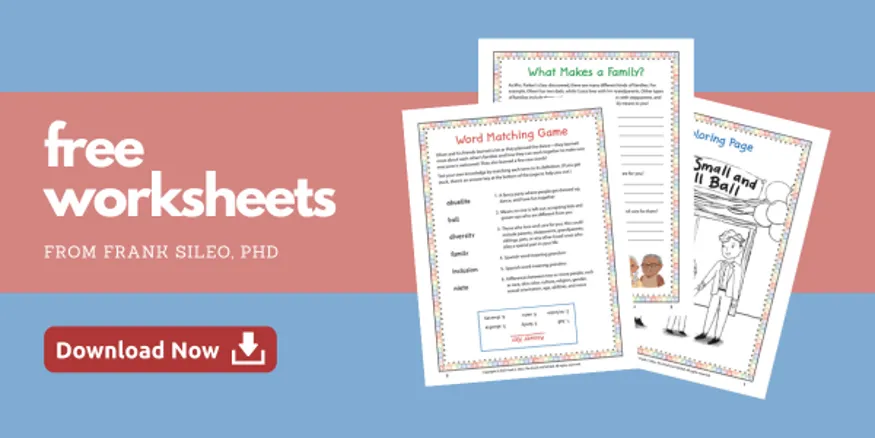
We sat down with Frank Sileo, licensed psychologist and author of The Small and Tall Ball, to get the scoop on what inspired him to write a children's book, the importance of having conversations around inclusivity and diversity, and suggestions on how to use The Small and Tall Ball in classroom settings.
What inspired you to write The Small and Tall Ball?
In my professional practice in psychology, I work with so many kids who are diverse and come from diverse families. I recently had a case where I was seeing a child from a family with two moms. Their school was having a “Dad and Daughter Dance.” The child was quite upset that they could not go to the dance. This child felt excluded from her peers and school. This young girl was saddened by this but also angered that no one recognized their family.
Why is it important to foster conversations around inclusivity and diversity?
We live in a world that is so diverse! Children will encounter people of different races, cultures, abilities, religions, gender identities, sexual orientations, and more. When we teach kids about diversity and inclusion, we open up our children's minds and foster acceptance, compassion, and empathy toward others. Diversity and inclusion should be taught at an early age. I am hoping this book opens up many conversations about these topics!
Since this book is recommended for children 4 to 8 years old, what are some ways to teach young kids about what it means to be excluded?
In teaching children about diversity and inclusion, it is important that we look at ourselves as parents and caregivers first. As a parent, you should role model an inclusive attitude. We should make sure our language is inclusive. Parents should expose their children in their lives and in the media to diverse people, families, cultures, and places.
I encourage parents to speak openly about diversity and inclusion with their kids. Kids are naturally curious and will ask questions. Answer your child in an honest, age-appropriate, and concrete way. Encourage your child to share their thoughts and feelings with you as well.
When it comes to exclusion, help your child to understand what other children may be feeling if they are left out of something. When children can empathize with others, it can prompt them to include others who may be excluded.
If teachers want to use this book in the classroom, what are some suggestions on how to help kids comprehend the lessons taught in The Small and Tall Ball?
It is my hope that teachers use my book in their classrooms and that schools begin having Small and Tall Balls! Before reading the book, teachers may want to help kids understand what diversity and inclusion means. They can look for diversity in movies, magazines, in books, and in their own classroom. They can do projects on how diversity is celebrated in their families. Teachers can introduce children to aspects of different cultures, places, and diverse families. Ask questions after reading the book such as, “How do you think Oliver felt when his family wasn't included?” [or] “How did the kids in the story make the dance more inclusive?” Teachers may also ask their students to reflect on a time that they or someone they know may have been excluded. When kids can make a personal connection, it becomes more impactful and meaningful to them.
The Small and Tall Ball: A Story About Diversity and Inclusion

In The Small and Tall Ball, readers will follow the heartwarming story of Oliver, a child who feels excluded from the yearly “Mother-Son & Father-Daughter Dance” because he has two dads. While planning for the dance goes on around him, Oliver learns that other kids in his class are also unable to attend because they have diverse families. “This is NOT fair!” cries one student. How can the students come together to plan a dance where all kids and families are welcome? Find out how the class thinks up a clever idea so everyone can enjoy the dance – making it a special night for those small and those tall!
Inside you’ll also find a special note for parents and caregivers that explains how to talk to kids about the importance of inclusion and the diverse families all around us.
Inside you’ll also find a special note for parents and caregivers that explains how to talk to kids about the importance of inclusion and the diverse families all around us.
Topics:

Frank Sileo PhD
Frank J. Sileo, PhD, is a licensed psychologist and the founder and executive director of The Center for Psychological Enhancement in Ridgewood, NJ. A Fordham University graduate, he works with children, adolescents, adults, and families. Since 2010, he has been consistently recognized as one of the New Jersey’s top kids’ doctors. He is the author of fifteen children’s books, which have received various prestigious book awards and have been translated into four languages. He also wrote an award-winning parenting book about raising chronically medically ill children. Dr. Sileo speaks across the country, has published in numerous peer-reviewed journals, and is a go-to psychologist in the media. Learn more at drfranksileo.com. You can follow him on Facebook, Twitter, and Instagram @drfranksileo.
You May Also Be Interested In These Related Blog Posts


