Addressing Weight Obsession, Comparison, and Unrealistic Expectations in Treatment

In my work with clients, I see the same painful cycles show up again and again. Understanding what drives them is the first step toward helping clients find a different path.
The weight-will-fix-it trap
In my practice, I work with many clients who have fallen into the trap of believing that weight loss will solve their problems, including their body image struggles. The pattern is remarkably consistent: they lose weight, receive compliments, and feel a brief sense of accomplishment. Then the ground shifts. The relief fades, and the feeling that they are not doing enough creeps back in. So they start on a new diet plan, a new exercise program, or a new health obsession.
What drives this cycle is rarely about weight itself. Body image expectations sit at the root of it. These expectations are often rigid, idealized, and deeply internalized. Clients who pursue weight loss as a solution to body dissatisfaction tend to find that the goalposts keep moving, because the underlying relationship with the body has not changed.
What I find useful in session: I encourage clients to explore the difference between their values (what genuinely matters to them about how they live and feel) and their expectations (the often appearance-focused standards they have absorbed from culture, family, or social media). That distinction opens the door to healing the relationship with the body, not just managing symptoms.
How comparison keeps clients stuck
Comparison is a normal feature of human cognition. We naturally notice similarities and differences between ourselves and others. But in clients with eating disorders, body-based comparison becomes a compulsive behavior that quietly drives distress, often without the client fully recognizing it.
I see comparison functioning as a safety behavior in a lot of my clients. They use it to measure their worth, gauge their social standing, or reassure themselves about how they are doing. In practice, though, it backfires. Research consistently shows that all forms of comparison, whether upward or downward, are associated with decreased self-esteem and increased body dissatisfaction.
Social media makes this worse. A client who compares themselves to someone who has publicly documented a weight loss journey may construct a fantasy: if I achieve that, I will finally be free of body image struggles. That fantasy is built on misinformation and selectively edited narratives. It reinforces disordered beliefs rather than challenging them.
Comparison also feeds perfectionism. The client who compares upward faces a standard that keeps receding. The client who compares downward often feels guilt or shame rather than genuine relief.
A note for clinicians: I find that bringing psychoeducation about comparison into treatment can be genuinely useful. Many clients are surprised to learn that the research does not support comparison as a source of motivation. Helping them understand why a behavior that feels regulating is actually maintaining their distress can build real motivation for change. Reducing appearance-based comparison is a meaningful clinical target.
Reframing expectations around weight loss
One of the most important pieces of work I do with clients involves making explicit what they are actually hoping weight loss will provide, and then examining whether those hopes can be served through body-focused goals or whether they need to be pursued another way.
The table below is something I use in my own practice. It maps common harmful body expectations to their underlying values, and contrasts them with expectations that support a more sustainable, body-trusting relationship.
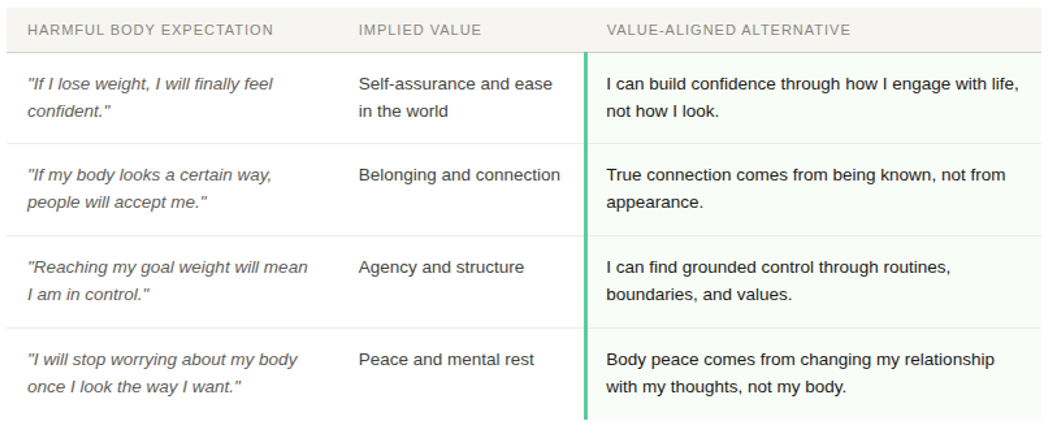
This kind of values clarification work helps clients see that the expectations maintaining their eating disorder behaviors are often proxies for legitimate needs. Those needs can be addressed directly, rather than through an unending pursuit of a different body.
What I want clinicians to keep in mind
These three areas, weight obsession, comparison behaviors, and unrealistic expectations, frequently show up together and reinforce each other. Addressing one without the others can leave clients with treatment gains that erode over time.
Psychoeducation matters more than we sometimes give it credit for. Many clients are genuinely surprised to learn that weight loss does not reliably improve body image, or that comparison consistently causes harm rather than motivation. These facts can be powerful allies in building readiness for change.
Safety behaviors are hard to relinquish. Comparison, body checking, and diet cycling all function as anxiety management. Clients may intellectually agree that these behaviors are unhelpful while still feeling unable to stop. Compassionate exploration of what the behavior is protecting against tends to be more productive than direct challenge.
And finally, values work is not a bypass. Asking clients to identify their values is not the same as asking them to accept their current body. For many, it is a slow, iterative process of untangling who they are from what they look like. That work deserves time, patience, and care.
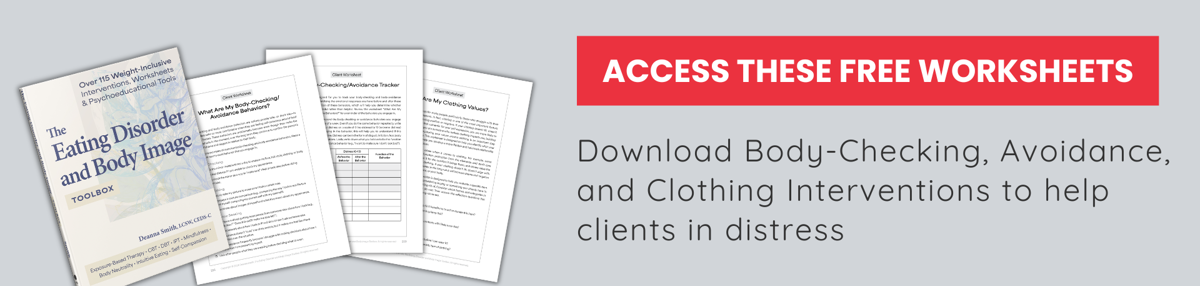
Divided into four easy-to-navigate sections (core knowledge, general interventions, disorder-specific tools, and body image work), this toolbox gives you the foundation you need to support individualized, recovery-oriented care. Think of it as your companion to reshape your clients’ relationships with food and their bodies – starting right now.

Watch Deanna Smith, LCSW, CEDS, eating disorders and body image expert, for this comprehensive training that will give you integrative tools to meet the needs of your clients who are struggling with perfectionism, disordered eating, body image, and related negative effects like anxiety and depression. She’ll give you a roadmap for navigating these complex issues.

Deanna Smith, LCSW, CEDS-C, is a licensed clinical social worker, author, educator, and owner of The Center for Growth, a private practice specializing in eating disorders, body image concerns, body dysmorphic disorder (BDD), obsessive-compulsive disorder (OCD), anxiety disorders, and perfectionism. She has over a decade of clinical experience working with adolescents and adults across multiple levels of care and has presented in specialized spaces on proper assessment and intervention techniques to address these complex disorders.
Deanna is the author of the book The Eating Disorder and Body Image Toolbox, a comprehensive, weight-inclusive resource offering over 115 evidence-based interventions, worksheets, and psychoeducational tools for clinicians. She has served as an Adjunct Professor at the University of Utah and is an author and presenter for PESI, providing professional education locally and internationally on topics including BDD, OCD, perfectionism, body image, and effective therapeutic interventions.
Her clinical work is grounded in evidence-based approaches such as Exposure and Response Prevention (ERP), Cognitive Behavioral Therapy (CBT), Dialectical Behavior Therapy (DBT), and Acceptance and Commitment Therapy (ACT). Deanna is passionate about collaborative, compassionate care and supporting meaningful, sustainable change to support long-term change in clients who are struggling with body dissatisfaction and disordered eating responses.
Speaker Disclosures:
Financial: Deanna Smith maintains a private practice and receives royalties as a published author. She receives a speaking honorarium and recording royalties from PESI, Inc. She has no relevant financial relationships with ineligible organizations.
Non-financial: Deanna Smith has no relevant non-financial relationships.


