A Hidden Culprit of Poor Handwriting Posture
977 20160809 013447 Atnr
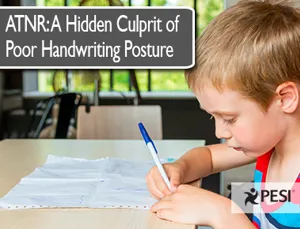
We know that good posture is important to ensure stress on your muscles, joints and ligaments is distributed evenly across your body. Proper posture when writing is especially important, so it's no wonder we spend so much time teaching our children what proper handwriting posture looks like:

  • Feet flat on the floor
  • Thighs parallel to floor and knees at a 90 degree angle
  • Back up straight, inclined towards the desk and pivoted from the hips
  • Forearms resting on desk with elbows level with the desktop at 90 degrees
  • Paper stabilized with non-dominant hand
  • Neck and shoulders relaxed
  • Body faces desk squarely so non-dominant arm can support body weight
  • Paper tilted to the up to the right (if right handed) or up to the (if left handed)
For most children, following this posture is no problem. But what about Johnny, a bright child in your class who just can't follow your directions to sit up straight? Is it that Johnny just wants to look cool slouched in his chair, or is something bigger going on?

In the video below, Kathy Johnson, MS Ed., explores what happens to handwriting when the Asymmetrical Tonic Neck Reflex (ATNR) is retained.


This blog was brought to life by PESI speaker Kathy Johnson, MS Ed. Johnson is the author of The Roadmap From Learning Disabilities To Success, a nationally recognized expert in multiple therapy methods including: Primitive Reflex Training, Therapeutic Listening, Samonas Listening, PACE, Phono-Graphix, Irlen Syndrome, Brain Gym 101, and An Introduction to Rhythmic Movement.


Kathy Johnson MS Ed

Kathy Johnson, MS Ed., has been working with students since 2000 to overcome their reading struggles, as well as other learning issues. She found an excellent program that brought their decoding abilities to grade level in a matter of months. Yet, some could not read the test in grade level books, so she began her exploration into the trainings and therapies that brought students’ success. Many increased their IQ and no longer required extra services. Kathy received training in order to bring these therapies to others which include Primitive Reflex Training by Samuel A. Berne, OD, Therapeutic Listening by Sheila Frick, Samonas Listening by Jill Stowell, PACE by Learning Rx, Phono-Graphix by Read America, Irlen Syndrome, Brain Gym 101, and An Introduction to Rhythmic Movement.

In 2000, Kathy started The Hunter School of Ballston Spa for struggling students, in which she and her assistant taught third through eighth graders required academics while remediating their struggles through therapy during the school hours. In 2002, she started an educational consulting business to screen and remediate student struggles individually. Since then she has also given lectures and workshops to clinics and schools, been a guest on Internet talk radio shows, and wrote The Roadmap from Learning Disabilities to Success plus other DVDs and publications. Kathy earned her Master’s degree from the State University of New York at Albany where she instructed faculty and staff, was an adjunct professor at Schenectady County Community College, and taught at The Adirondack School of Northeastern New York.


Speaker Disclosures:

Financial: Kathy Johnson maintains an educational consulting firm, Pyramid of Potential. She has authored a series of workbooks and CDs, The Pyramid of Potential Series. She is a compensated author for ZLS Publishing. She receives a speaking honorarium from PESI, Inc.

Nonfinancial: Kathy Johnson has received training in Therapeutic Listening and Samonas Listening.

Let's Stay in Touch

Get exclusive discounts, new training announcements & more!

You May Also Be Interested In These Related Blog Posts
986 20160811 112839 Vocabofreading
The Vocabulary of Reading
No one can ever prepare a parent for the confusion that comes when their child appears to learn in a different way from other children. And sometimes, we forget that parents of our students may als...
989 20160815 034516 Toniclabyrinthinereflex
Integrating Tonic Labyrinthine Reflex: An exercise for children with learning disabilities
Do you work with clients struggling with learning disabilities? It could be from a retained reflex.
Hands Breaking Free From Handcuffs Against A Blue Sky
How To Harness the Power of Values and Help Your Clients Speak Up When It Matters
Dr. Danielle N. Moyer shares clinical strategies for using values-based interventions to empower clients to communicate authentically, overcome avoidance, and build meaningful connections.
Mindfulness Practices Person Meditating
Using Mindfulness to Support Clients with Sociopolitical Unrest
Learn practical exercises to manage your own reactions, stay present with clients, and respond with intention rather than fear when difficult topics arise in session. This resource helps clinicians...
986 20160811 112839 Vocabofreading
The Vocabulary of Reading
No one can ever prepare a parent for the confusion that comes when their child appears to learn in a different way from other children. And sometimes, we forget that parents of our students may als...
989 20160815 034516 Toniclabyrinthinereflex
Integrating Tonic Labyrinthine Reflex: An exercise for children with learning disabilities
Do you work with clients struggling with learning disabilities? It could be from a retained reflex.
Hands Breaking Free From Handcuffs Against A Blue Sky
How To Harness the Power of Values and Help Your Clients Speak Up When It Matters
Dr. Danielle N. Moyer shares clinical strategies for using values-based interventions to empower clients to communicate authentically, overcome avoidance, and build meaningful connections.
Mindfulness Practices Person Meditating
Using Mindfulness to Support Clients with Sociopolitical Unrest
Learn practical exercises to manage your own reactions, stay present with clients, and respond with intention rather than fear when difficult topics arise in session. This resource helps clinicians...