
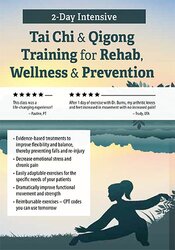
2-Day Intensive Tai Chi & Qigong Training for Rehab, Wellness & Prevention
- Speaker:
- John Burns, DPT, MPT, MSOM, Dipl-Ac
- Duration:
- 11 Hours 41 Minutes
- Format:
- Audio and Video
- Copyright:
-
Aug 15, 2019
- Product Code:
- POS020781
- Media Type:
- Digital Seminar

Description
You work hard to bring healing to your patients. Bringing an end to pain and restoring movement, strength, dignity, and independence. With the right skills and tools, your work can have life-changing impacts on those you serve.
But many patients fail to respond to traditional biomedical approaches that ignore the stress and social influences that can hinder therapeutic progress. And with a short amount of time in session, you worry that the “homework” you give your patients can seem tedious, unappealing, and ultimately fail to encourage them to commit to your treatment plan.
In this recording, you'll discover how to break through these barriers and improve treatment sessions using the time-tested methods of Tai Chi and Qigong. In just 2 days, revolutionize your treatment methods, regardless of where you practice. These ancient methods of mind-body exercise have been proven to reduce chronic pain and emotional stress, which can dramatically improve a client’s self-efficacy during and after therapy.
In addition, these movements can help you reduce the risk of falls and dramatically improve functional movement. Best of all – get reimbursed using this comprehensive, mind-body method.
Don’t miss out – this hands-on training is a must-have for any clinician looking to boost results by embracing the mind-body model of healthcare.
Credit
Handouts/Brochure
| File type | File name | Number of pages | |
|---|---|---|---|
| Manual - 2-Day Intensive Tai Chi & Qigong Training for Rehab, Wellness & Prevention (5.4 MB) | 71 Pages | Available after Purchase |
Speaker
John Burns, DPT, MPT, MSOM, Dipl-Ac Related seminars and products
Dr. John Burns DPT, MPT, MSOM, Dipl-Ac, is a nationally-recognized instructor of both Tai Chi F.I.T. and Qigong F.I.T. He has over 30 years of experience in mind-body exercises and therapies. With his vast experience he has developed programs for physical therapists, acupuncturists, massage therapists, physicians, and nurses.
Dr. Burns provides instruction of mind-body exercises in community and rehab settings, psychiatric hospitals, and to physical therapy students at Marquette University, as well as, teaches students of Oriental Medicine at the Midwest College of Oriental Medicine.
His seminars blend the evidence and his experience with a teaching style that reflects his passion and conviction to improve upon the health of people of all ages and abilities. He is the founding director of the Academy of Mind-Body-Movement and this Level 1: Mind-Body-Movement Specialist certification course.
Dr. Burns is also currently the Clinical Coordinator of Acupuncture and Mind-Body Exercises at Aurora Health Care. He holds a Doctor of Physical Therapy degree from the University of Colorado Medical School and a Master’s of Science in Oriental Medicine degree from the Midwest College of Oriental Medicine.
With his extensive knowledge and experience in both Western and Eastern medicine he developed this program to help empower you in your continued efforts to provide optimal patient/client-centered care.
Speaker Disclosures:
Financial: John Burns has an employment relationship with Aurora Health Care. He is a faculty member at Marquette University; and Midwest College of Oriental Medicine Dr. Burns has received a United State Patent for a fitness and rehab apparatus. He receives a speaking honorarium from PESI, Inc.
Non-financial: John Burns has no relevant non-financial relationship to disclose.
Additional Info
Access for Self-Study (Non-Interactive)Access never expires for this product.
Questions?
Visit our FAQ page at www.pesi.com/faq or contact us at www.pesi.com/info
Objectives
- Analyze the evidence behind the need for a biopsychosocial model of healthcare
- Review the research of utilizing Tai Chi and Qigong within a variety of clinical settings
- Demonstrate 30 Qigong movements for improving flexibility and dynamic balance to prevent the risks of falls
- Demonstrate 15 Tai Chi movements for improving upper and lower body functional movement and strength
- Examine the use of other ancient exercises such as Gua Sha, Tui Na, Acupressure, and cupping
- Demonstrate the ability to safely utilize both Tai Chi and Qigong for rehab, fitness, and athletic performance to review the Level 1 Mind-Body-Movement Specialist Certification
- Utilize weight transference techniques to improve balance
- Apply situational focus in Tai Chi practice, encouraging mental alertness
- Teach modifications for participants of different movement abilities
- Define the international fall reduction statistics directly related to Tai Chi programs
- Develop practices of incorporating Tai Chi into real life situations for fall prevention
- Incorporate mindfulness in Tai Chi practice to enhance health and well-being benefits
Outline
THE IMPORTANCE OF MIND-BODY INTERVENTIONS IN HEALTHCARE
- The dangers of a strictly biomedical approach
- Problem of pain management, opioids, and mental health crisis
- Addressing more than the pain – addressing the client’s body, mind, emotions, and spiritual connectedness
- Review the research on mind-body interventions
- How to improve and motivate patients being more active in their rehab, wellness and prevention goals
- Aligning Tai Chi and Qigong with Dialectical Behavioral Therapy (DBT), mindfulness and distress tolerance
WHY YOU SHOULD IMPLEMENT TAI CHI & QIGONG
- Looking at the evidence
- How this model can comprehensively treat the client
- How to utilize this method in various clinical settings
DEMONSTRATION OF INTERVENTIONS: MOVEMENTS TO IMPROVE VARIOUS DYSFUNCTIONS - LAB
- Tai Chi & Qigong warm-up - Rhythmic movements to elicit a therapeutic dopamine response, graded weight shifting and proximal to distal muscle recruitment
- Qigong to improve upper body functional strength, flexibility and ROM
- Qigong to improve lower body functional strength, flexibility and ROM
- Qigong to improve static and dynamic balance
- Qigong to improve segmental spinal control for improved stability and mobility
- Qigong to improve bone density to prevent fractures
- Qigong to improve stamina and cardiovascular endurance
- Tai Chi to improve proximal-to-distal muscle recruitment
- Tai Chi to improve an individual’s physical and emotional performance potential to face and overcome life’s physical and emotional challenges
- Tai Chi and Qigong as an ancient “physical therapy” intervention to enhance an individual’s ability to achieve their functional and sports performance goals
TAKE HOME SOLUTIONS
- Safely review all Tai Chi and Qigong exercises
- When the student becomes the instructor: how to empower your clients toward change
- Why safety is important: teaching and practicing principles of Tai Chi and Qigong safely
WHEN, WHERE, AND HOW TO UTILIZE TAI CHI AND QIGONG METHODS
- Case studies of various rehab setting
- Orthopedics
- Geriatrics
- Pediatrics
- Oncology
- Behavioral health
- How to enhance your reimbursement using CPT codes
- Real-life scenarios
Target Audience
- Physical Therapists
- Physical Therapist Assistants
- Occupational Therapists
- Occupational Therapy Assistants
- Exercise Physiologists
- Athletic Trainers
- Activity Professionals
Reviews
| 5 |
|
| 4 |
|
| 3 |
|
| 2 |
|
| 1 |
|
Overall: 5
Total Reviews: 4
Satisfaction Guarantee
Your satisfaction is our goal and our guarantee. Concerns should be addressed to: PO Box 1000, Eau Claire, WI 54702-1000 or call 1-800-844-8260.
ADA Needs
We would be happy to accommodate your ADA needs; please call our Customer Service Department for more information at 1-800-844-8260.
PESI Mobile App
Access CE trainings on your phone or tablet through our free mobile app. Choose video or audio-only versions of online courses from the world’s best instructors, and complete your CE requirements anywhere, anytime, at your own pace.




Please wait ...