
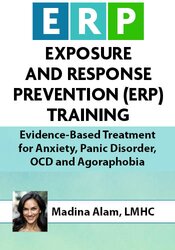
Exposure and Response Prevention (ERP) Training
Evidence-Based Treatment for Anxiety, Panic Disorder, OCD and Agoraphobia
- Speaker:
- Madina Alam, LMHC
- Duration:
- 12 Hours 23 Minutes
- Format:
- Audio and Video
- Copyright:
-
Feb 26, 2026
- Product Code:
- POS150570
- Media Type:
- Digital Seminar
Description
I almost quit being a therapist.
My clients were trapped in cycles of anxiety, OCD, and avoidance – but no matter what I tried, I couldn’t help them make real progress.
Powerless, frustrated, and burned out I needed a better way. Then I discovered Exposure and Response Prevention (ERP) – and everything changed.
Because with ERP I had a highly effective evidence-based pathway to finally free clients trapped by obsessions and rituals, paralyzed by intrusive thoughts and stuck in panic mode.
And it worked for me right away. Clients were improving. Fast. And I felt confident, effective, and reinvigorated in my work.
Now I want to share that with you in this start to finish 2-day training.
In this step-by-step program I’ll teach you to use ERP safely, simply, and powerfully, giving you practical strategies that you can use right away to guide clients with OCD, panic disorders and agoraphobia to real change …
And if you’re worried that exposure is scary … too intense … maybe even harmful. Don’t be.
This proven technique not only works, I’ll make sure you learn to deliver it in a way that feels completely safe and manageable.
If you work with clients with anxiety or OCD this is a must-have approach for your clinical toolbox.
So don’t wait.
Purchase now and leave ready to use ERP with your clients!
Madina Alam, LMHC
Credit
Planning Committee Disclosure - No relevant relationships
All members of the PESI, Inc. planning committee have provided disclosures of financial relationships with ineligible organizations and any relevant non-financial relationships prior to planning content for this activity. None of the committee members had relevant financial relationships with ineligible companies or other potentially biasing relationships to disclose to learners. For speaker disclosures, please see the faculty biography.
NOTE: Tuition includes one free CE Certificate (participant will be able to print the certificate of completion after passing the online post-test (80% passing score) and completing the evaluation). Instructional methods will include PowerPoint, didactic lecture, and others.
Continuing Education Information: Listed below are the continuing education credit(s) currently available for this non-interactive self-study package. Program content is reviewed periodically per accrediting board rules for currency and appropriateness for credit. Credit approvals are subject to change. Please note, your state licensing board dictates whether self-study is an acceptable form of continuing education, as well as which credit types are acceptable for continuing education hours. Please refer to your state rules and regulations. If your profession is not listed, please contact your licensing board to determine your continuing education requirements and check for reciprocal approval.
For other credit inquiries not specified below, please contact info@pesi.com or 800-844-8260 before purchase.
Materials that are included in this course may include interventions and modalities that are beyond the authorized practice of your profession. As a licensed professional, you are responsible for reviewing the scope of practice, including activities that are defined in law as beyond the boundaries of practice in accordance with and in compliance with your profession's standards.
For Planning Committee disclosures, please see the statement above. For speaker disclosures, please see the faculty biography.
Earn up to 12.25 CE hours. Please see below, for more details, as credit amounts vary by state and profession.
This self-study activity consists of 12.25 clock hours of continuing education instruction. Credit requirements and approvals vary per state board regulations. Please save the course outline, the certificate of completion you receive from the activity and contact your state board or organization to determine specific filing requirements.
CE credit is available. This course consists of 12.25 continuing education clock hours for Arizona Counselors. PESI is an approved provider of continuing education seminars with a national social work association. Please see social work approvals for this program.
The California Board of Behavioral Sciences accepts CE programs that are approved by other approval agencies, including several that approve PESI and its programs. A full list of approval agencies accepted by the BBS can be found at www.bbs.ca.gov/licensees/cont_ed.html under “Where to find CE Courses.” This intermediate level self-study activity consists of 12.5 clock hours of continuing education instruction.
Professional development hours (PDH) are available. This professional development activity consists of 12.25 PDH in the Coursework category. It is designed to meet the requirements of the Colorado State Board of Licensed Professional Counselor Examiners. Licensees can accrue up to 20 PDH in the Coursework category during each renewal cycle. Please save the certificate of completion in case it is requested by the board.
CE credit is available. This course consists of 12.25 continuing education clock hours for Connecticut Counselors. The Regulations of Connecticut State Agencies confirm acceptance of this program as a qualifying continuing education activity if approved by a national professional association of social work (Sec. 20-195cc-3). PESI is an approved provider of continuing education seminars with a national social work association. Please see social work approvals for this program.
CE credit is available. This course consists of 14.0 continuing education clock hours for DC Counselors. The District of Columbia Municipal Regulations for Professional Counseling (S.6612.3) confirm acceptance of continuing education programs relevant to counseling by organizations that have been approved by a counseling board in another state. PESI, Inc. is recognized by the New York State Education Department's (NYSED) State Board for Mental Health Practitioners as an approved provider of continuing education for Licensed Mental Health Counselors. #MHC-0033. This activity will qualify for 14.0 CE hours.
PESI, Inc. is an approved provider with the Florida Board of Clinical Social Work, Marriage and Family Therapy and Mental Health Counseling. Provider Number 50-399. This self-study course qualifies for 12.25 continuing education credits.
This intermediate self-study activity consists of 12.0 clock hours of continuing education instruction. Per the IDFPR: Social Work Continuing Education Sponsors approved by the Division in accordance with the rules for the administration of Clinical Social Work and Social Work Practice Act (225 ILCS 201), 68 Ill. Adm. Code 1470.95; PESI, Inc. is a registered social work continuing education sponsor with the Department of Financial and Professional Regulation, Division of Professional Regulation. License #: 159-000154. A certificate of attendance will be awarded at the end of the program to participants who are in full attendance, pass a post-test, and who complete the program evaluation.
CE credit is available. This course consists of 12.25 continuing education clock hours for Indiana Counselors. The Rules of the Indiana Behavioral Health and Human Services Licensing Board (839 IAC 1·6·2) confirm acceptance of continuing education programs relevant to counseling that are approved by another state’s mental health counselor board. PESI, Inc. is an approved provider with the State of Ohio Counselor, Social Worker and Marriage & Family Therapist Board. Provider approval #:RCST071001. Full attendance at this course meets the qualifications for 12.25 clock hours of continuing education credit.
CE credit is available. This live activity consists of 12.25 continuing education clock hours for Iowa Counselors and is designed to meet the continuing education requirements of the Iowa Bureau of Professional Licensure, IAC 645–32.3(154D,272C). Please retain the course advertisement and certificate of completion for four years in your CE records.
CE credit is available. This course consists of 12.25 continuing education contact hours for Kansas Counselors and is designed to meet the continuing education requirements of the Kansas Behavioral Sciences Regulatory Board (Regulation 102-3-10a) for Professional Counselors. Please retain the course advertisement and certificate of completion for your CE records.
CE credit is available. This self-study course consists of 14.75 continuing education credit hours for Kentucky Counselors. The Continuing Education Requirements for the Kentucky Board of Licensed Professional Counselors (201 KAR 36:030 Section 2) state continuing education programs from providers sponsored or approved by a state counseling licensure board shall be approved without further review by the board. PESI, Inc. is approved by the South Carolina Board of Examiners for Licensure of Professional Counselors, Marriage and Family Therapists, and Psycho-Educational Specialists. Provider #4540. PESI maintains responsibility for this program and its contents.
CE credit is available. This course consists of 12.25 continuing education clock hours for Maine Counselors and is designed to meet the continuing education requirements of the Maine Board of Counseling Professionals Licensure Rules (Chapter 7-A). Please retain the course advertisement and certificate of completion for your CE records.
CE credit is available. This formal, asynchronous course consists of 12.25 continuing education clock hours for Missouri Counselors. The Missouri Committee for Professional Counselors accepts continuing education programs relevant to counseling that are provided by organizations recognized by national social worker associations. PESI, Inc. is recognized by a national social worker association. Please see social work approvals for this program.
The Montana Board of Behavioral Health no longer pre-approves any courses or sponsors. Each licensee is responsible for taking courses which contribute to their competence and directly relate to their scope of practice as defined in board statute (MAR 24-219-32). Licensees must keep CE documentation for three years in case of an audit. This intermediate level self-study activity consists of 12.25 clock hours of instruction.
CE credit is available. This course consists of 12.25 continuing education clock hours for Nebraska Counselors and is designed to meet the continuing education requirements of the Nebraska Department of Health and Human Services (Title 172: Chapter 94: 012). Please retain the course advertisement and certificate of completion for your CE records.
PESI, Inc. is an approved CEU provider with the State of Nevada Board of Examiners for Marriage and Family Therapists and Clinical Professional Counselors. This self-study activity qualifies for 12.25 contact hours. Approved Provider # NVCEP2006.
CE credit is available. This course consists of 12.5 continuing education clock hours for New Hampshire Counselors. The Regulations of the New Hampshire Board of Mental Health Practice confirm acceptance of this program as a qualifying Category A continuing education activity if provided by an organization recognized by national social worker associations (Mhp 402.02(b)). PESI, Inc. is recognized by a national social worker association. Please see national social work approvals for this program.
PESI, Inc. is recognized by the New York State Education Department's (NYSED) State Board for Mental Health Practitioners as an approved provider of continuing education for Licensed Mental Health Counselors. #MHC-0033. This self-study activity will qualify for 14.75 contact hours. Full attendance is required; no partial credits will be offered for partial attendance.
CE credit is available. This course consists of 14.75 continuing education clock hours for North Dakota Counselors and is designed to meet the continuing education requirements of the North Dakota Board of Counselor Examiners (Article 97-02-01-06). Please retain the course advertisement and certificate of completion for your CE records.
PESI, Inc. is an approved provider with the State of Ohio Counselor, Social Worker and Marriage & Family Therapist Board. Provider approval #:RCST071001. Full attendance at this course meets the qualifications for 12.25 clock hours of general continuing education. Tracking number: 20-1368041
The Pennsylvania State Board of Social Workers, Marriage and Family Therapists and Professional Counselors accepts many national association CE approvals, several of which PESI offers. For a full list, please see your State Board regulations at https://www.dos.pa.gov/ProfessionalLicensing/BoardsCommissions/. This intermediate level self-study activity consists of 12.25 clock hours of continuing education instruction.
CE credit is available. This course consists of 12.0 continuing education credit hours for Rhode Island Counselors. The Rhode Island Code of Regulations (216-RICR-40-05-11 (11.3.12.B)) confirm acceptance of continuing education programs relevant to counseling that offer AMA PRA Category 1 Credit™. This live activity is certified for a maximum of 12.0 AMA PRA Category 1 Credits™ by PESI as an accredited ACCME provider authorized to award credit by the AMA. PESI, Inc. is accredited by the Accreditation Council for Continuing Medical Education to provide continuing medical education for physicians.
This self-study program has been approved for 12.0 continuing education hours by the South Carolina Board of Examiners for Licensure of Professional Counselors, Marriage and Family Therapists, and Psycho-Educational Specialists. Provider #4540.
CE credit is available. This course consists of 12.25 continuing education credit hours for South Dakota Counselors. The Rules of the South Dakota Board of Examiners for Counselors & Marriage and Family Therapists, ARSD 20:68:07:24, confirm that the board will accept qualified continuing education programs accredited or approved by another state's counseling board. PESI, Inc. is approved by the South Carolina Board of Examiners for Licensure of Professional Counselors, Marriage and Family Therapists, and Psycho-Educational Specialists. Provider #4540. PESI maintains responsibility for this program and its contents.
CE credit is available. This course consists of 12.25 continuing education credit hours for Tennessee Counselors. The Rules of the Board for Licensed Professional Counselors, Licensed Marital and Family Therapists, and Licensed Clinical Pastoral Therapists, Section 0450-01-.12, confirm continuing education courses which pertain to the practice of counseling shall be considered approved if sanctioned by any state regulatory agency for professional counseling in the United States. PESI, Inc. is approved by the South Carolina Board of Examiners for Licensure of Professional Counselors, Marriage and Family Therapists, and Psycho-Educational Specialists. Provider #4540. PESI maintains responsibility for this program and its contents.
CE credit is available. This course consists of 12.5 continuing education hours for Texas Counselors. The Regulations of the Texas State Board of Examiners of Professional Counselors (22 TAC 681.140) confirm acceptance of programs relevant to counseling that are approved by a national or state association of medical, mental or behavioral health professionals or a state governmental agency. Please see association and other state counseling board approvals for this program and retain the course advertisement and certificate of completion for your CE records.
CE credit is available. This course consists of 12.25 continuing education clock hours for Utah Counselors and is designed to meet the continuing education requirements of the Clinical Mental Health Counselor Licensing Act Rule, R156-60c. Please retain the course advertisement and certificate of completion for your CE records.
CE credit is available. This course is approved for 12.25 clock hours of continuing competency instruction for Virginia Counselors. The Virginia Board of Counseling recognizes continuing competency activities in the behavioral health field offered by organizations that are approved by a counseling board in another state (18VAC115-20-105). PESI, Inc. is recognized by the New York State Education Department's (NYSED) State Board for Mental Health Practitioners as an approved provider of continuing education for Licensed Mental Health Counselors. #MHC-0033. This activity will qualify for 12.25 contact hours.
CE credit is available. This course consists of 12.25 continuing education clock hours for Wisconsin Counselors. The Wisconsin Department of Safety and Professional Services (MPSW 19) accepts continuing education programs relevant to counseling by approved providers recognized by national social worker associations. PESI, Inc. is recognized by a national social worker association (Sec. 20-195cc-3). Please see social work approvals for this program.
CE credit is available. This course consists of 12.25 continuing education clock hours for Wyoming Counselors and is designed to meet the continuing education requirements of the Wyoming Mental Health Professions Board (Chapter 14, Section 4). Please retain the course advertisement and certificate of completion for your CE records.
PESI, Inc., #1062, is approved as an ACE provider to offer social work continuing education by the Association of Social Work Boards (ASWB) Approved Continuing Education (ACE) program. Regulatory boards are the final authority on courses accepted for continuing education credit. ACE provider approval period: January 27, 2026 - January 27, 2029. Social workers completing this course receive 12.5 Clinical continuing education credits.
Course Level: Intermediate Format: Recorded asynchronous distance. Full attendance is required; no partial credits will be offered for partial attendance.
Canadian Social Workers: Canadian provinces may accept activities offered by providers approved by the ASWB ACE program for ongoing professional development.
CE credit is available for 12.5 continuing education hours for Alabama Social Workers. Please see national social work approvals for this program.
CE credit is available for 12.5 continuing education hours for Alaska Social Workers. Please see national social work approvals for this program.
CE credit is available for 12.5 continuing education hours for Arizona Social Workers. Please see national social work approvals for this program.
This course consists of 12.25 continuing education contact hours for Arkansas Social Workers and is designed to meet the continuing education requirements of the State of Arkansas Department of Health Social Work Licensing Board (Ark. Code Ann. §17-103-203). Please retain the course advertisement and certificate of completion for your CE records.
The California Board of Behavioral Sciences accepts CE programs that are approved by other approval agencies, including several that approve PESI and its programs. A full list of approval agencies accepted by the BBS can be found at www.bbs.ca.gov/licensees/cont_ed.html under “Where to find CE Courses.” This intermediate level self-study activity consists of 12.5 clock hours of continuing education instruction.
PESI, Inc. is an approved provider with the Colorado Chapter of the National Association of Social Workers. Provider #1413. This self-study course has been approved for 12.3 continuing education hours.
COLORADO PARTICIPANTS ONLY: If you did not answer YES to be reported to the Colorado Chapter of the NASW on the evaluation, please contact cepesi@pesi.com and provide the full title of the webcast, speaker name, date of live broadcast, your name and your license number in the email.
CE credit is available for 12.5 continuing education hours for Connecticut Social Workers. Please see national social work approvals for this program.
CE credit is available for 12.5 continuing education hours for Delaware Social Workers. Please see national social work approvals for this program.
CE credit is available for 12.5 continuing education hours for District of Columbia Social Workers. Please see national social work approvals for this program.
PESI, Inc. is an approved provider with the Florida Board of Clinical Social Work, Marriage and Family Therapy and Mental Health Counseling. Provider Number 50-399. This self-study course qualifies for 12.25 continuing education credits.
CE credit is available for 12.5 continuing education hours for Georgia Social Workers. Please see national social work approvals for this program.
CE credit is available for 12.5 continuing education hours for Hawaii Social Workers. Please see national social work approvals for this program.
CE credit is available for 12.5 continuing education hours for Idaho Social Workers. Please see national social work approvals for this program.
PESI, Inc. is an approved provider with the State of Illinois, Department of Financial and Professional Regulation, Division of Professional Regulation. License #: 159-000154. Successful completion of this self-study activity qualifies for 12.0 contact hours.
CE credit is available for 12.5 continuing education hours for Indiana Social Workers. Please see national social work approvals for this program.
CE credit is available for 12.5 continuing education hours for Iowa Social Workers. Please see national social work approvals for this program.
PESI, Inc. is an approved provider with the Kansas Behavioral Sciences Regulatory Board. Provider #14-006. This self-study course has been approved for 12.0 continuing education hours.
CE credit is available for 12.5 continuing education hours for Kentucky Social Workers. Please see national social work approvals for this program.
This course consists of 12.25 continuing education contact hours for Maine Social Workers and is designed to meet the continuing education requirements of the Maine State Board of Social Work Licensure (Rule 416, Chapter 14(1)(1)). Please retain the course advertisement and certificate of completion for your CE records.
CE credit is available for 12.5 continuing education hours for Massachusetts Social Workers. Please see national social work approvals for this program.
CE credit is available for 12.5 continuing education hours for Michigan Social Workers. Please see national social work approvals for this program.
PESI, Inc. is an approved provider with the State of Minnesota, Board of Social Work. Provider #: CEP-140. This self-study package has been approved for 12.0 continuing education hours. This certificate has been issued upon successful completion of a post-test.
CE credit is available for 12.5 continuing education hours for Missouri Social Workers. Please see national social work approvals for this program.
The Montana Board of Behavioral Health no longer pre-approves any courses or sponsors. Each licensee is responsible for taking courses which contribute to their competence and directly relate to their scope of practice as defined in board statute (MAR 24-219-32). Licensees must keep CE documentation for three years in case of an audit. This intermediate level self-study activity consists of 12.25 clock hours of instruction.
CE credit is available for 12.5 continuing education hours for Nevada Social Workers. Please see national social work approvals for this program.
CE credit is available for 12.5 continuing education hours for New Hampshire Social Workers. Please see national social work approvals for this program.
CE credit is available for 12.5 continuing education hours for New Jersey Social Workers. Please see national social work approvals for this program.
CE credit is available for 12.5 continuing education hours for New Mexico Social Workers. Please see national social work approvals for this program.
PESI, Inc. is recognized by the New York State Education Department's (NYSED) State Board for Social Work as an approved provider of continuing education for licensed social workers #SW-0008. This self-study activity will qualify for 14.75 contact hours. Full attendance is required; no partial credits will be offered for partial attendance.
CE credit is available for 12.5 continuing education hours for North Dakota Social Workers. Please see national social work approvals for this program.
PESI, Inc. is an approved provider with the State of Ohio Counselor, Social Worker and Marriage & Family Therapist Board. Provider approval #:RCST071001. Full attendance at this course meets the qualifications for 12.25 clock hours of general continuing education. Tracking number: 20-1368041
CE credit is available for 12.5 continuing education hours for Oklahoma Social Workers. Please see national social work approvals for this program.
CE credit is available for 12.5 continuing education hours for Oregon Social Workers. Please see national social work approvals for this program.
The Pennsylvania State Board of Social Workers, Marriage and Family Therapists and Professional Counselors accepts many national association CE approvals, several of which PESI offers. For a full list, please see your State Board regulations at https://www.dos.pa.gov/ProfessionalLicensing/BoardsCommissions. This intermediate level self-study activity consists of 12.25 clock hours of continuing education instruction.
CE credit is available for 12.5 continuing education hours for Rhode Island Social Workers. Please see national social work approvals for this program.
CE credit is available for 12.5 continuing education hours for South Carolina Social Workers. Please see national social work approvals for this program.
CE credit is available for 12.5 continuing education hours for South Dakota Social Workers. Please see national social work approvals for this program.
CE credit is available for 12.5 continuing education hours for Texas Social Workers. Please see national social work approvals for this program.
CE credit is available for 12.5 continuing education hours for Vermont Social Workers. Please see national social work approvals for this program.
CE credit is available for 12.5 continuing education hours for Virginia Social Workers. Please see national social work approvals for this program.
CE credit is available for 12.5 continuing education hours for Washington Social Workers. Please see national social work approvals for this program.
CE credit is available for 12.5 continuing education hours for Wisconsin Social Workers. Please see national social work approvals for this program.
This activity consists of 12.25 hours of continuing education instruction and is designed to meet the requirements of the Arizona Board of Psychologist Examiners (Sec. R4-26). Please save the course outline, certificate of completion, and any other supporting documentation you receive from this home study activity in case it is requested by the board.
CE credit is available. This self-study course consists of 12.0 continuing education credit hours for California Psychologists. The California Department of Consumer Affairs Board of Psychology recognizes and accepts for continuing education credit courses that are specifically applicable and pertinent to the practice of psychology and by entities approved by the ACCME (Accreditation Council for Continuing Medical Education). This enduring material is certified for a maximum of 12.0 AMA PRA Category 1 Credits™ by PESI as an accredited ACCME provider authorized to award credit by the AMA. PESI, Inc. is accredited by the Accreditation Council for Continuing Medical Education to provide continuing medical education for physicians.

PESI, Inc., is an approved provider with the Florida Board of Psychology.Provider Number #50-399.This product qualifies for 12.3 self-study continuing education credits.
PESI, Inc is an approved provider with the State of Illinois, Department of Professional Regulation. License #: 268.000102. Full attendance at this self-study course qualifies for 12.0 contact hours.
PESI, Inc. is approved by the Kentucky Board of Examiners of Psychology to offer continuing education for psychologists, approved provider #202312H. PESI maintains responsibility for this program and its content. This self-study activity will qualify for 12.25 contact hours.
PESI, Inc. is recognized by the New York State Education Department's (NYSED) State Board for Psychology as an approved provider of continuing education for licensed psychologists #PSY-0014. This self-study activity will qualify for 14.75 contact hours. Full attendance is required; no partial credits will be offered for partial attendance.
CE credit is available. This course consists of 12.25 continuing education clock hours for North Dakota Psychologists. The North Dakota State Board of Psychologist Examiners, pursuant to 66-03-01-03, confirms acceptance of continuing education programs for content related to practice authorized in North Dakota (century code 43-32) for programs approved by certain ce associations. When printing your certificate, please include any national social work approvals.
PESI, Inc. is approved by the Ohio Psychological Association, Provider #263896894, to sponsor continuing education for psychologists. PESI, Inc. maintains responsibility for this program and its content. PESI is offering this self-study activity for 12.25 Standard hours of continuing education credit.
PESI, Inc. is approved by the Pennsylvania State Board of Psychology to offer continuing education for psychologists. Provider #PSY000211. PESI maintains responsibility for the program(s). This self-study program qualifies for 12.25 continuing education hours.
Physicians: PESI, Inc. is accredited by the Accreditation Council for Continuing Medical Education to provide continuing medical education for physicians. This activity was originally recorded on 02/26/2026. It was last reviewed on 10/20/2025 and is valid until 10/20/2028. You are required to successfully complete and submit a post-test prior to receiving a certificate of completion.
PESI, Inc. designates this enduring material for a maximum of 12.0 AMA PRA Category 1 Credit(s)™. Physicians should only claim credit commensurate with the extent of their participation in the activity.
Psychologists: The following state psychologist boards recognize activities sponsored by PESI, Inc. as an approved ACCME provider: Alaska, Arkansas, California, Colorado, Georgia, Illinois, Indiana, Kentucky, Maine, Maryland, Michigan, Missouri, Nebraska, Nevada, New Hampshire, New Jersey, New Mexico, Oklahoma, Pennsylvania, South Carolina and Wisconsin. This activity consists of 12.0 clock hours of continuing education instruction. You are required to successfully complete and submit a post-test prior to receiving a certificate of completion.
This activity consists of 12.25 continuing education clock hours for Arizona marriage & family therapists and is designed to meet the continuing education requirements of the Arizona State Board of Behavioral Health Examiners, Section R4-6-802 D. Please retain the course advertisement and certificate of completion for your CE records.
This self-study activity consists of 12.25 clock hours of continuing education instruction. Credit requirements and approvals vary per state board regulations. Please save this course outline, the certificate of completion you receive from this self-study activity and contact your state board or organization to determine specific filing requirements.
This activity consists of 14.75 continuing education clock hours for Alaska marriage & family therapists and is designed to meet the continuing education requirements of the Alaska Board of Marital & Family Therapy, Section 12 AAC 19.320. Please retain the course advertisement and certificate of completion for your CE records.
The California Board of Behavioral Sciences accepts CE programs that are approved by other approval agencies, including several that approve PESI and its programs. A full list of approval agencies accepted by the BBS can be found at www.bbs.ca.gov/licensees/cont_ed.html under “Where to find CE Courses.” This intermediate level self-study activity consists of 12.5 clock hours of continuing education instruction.
This activity consists of 12.5 continuing education clock hours for Connecticut marriage & family therapist is designed to meet the continuing education requirements of the Connecticut State Department of Public Health. Please retain the course advertisement and certificate of completion for your CE records.
This activity consists of 12.25 continuing education clock hours for District of Columbia marriage & family therapist is designed to meet the continuing education requirements of the DC Municipal Regulations for Marriage and Family Therapy (7707.8). Please retain the course advertisement and certificate of completion for your CE records.
PESI, Inc. is an approved provider with the Florida Board of Clinical Social Work, Marriage and Family Therapy and Mental Health Counseling. Provider Number 50-399. This self-study course qualifies for 12.25 continuing education credits.
This course consists of 12.25 continuing education contact hours for Idaho Marriage and Family Therapists and is designed to meet the continuing education requirements of the Idaho Licensing Board of Professional Counselors and Marriage and Family Therapists (24.15.01; Section 375; 425. Continuing Education). Please retain the course advertisement and certificate of completion for your CE records.
PESI, Inc. has been approved as a provider of continuing education by the State of Illinois, Department of Professional Regulation. Provider #:168-000156. Full attendance at this self-study activity qualifies for 12.0 credits.
This activity consists of 12.5 continuing education clock hours for Indiana marriage & family therapists and is designed to meet the continuing education requirements of the 839 Indiana Admin Code 1-6-2. Please retain the course advertisement and certificate of completion for your CE records.
This activity consists of 14.75 continuing education clock hours for Iowa marriage & family therapist and is designed to meet the continuing education requirements of the Iowa Board of Behavioral Science. Please retain the course advertisement and certificate of completion for your CE records.
This activity consists of 12.25 continuing education contact hours for Kansas Marriage and Family Therapists and is designed to meet the continuing education requirements of the Kansas Behavioral Sciences Regulatory Board (K.A.R. 102-5-10. Continuing education for licensees). Please retain the course advertisement and certificate of completion for your CE records.
This course consists of 12.25 continuing education clock hours for Maine Marriage and Family Therapists and is designed to meet the continuing education requirements of the Maine Board of Counseling Professionals Licensure Rules (Chapter 7-A). Please retain the course advertisement and certificate of completion for your CE records.
The Montana Board of Behavioral Health no longer pre-approves any courses or sponsors. Each licensee is responsible for taking courses which contribute to their competence and directly relate to their scope of practice as defined in board statute (MAR 24-219-32). Licensees must keep CE documentation for three years in case of an audit. This intermediate level self-study activity consists of 12.25 clock hours of instruction.
PESI, Inc. is an approved CEU provider with the State of Nevada Board of Examiners for Marriage and Family Therapists and Clinical Professional Counselors. This self-study activity qualifies for 12.25 contact hours. Approved Provider # NVCEP2006.
This course consists of 12.5 continuing education contact hours for New Hampshire Marriage and Family Therapists and is designed to meet the continuing education requirements of the New Hampshire Board of Menal Health Practice Office of Professional Licensure and Certification (N.H. Code Admin. R. Mhp 402.02 Approved Continuing Education Units). Please retain the course advertisement and certificate of completion for your CE records.
This course consists of 12.5 continuing education contact hours for New Jersey Marriage and Family Therapists and is designed to meet the continuing education requirements of the New Jersey State Board of Marriage and Family Therapy Examiners (New Jersey Admin. Code 13:34-5). Please retain the course advertisement and certificate of completion for your CE records.
This course consists of 12.5 continuing education contact hours for New Mexico Marriage and Family Therapists and is designed to meet the continuing education requirements of the New Mexico Counseling and Therapy Practice Board (16.27.16.9 NMAC). Please retain the course advertisement and certificate of completion for your CE records.
PESI, Inc. is recognized by the New York State Education Department's (NYSED) State Board for Mental Health Practitioners as an approved provider of continuing education for Licensed Marriage and Family Therapists. #MFT-0024. This self-study activity will qualify for 14.75 contact hours. Full attendance is required; no partial credits will be offered for partial attendance.
This course consists of 12.25 continuing education contact hours for North Carolina Marriage and Family Therapists and is designed to meet the continuing education requirements of the North Carolina Marriage and Family Therapy Licensure Board (21 NCAC 31.0701 Requirements for Continuing Education). Please retain the course advertisement and certificate of completion for your CE records.
PESI, Inc. is an approved provider with the State of Ohio Counselor, Social Worker and Marriage & Family Therapist Board. Provider approval #:RCST071001. Full attendance at this course meets the qualifications for 12.25 clock hours of general continuing education. Tracking number: 20-1368041
The Pennsylvania State Board of Social Workers, Marriage and Family Therapists and Professional Counselors accepts many national association CE approvals, several of which PESI offers. For a full list, please see your State Board regulations at https://www.dos.pa.gov/ProfessionalLicensing/BoardsCommissions/. This intermediate level self-study activity consists of 12.25 clock hours of continuing education instruction.
This course consists of 12.0 continuing education contact hours for Rhode Island Marriage and Family Therapists and is designed to meet the continuing education requirements of the Rhode Island Licensing Board of Clinical Mental Health Counselors and Marriage and Family Therapists (216-RICR-40-05-11.3.12 Continuing Education Requirements). Please retain the course advertisement and certificate of completion for your CE records.
This self-study program has been approved for 12.0 continuing education hours by the South Carolina Board of Examiners for Licensure of Professional Counselors, Marriage and Family Therapists, and Psycho-Educational Specialists. Provider #4540.
This course consists of 12.25 continuing education contact hours for South Dakota Marriage and Family Therapists and is designed to meet the continuing education requirements of the South Dakota Board of Examiners for Counselors & Marriage and Family Therapists (ARSD 20:68:07:24 Approved continuing education programs). Please retain the course advertisement and certificate of completion for your CE records.
This course consists of 12.25 continuing education contact hours for Idaho Counselors and is designed to meet the continuing education requirements of the Idaho Licensing Board of Licensed Professional Counselors, Licensed Marital and Family Therapists and Licensed Clinical Pastoral Therapists (Tenn. Comp. R. & Regs. 0450-01-.12 - CONTINUING EDUCATION). Please retain the course advertisement and certificate of completion for your CE records.
CE credit is available. This course consists of 12.5 continuing education hours for Texas Marriage and Family Therapists. The Regulations of the Texas State Board of Examiners of Marriage and Family Therapists (22 TAC §801.261) confirm acceptance of programs relevant to counseling that are approved by a national or state association of medical, mental or behavioral health professionals or a state governmental agency. Please see association and other state counseling board approvals for this program and retain the course advertisement and certificate of completion for your CE records.
This course consists of 12.25 continuing education clock hours for Utah Marriage and Family Therapists and is designed to meet the continuing education requirements of the Utah Mental Health Professional Practice Act Rule (R156-60b-304 Continuing Education). Please retain the course advertisement and certificate of completion for your CE records.
This activity consists of 12.25 continuing education contact hours for Virginia Marriage and Family Therapists and is designed to meet the continuing competency criteria of the Virginia Board of Counseling (18VAC115-50-96. Continuing competency activity criteria). Please retain the course advertisement and certificate of completion for your CE records.
This course consists of 12.5 continuing education contact hours for Wisconsin Marriage and Family Therapists and is designed to meet the continuing education requirements of the Wisconsin Marriage and Family Therapy, Professional Counseling and Social Work Examining Board (MPSW 19.03 Approved continuing education). Please retain the course advertisement and certificate of completion for your CE records.
This course consists of 12.25 continuing education clock hours for Wyoming Marriage and Family Therapists and is designed to meet the continuing education requirements of the Wyoming Mental Health Professions Board (Chapter 14, Section 4). Please retain the course advertisement and certificate of completion for your CE records.

PESI, Inc. is accredited as a provider of nursing continuing professional development by the American Nurses Credentialing Center’s Commission on Accreditation. Nurses completing these self-study materials will earn 12.25 contact hours. Expires: 12/01/2028.
PESI, Inc. is a provider approved by the California Board of Registered Nursing, Provider #: 17118 for 12.0 self-study contact hours.
** You will need to provide your license number to PESI. PESI must have this number on file in order for your hours to be valid.
PESI, Inc. is an approved provider by the Florida Board of Nursing. Provider #: FBN2858. These materials qualify for 12.0 self-study contact hours.
The California Board of Behavioral Sciences accepts CE programs that are approved by other approval agencies, including several that approve PESI and its programs. A full list of approval agencies accepted by the BBS can be found at www.bbs.ca.gov/licensees/cont_ed.html under “Where to find CE Courses.” This intermediate level self-study activity consists of 12.5 clock hours of continuing education instruction.
This self-study program has been approved for 12.0 continuing education hours by the South Carolina Board of Examiners for Licensure of Professional Counselors, Marriage and Family Therapists, and Psycho-Educational Specialists. Provider #4540.
This self-study activity qualifies for 12.25 continuing education clock hours as required by many national, state and local licensing boards and professional organizations. Save your activity advertisement and certificate of completion, and contact your own board or organization for specific requirements.
Handouts/Brochure
| File type | File name | Number of pages | |
|---|---|---|---|
| Manual - Exposure and Response Prevention (ERP) Training (7.8 MB) | 104 Pages | Available after Purchase | |
| Extra Handout - Slides with white background (6.2 MB) | 81 Pages | Available after Purchase | |
| Google Drive link and other materials (21.1 KB) | 1 Pages | Available after Purchase | |
| Extra Handout - Slides with white background - French (6.2 MB) | 81 Pages | Available after Purchase | |
| Google Drive link and other materials - French (21.1 KB) | 1 Pages | Available after Purchase | |
| Manual - Exposure and Response Prevention (ERP) Training - French (7.8 MB) | 104 Pages | Available after Purchase | |
| Extra Handout - Slides with white background - Italian (6.2 MB) | 81 Pages | Available after Purchase | |
| Google Drive link and other materials - Italian (21.1 KB) | 1 Pages | Available after Purchase | |
| Manual - Exposure and Response Prevention (ERP) Training - Italian (7.8 MB) | 104 Pages | Available after Purchase | |
| Extra Handout - Slides with white background - German (6.2 MB) | 81 Pages | Available after Purchase | |
| Google Drive link and other materials - German (21.1 KB) | 1 Pages | Available after Purchase | |
| Manual - Exposure and Response Prevention (ERP) Training - German (7.8 MB) | 104 Pages | Available after Purchase | |
| Extra Handout - Slides with white background - Spanish (6.2 MB) | 81 Pages | Available after Purchase | |
| Google Drive link and other materials - Spanish (21.1 KB) | 1 Pages | Available after Purchase | |
| Manual - Exposure and Response Prevention (ERP) Training - Spanish (7.8 MB) | 104 Pages | Available after Purchase |
Speaker

Madina Alam, LMHC Related seminars and products
Madina Alam, LMHC, is a licensed therapist and founder of Mental Health Madina, PLLC. She specializes in anxiety disorders, with a focus on Exposure and Response Prevention (ERP) for OCD, panic disorder, and agoraphobia. Madina provides therapy, training, and education for clinicians and is passionate about making evidence-based anxiety treatment accessible and practical. She earned her master’s degree from the University of Albany, is licensed in both New York and North Carolina, and is also a certified yoga instructor. She also hosts nationwide mental health events focused on reducing stigma and creating spaces where vulnerability is celebrated.
Speaker Disclosures:
Financial: Madina Alam is the founder and therapist at Mental Health Madina, PLLC. She receives compensation as a CEU instructor and speaker. She also receives a speaking honorarium from PESI, Inc. Madina Alam has no relevant financial relationships with ineligible organizations.
Non-financial: Madina Alam has no relevant non-financial relationships.
Additional Info
Access for Self-Study (Non-Interactive)Access never expires for this product.
Questions?
Visit our FAQ page at www.pesi.com/faq or contact us at www.pesi.com/info
Objectives
- Analyze cognitive, behavioral, and neurobiological findings that inform the development of exposure therapy strategies.
- Identify the DSM-5 diagnostic criteria for OCD, Panic Disorder, Illness Anxiety Disorder, and Agoraphobia.
- Summarize the evidence base for ERP.
- Identify avoidance cycles and maintaining factors using functional analysis tools.
- Restate the rationale for eliminating safety behaviors during exposure-based treatments for anxiety.
- Examine the role of inhibitory learning in extinction and how this process can impact exposure therapy outcomes.
- Choose exposures that ensure appropriate sequencing based on fear intensity ratings.
- Use various exposure modalities (imaginal, interoceptive, in vivo, or virtual reality) for case scenarios for clients with OCD, anxiety, panic disorders and agoraphobia.
- Develop response prevention contracts, including client commitments and therapist responsibilities.
- Analyze ethical issues, client safety, informed consent, and professional responsibility in the use of exposure therapies.
- Compare the advantages and limitations of telehealth versus face-to-face delivery for anxiety and OCD.
- Integrate Exposure and Response Prevention with ACT, CBT, and mindfulness techniques.
Outline
Foundations of ERP & Clinical Context
- Overview of anxiety and avoidance cycles
- DSM-5™ diagnostic criteria for OCD, PD, IAD, and agoraphobia
- Functional impairment and impact on daily life
- Behavioral principles: habituation, inhibitory learning, and fear extinction
- Review of research evidence, efficacy rates, and limitations of ERP
Comprehensive Assessment & Case Conceptualization
- Standardized measures and structured interview
- Functional analysis to identify triggers, safety behaviors, and avoidance patterns
- Identity maintaining factors
- Create a clear case formulation to guide ERP interventions
How to Build Effective Exposures
- Design graded exposure ladders with measurable steps
- Write and review response prevention (RP) contracts
- Select exposure modalities: imaginal, interoceptive, in-vivo, and virtual reality
- Demonstration of exposure session planning and execution
Troubleshooting Common Challenges
- Common barriers to exposure therapies
- Working with low motivation, resistance, or ambivalence
- Address cultural factors, religious beliefs, and stigma
- Modify ERP for clients with high shame or perfectionism
- Risk management: safety planning and crisis protocols
Special Topics, Ethics, and Relapse Prevention
- Telehealth ERP delivery
- Informed consent
- Scope of practice and interprofessional collaboration
- “Booster” sessions and maintenance strategies post-treatment
- Measuring outcomes and tracking progress
- Develop a long-term implementation plan
ERP for OCD: Step by Step
- Identify obsessional themes and compulsive behaviors
- Differentiate between mental rituals vs. overt compulsions
- Combine ERP with mindfulness and cognitive interventions
ERP for Anxiety & Panic Disorders
- Target catastrophic misinterpretations of bodily sensations
- Interoceptive exposure techniques and safety behavior elimination
- Manage anticipatory anxiety and avoidance patterns
- Working with illness anxiety disorder (IAD)
ERP for Agoraphobia
- Exposure to feared environments using real-world and simulated contexts
- Incorporate client values to enhance treatment adherence
- Gradual generalization to complex social and travel situations
Integrate ERP for Comorbidity
- Working with co-occurring depression, PTSD, or substance use
- Integrate with other therapeutic modalities (ACT, CBT, mindfulness)
- Sequence treatment priorities for best outcomes
Target Audience
- Counselors
- Social Workers
- Psychologists
- Marriage and Family Therapists
- Allied Health Providers
- Registered Psychotherapists
- Nurse Practitioners



Reviews
Satisfaction Guarantee
Your satisfaction is our goal and our guarantee. Concerns should be addressed to: PO Box 1000, Eau Claire, WI 54702-1000 or call 1-800-844-8260.
ADA Needs
We would be happy to accommodate your ADA needs; please call our Customer Service Department for more information at 1-800-844-8260.
PESI Mobile App
Access CE trainings on your phone or tablet through our free mobile app. Choose video or audio-only versions of online courses from the world’s best instructors, and complete your CE requirements anywhere, anytime, at your own pace.




Please wait ...