The Difference Between Baby Blues vs Perinatal Mood and Anxiety Disorder


Giving birth transforms the world of a woman. The process of labor and delivery takes her thrugh varying states of incomparable physical and emotional sensation. And when the newborn finally arrives, waves of hormones and emotiona surge. Soon enough, mothers become preoccupied with their newborns, counting fingers and toes, learning when and how to change diapers and feed, and obsessing over early decisions like whether to endorse the use of a pacifier in hopes of a few more minutes of sleep.

Nothing feels normal during this exquisite and precarious transition, which is why the pressure mothers feel to thrive during this phase seems inherently contradictory. That's why all mental health professionals, as well as individuals who participate in maternal care, must be sensitive to the urgency of the questions new mothers are asking themselves: Is this normal? Am I okay? Am I doing this right?

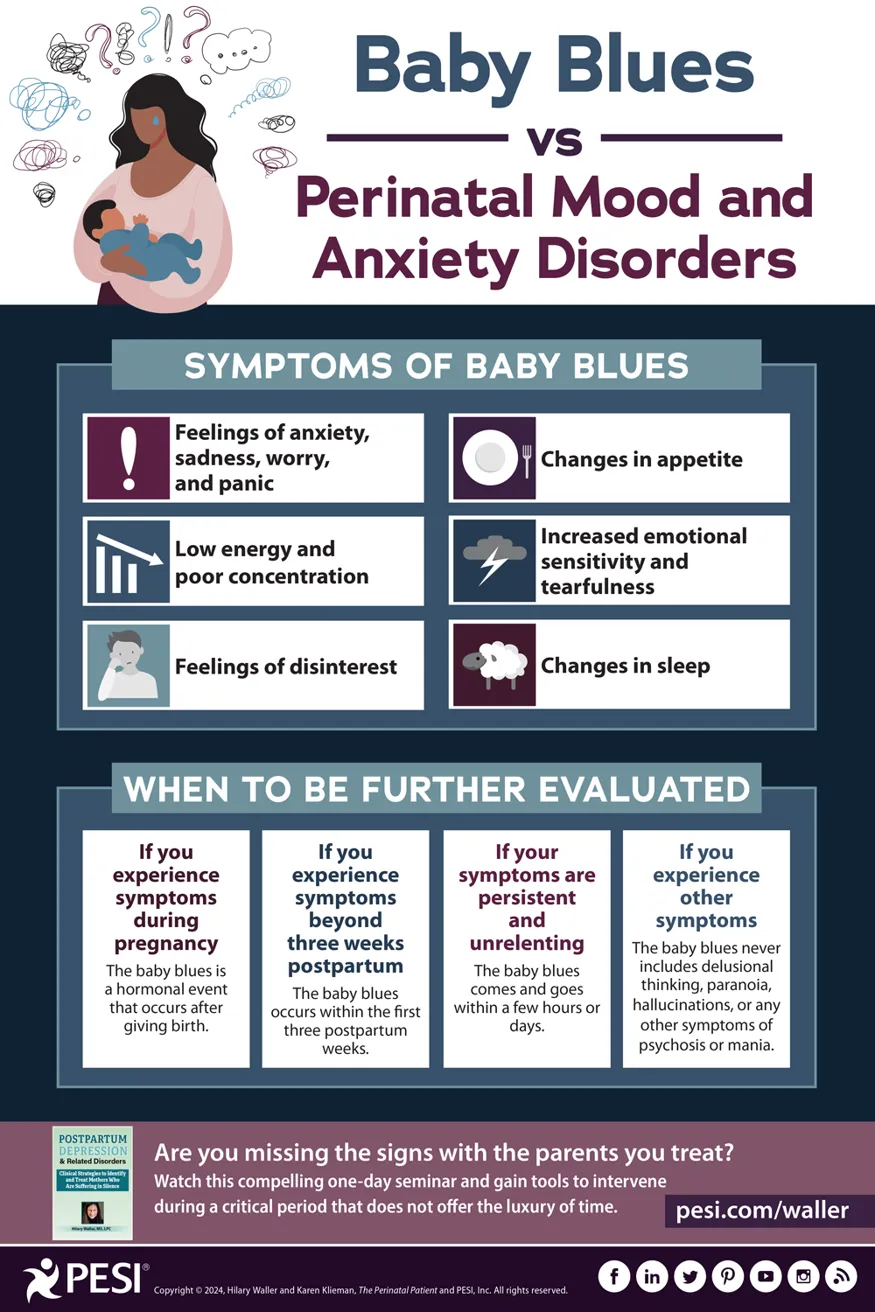
While it is true that the first six weeks are one of enormous change, the newly postpartum stage is just beginning and can make new mothers question their mental state. Still, it can be hard to tell the difference between the baby blues and a perinatal mood and anxiety disorder. Symptoms of the baby blues and postpartum depression and anxiety look and feel the same, but they are different in a few important ways:
  • The baby blues is a hormonal event that occurs after giving birth.
  • The baby blues occurs within the first three postpartum weeks.
  • The baby blues comes and goes within a few hours or days.
  • The baby blues never includes delusional thinking, paranoia, or hallucinations.
Plus, the majority of women who are diagnosed with a perinatal mood and anxiety disorder will experience either a continuation or an onset of symptoms after reaching the six-week milestone.

Download this free infographic straight from The Perinatal Patient to help you and your clients understand the symptoms of baby blue vs a perinatal mood and anxiety disorder and when to be further evaluated.
Digital Seminar:
Postpartum Depression & Related Disorders: Clinical Strategies to Identify and Treat Parents Who Are Suffering in Silence
POS055415
It’s not a topic that comes up at play groups or over coffee. Instead, new parents suffer quietly, engulfed in shame and secrecy, afraid to dispel the ever-present myths about parenthood - “everything is perfect,” “I love being a parent,” and “this is the happiest time of my life.”

Watch this compelling one-day seminar and gain tools to intervene during a critical period that does not offer the luxury of time. Postpartum parents are exceptionally vulnerable, as are their infants who are fully dependent on them. This seminar is a must-attend for any professional working with pregnant or postpartum parents.
The Perinatal Patient
PUB088630
Caught between worrying about how she feels and desperately working to portray the image of a good mother, a perfect mother, a mother who knows what she’s doing, the postpartum woman in distress is more likely to choose silence or minimization over disclosure.

She will allow her suffering – her dark mood, scary intrusive thoughts, intense anxiety, excessive monitoring of the baby, feelings of inadequacy, grief over lost independence, thoughts of harming herself or the baby, and even delusions and hallucinations – to fly under the radar in exchange for a calm and collected exterior. Even if she’s worried about how she feels. Even if she and her baby are in danger.

The Perinatal Patient seeks to change that. Co-written by world-renowned maternal mental health expert Karen Kleiman and her highly accomplished mentee at The Postpartum Stress Center, Hilary Waller, this book offers revolutionary, compassionate guidance into the nuanced assessment and treatment of mental health symptoms postpartum – a critical period that does not offer the luxury of time.

Hilary Waller MS, LPC

Hilary Waller, MS, LPC, is a psychotherapist who specializes in the treatment of perinatal mood and anxiety disorders. She is the director of education and programming at The Postpartum Stress Center outside of Philadelphia, which was founded by renowned perinatal expert Karen Kleiman and was listed in Philly Magazine as a “Center of Excellence” for maternal/fetal care in 2008. In addition to providing direct care services to individuals, couples, and groups at the center, Hilary serves as an instructor with Karen Kleiman, providing a quarterly 12 CE hour postgraduate advanced training for clinicians across the US and abroad who want to specialize in treating the perinatal population. She conducts workshops and trainings for maternal mental healthcare providers as well as non-clinical staff working with the perinatal population. Hilary completed her master’s degree in counseling psychology from Holy Family University in 2013. She is deeply honored to support new patients.


Speaker Disclosures:
Financial: Hilary Waller maintains a private practice and is an adjunct faculty at Gwynedd Mercy University. She receives royalties as a published author. Hilary Waller receives a speaking honorarium, recording, and book royalties from Psychotherapy Networker and PESI, Inc. She has no relevant financial relationships with ineligible organizations.
Non-financial: Hilary Waller is a member of the American Counseling Association, the American Counseling Association, the American Mental Health Counselors Association, the American Society of Reproductive Medicine, and EMDRIA.

Karen Kleiman MSW, LCSW
Karen Kleiman, MSW, LCSW, is a well-known international maternal mental health expert with over thirty-five years of experience. As an advocate and author of several groundbreaking books on postpartum depression and anxiety, her work has been featured worldwide within the mental health community and beyond for decades. In 1988, Karen founded The Postpartum Stress Center, the premier treatment and training facility for prenatal and postpartum depression and anxiety. In 2022, she founded The Karen Kleiman Training Center, LLC, dedicated to the advancement of clinical expertise and therapeutic strategies for the treatment of perinatal mood and anxiety disorders. All advanced trainings are heavily influenced by The Art of Holding Perinatal Women in Distress™ model of intervention she developed in 2017.
Let's Stay in Touch

Get exclusive discounts, new training announcements & more!

You May Also Be Interested In These Related Blog Posts
Woman Depression And Anxiety At Night
5 Brain-Based Cognitive Restructuring Strategies for Anxiety
Discover five brain-based cognitive restructuring strategies therapists can use to help clients reduce anxiety by shifting unhelpful thought patterns using evidence-based, neuroscience-informed tec...
Hc Blog Free Pharmacology CE Realize The Potential Of Rapid Acting Treatments For Depression 1200X628
Free Pharmacology CE: Understanding the Mechanisms Behind Rapid-Acting Antidepressants
Deepen your understanding of how rapid-acting antidepressants are revolutionizing depression care so you can make the right choice for the situation with this FREE CE seminar.
2298 20240918 092039 Bh Blog Perinatal Patient Overcoming Client Resistance
Overcoming Patient Resistance During the Perinatal Period
New mothers often experience a conflict between wanting privacy and needing support, leading to resistance in seeking help. Perinatal experts Hilary Waller, LPC, and Karen Kleiman, MSW, LCSW, share...
2297 20240911 092325 Bh Blog The Hidden Impact Of Core Beliefs On Mental (1)
The Hidden Impact of Core Beliefs on Mental Health
Understanding a client’s core beliefs is essential for deciphering their reactions to life’s triggers. PESI authors Leslie Sokol, PhD, and Marci Fox, PhD, share free worksheets to use with clients...
Woman Depression And Anxiety At Night
5 Brain-Based Cognitive Restructuring Strategies for Anxiety
Discover five brain-based cognitive restructuring strategies therapists can use to help clients reduce anxiety by shifting unhelpful thought patterns using evidence-based, neuroscience-informed tec...
Hc Blog Free Pharmacology CE Realize The Potential Of Rapid Acting Treatments For Depression 1200X628
Free Pharmacology CE: Understanding the Mechanisms Behind Rapid-Acting Antidepressants
Deepen your understanding of how rapid-acting antidepressants are revolutionizing depression care so you can make the right choice for the situation with this FREE CE seminar.
2298 20240918 092039 Bh Blog Perinatal Patient Overcoming Client Resistance
Overcoming Patient Resistance During the Perinatal Period
New mothers often experience a conflict between wanting privacy and needing support, leading to resistance in seeking help. Perinatal experts Hilary Waller, LPC, and Karen Kleiman, MSW, LCSW, share...
2297 20240911 092325 Bh Blog The Hidden Impact Of Core Beliefs On Mental (1)
The Hidden Impact of Core Beliefs on Mental Health
Understanding a client’s core beliefs is essential for deciphering their reactions to life’s triggers. PESI authors Leslie Sokol, PhD, and Marci Fox, PhD, share free worksheets to use with clients...