The Basics of a Good Night’s Sleep for Kids and Teens with ADHD

Kids and teens with ADHD will often struggle with sleep. They tend to be night owls and have trouble settling their minds (and bodies) to drift off into sleep. Unfortunately, tired brains don’t work as well and can make someone’s ADHD look worse. Sleep deprivation can also undo some of the benefit of medication. Here are the basics of a good night’s sleep:

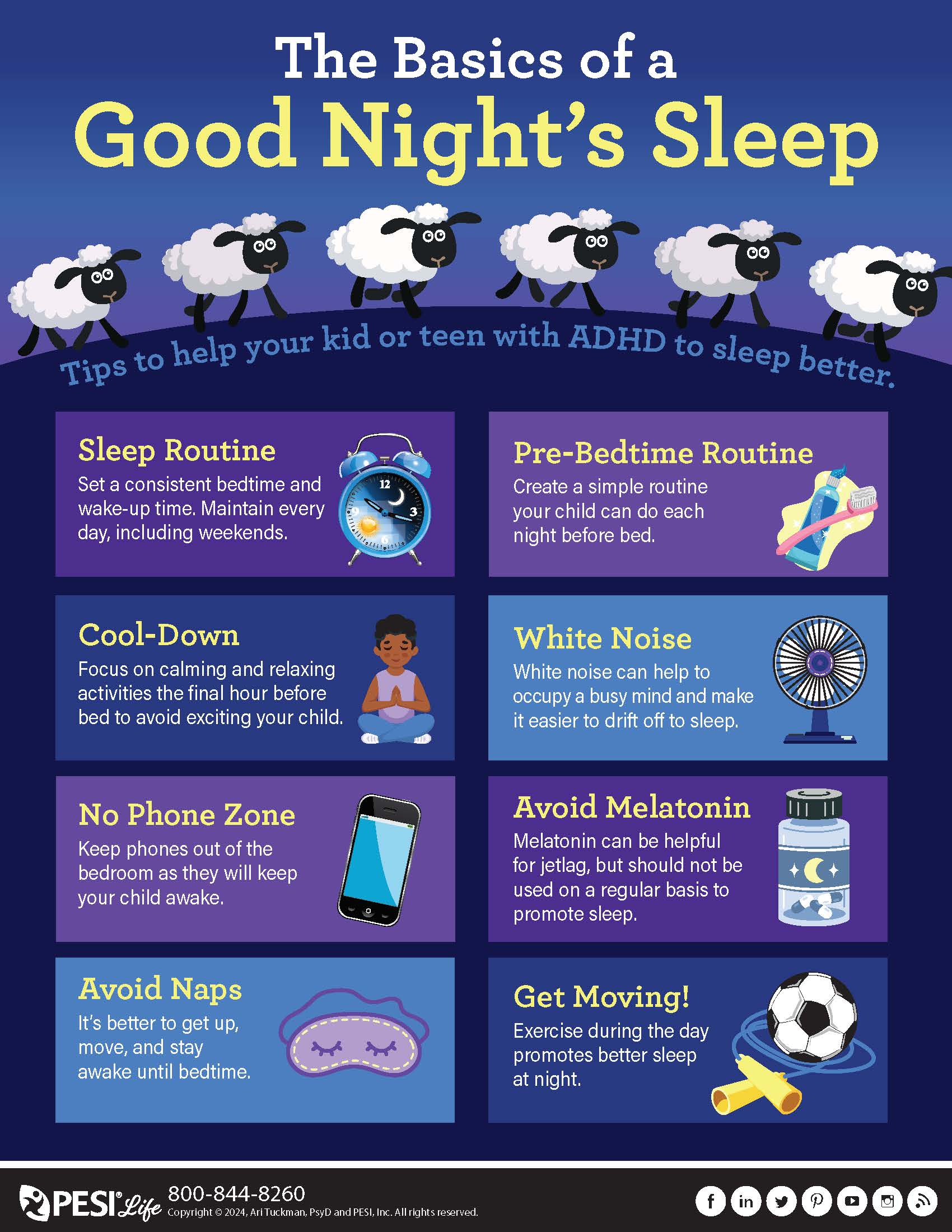
  • Go to bed around the same time each night and wake up around the same time each morning. On weekends, don’t shift it more than an hour or you run the risk of jetlagging yourself which makes for a rough Monday morning.
  • Set a routine for what happens when as your child gets ready for bed. Write out the schedule and tape up a small note in each room with what needs to happen there and when they need to be done by.
  • Minimize exciting activities in the final hour before bed if it revs up your child.
  • Low music, white noise, or other sounds (e.g., crashing waves, crickets, etc.) can help to occupy a busy mind and make it easier to drift off to sleep. So can mindfulness apps that offer a variety of content.
  • Phones should be left out of the bedroom because they are much more interesting than staring at the ceiling and will keep your child awake.
  • Melatonin can be helpful for jetlag but should not be used on a regular basis to promote sleep.
  • Short naps of less than thirty minutes in the first half of the day can be restorative, but longer naps, especially in the afternoon, can make it harder to fall asleep at night. It’s better to get up and move around and stay awake until bedtime.
  • Exercise during the day promotes better sleep at night.

Download this free infographic with Dr. Ari Tuckman's strategies proven to work:


ADHD Training for Parents
ADHD Course
ADHD expert Dr. Ari Tuckman has helped thousands of parents ditch their frustrations and worries of “doing it wrong” by giving them the right tools. Now in bite-sized videos that fit your schedule, he'll share what really works!

Create calm in your home, confidently tackle behavior challenges, and unlock your child's full potential whether your kiddo is barely out of diapers or about to head off to college.
Get advanced strategies to customize treatment for every client
ADHD Course
In this uniquely comprehensive and detailed ADHD certification course you get real-world solutions for women, BIPOC individuals, parents and their kids, clients in complex and dynamic relationships, adults at work, AND MORE!

Learn with our hand-selected panel of world-leading ADHD clinicians and researchers to gain specialized skills for your immediate clinical needs.

Ari Tuckman PsyD, MBA

Ari Tuckman, PsyD, MBA, is a psychologist, international presenter, author, and ADHD expert. He is the author of four books on adult ADHD – one for clinicians and three for the general public. He has also written several book chapters and is a frequent author for ADHD-related publications, including ADDitude Magazine and Attention Magazine.

He is a popular and dynamic presenter who routinely earns excellent reviews for his ability to make complex concepts understandable and useful. He has given more than 650 presentations and podcast interviews for professionals and members of the public, across America and in Sweden, Turkey, Greece, Mexico, England, Spain, Denmark, Canada, and Iceland.

He has appeared on CNN, National Public Radio, and XM Radio and has been quoted in The New York Times, USA Today, The Washington Post, The Boston Globe, USnews.com, The Philadelphia Inquirer, Men’s Health, and many other media outlets. He is a former board member and current conference committee chair for CHADD and is the 2023 recipient of their Hall of Fame award for his significant contributions to the field.

Speaker Disclosures:
Financial: Ari Tuckman maintains a private practice. He receives royalties as a published author. Ari Tuckman receives a speaking honorarium and recording royalties from PESI, Inc. He has no relevant financial relationships with ineligible organizations.
Non-financial: Ari Tuckman is the National Conference Committee co-chair for CHAAD.

Let's Stay in Touch

Get exclusive discounts, new training announcements & more!

You May Also Be Interested In These Related Blog Posts
Group Of Young People Addicted To Social Networks
4 Evidence-Based Clinical Interventions for Problematic Screen Use
Problematic screen use is reshaping childhood, fueling depression, anxiety, and isolation. Get evidence-based clinical strategies to help address digital overuse and support healthier development.
Cardboard Rocket (1)
Building Resilient Beliefs: A Brain-Boosting Practice for Kids
Dr. Kate Truitt offers a practical, brain-based approach to help children build resilient beliefs—empowering them with the mindset tools needed to cope with challenges and thrive.
Blog Header Image GROW Your Mind With Intention
G.R.O.W. Your Mind with Intention: A Resilience Practice for Kids
Get practical strategies from Dr. Kate Truitt to help children develop resilience by fostering intentional thinking and emotional regulation skills.
Pbh Blog Dodge The Worry Debate Header
Dodge the Worry Debate: A Guide for Therapists Working with Anxious Kids
Get practical strategies to support children struggling with anxiety by reframing unhelpful “worry debates.”
Group Of Young People Addicted To Social Networks
4 Evidence-Based Clinical Interventions for Problematic Screen Use
Problematic screen use is reshaping childhood, fueling depression, anxiety, and isolation. Get evidence-based clinical strategies to help address digital overuse and support healthier development.
Cardboard Rocket (1)
Building Resilient Beliefs: A Brain-Boosting Practice for Kids
Dr. Kate Truitt offers a practical, brain-based approach to help children build resilient beliefs—empowering them with the mindset tools needed to cope with challenges and thrive.
Blog Header Image GROW Your Mind With Intention
G.R.O.W. Your Mind with Intention: A Resilience Practice for Kids
Get practical strategies from Dr. Kate Truitt to help children develop resilience by fostering intentional thinking and emotional regulation skills.
Pbh Blog Dodge The Worry Debate Header
Dodge the Worry Debate: A Guide for Therapists Working with Anxious Kids
Get practical strategies to support children struggling with anxiety by reframing unhelpful “worry debates.”