Managing Extreme Emotional Reactions
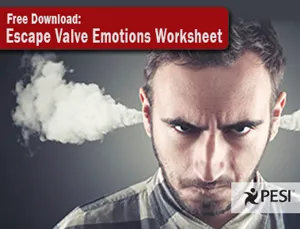

1028 20160921 020552 Escape Valve Emotions Worksheet
Working with individuals with personality disorders and other emotional/impulse control disorders often leads mental health professionals to find ways to help their clients manage extreme emotional reactions. These reactions are often fueled by underlying emotions that are difficult to deal with. The emotional reaction that is expressed is what we will call the “escape valve emotion." 

Let's explore a scenario where the escape valve emotion is anger.

Anger is an easy emotion to express and is often a surface reaction to a more central or core emotion. 

For example, Jessica meets criteria for Borderline Personality Disorder. Jessica has been asked to a friend’s birthday party, but she is not feeling up to it as she is prone to sadness and loneliness, which is how she is feeling on the day of the party. Her friend calls her and asks her to come, saying it would mean a lot to her, and “everyone will be there.” Jessica feels shame and guilt about feeling sad and lonely and not feeling up to going. Instead of talking directly to her friend, she ignores the first few texts and voicemail messages, but reads each one. This further exacerbates her dissonant and unacceptable emotions (in her view) of shame, guilt, sadness, and loneliness. The phone rings one more time, Jessica picks it up, and reacts in an angry and verbally hostile manner to her friend, “Who do you think you are? You’re always doing this to me! You expect me to entertain everyone and go to your fu--in party. I am tired of you and tired of your fake a-s friends” and hangs up the phone.

What Jessica has done is what a lot of individuals do when they encounter unacceptable/dissonant emotions along the borderline personality spectrum or other emotional/impulse control disorder spectrum. Instead of managing these emotions, they let them build up and fester and eventually come to the point that a pressure valve must be released, and often that pressure valve emotion is anger; a much easier emotion to express and it allows the pressure to escape, so it is self-reinforcing.

The Escape Valve Emotions Worksheet is designed to help your client(s) identify those unacceptable/dissonant emotions that build inside until they release their pressure valve (more acceptable/suitable) emotion, like Jessica in our example. This worksheet can be given to your client(s) to complete on their own or in session. The purpose is to increase awareness into the driving emotions of maladaptive reactions your client(s) are experiencing, or to the individual in a relationship with a reactive individual. Increasing awareness of underlying issues increases the probability of mastering reactions and self-control.


Online Course: Personality Disorders

Daniel J. Fox, Ph.D., has been treating and specializing in the treatment and assessment of individuals with personality disorders for the last 14 years in the state and federal prison system, universities, and in private practice. Learn more by visiting his website.

Daniel J. Fox Ph.D.

Daniel J. Fox, PhD, is a licensed psychologist in Texas, international speaker, and multiple-award winning author. He has been specializing in the treatment and assessment of individuals with personality disorders for over 20 years in the state and federal prison system, universities, and in private practice. His specialty areas include personality disorders, ethics, burnout prevention, and emotional intelligence. He has published several articles and books in these areas and is the author of the award-winning Narcissistic Personality Disorder Toolbox, The Clinician's Guide to Diagnosis and Treatment of Personality Disorders, the award-winning Antisocial, Borderline, Narcissistic and Histrionic Workbook: Treatment strategies for Cluster B Personality Disorders, The Borderline Personality Disorder Workbook, and Complex Borderline Personality Disorder.

Dr. Fox has been teaching and supervising students for over 20 years at various universities across the United States, some of which include West Virginia University, Texas A&M University, University of Houston, Sam Houston State University, and Florida State University. He works in the federal prison system, is an adjunct assistant professor at the University of Houston and maintains a private practice that specializes in the assessment and treatment of individuals with complex psychopathology and personality disorders. Dr. Fox has given numerous workshops and seminars on ethics and personality disorders, personality disorders and crime, treatment solutions for working with clients along the antisocial, borderline, narcissistic, and histrionic personality spectrum, emotional intelligence, managing mental health within the prison system, and others. Dr. Fox maintains a website of various treatment interventions focused on working with and attenuating the symptomatology related to individuals along with the antisocial, borderline, narcissistic, and histrionic personality spectrum (www.drdfox.com).


Speaker Disclosures:
Financial: Dr. Daniel Fox maintains a private practice and has an employment relationship with the University of Houston. He receives royalties as a published author. Dr. Daniel Fox receives a speaking honorarium, recording and book royalties from PESI, Inc. He has no relevant financial relationships with ineligible organizations.
Non-financial: Dr. Daniel Fox is an Editor/Reviewer with Prentice Hall and Worth Publishers.
Let's Stay in Touch

Get exclusive discounts, new training announcements & more!

You May Also Be Interested In These Related Blog Posts
Woman Depression And Anxiety At Night
5 Brain-Based Cognitive Restructuring Strategies for Anxiety
Discover five brain-based cognitive restructuring strategies therapists can use to help clients reduce anxiety by shifting unhelpful thought patterns using evidence-based, neuroscience-informed tec...
Hc Blog Free Pharmacology CE Realize The Potential Of Rapid Acting Treatments For Depression 1200X628
Free Pharmacology CE: Understanding the Mechanisms Behind Rapid-Acting Antidepressants
Deepen your understanding of how rapid-acting antidepressants are revolutionizing depression care so you can make the right choice for the situation with this FREE CE seminar.
2298 20240918 092039 Bh Blog Perinatal Patient Overcoming Client Resistance
Overcoming Patient Resistance During the Perinatal Period
New mothers often experience a conflict between wanting privacy and needing support, leading to resistance in seeking help. Perinatal experts Hilary Waller, LPC, and Karen Kleiman, MSW, LCSW, share...
2297 20240911 092325 Bh Blog The Hidden Impact Of Core Beliefs On Mental (1)
The Hidden Impact of Core Beliefs on Mental Health
Understanding a client’s core beliefs is essential for deciphering their reactions to life’s triggers. PESI authors Leslie Sokol, PhD, and Marci Fox, PhD, share free worksheets to use with clients...
Woman Depression And Anxiety At Night
5 Brain-Based Cognitive Restructuring Strategies for Anxiety
Discover five brain-based cognitive restructuring strategies therapists can use to help clients reduce anxiety by shifting unhelpful thought patterns using evidence-based, neuroscience-informed tec...
Hc Blog Free Pharmacology CE Realize The Potential Of Rapid Acting Treatments For Depression 1200X628
Free Pharmacology CE: Understanding the Mechanisms Behind Rapid-Acting Antidepressants
Deepen your understanding of how rapid-acting antidepressants are revolutionizing depression care so you can make the right choice for the situation with this FREE CE seminar.
2298 20240918 092039 Bh Blog Perinatal Patient Overcoming Client Resistance
Overcoming Patient Resistance During the Perinatal Period
New mothers often experience a conflict between wanting privacy and needing support, leading to resistance in seeking help. Perinatal experts Hilary Waller, LPC, and Karen Kleiman, MSW, LCSW, share...
2297 20240911 092325 Bh Blog The Hidden Impact Of Core Beliefs On Mental (1)
The Hidden Impact of Core Beliefs on Mental Health
Understanding a client’s core beliefs is essential for deciphering their reactions to life’s triggers. PESI authors Leslie Sokol, PhD, and Marci Fox, PhD, share free worksheets to use with clients...