How to Integrate Somatic Techniques into Your Existing Practice

Somatic psychotherapy techniques can be seamlessly woven into the therapy you’re already practicing. For clinicians with a mindfulness-based orientation, the transition to incorporating somatic tools is especially smooth, as both approaches emphasize awareness and presence.
The key is to involve clients in the process. Rather than prescribing techniques, frame them as collaborative experiments. Simple invitations such as “Would you like to try an experiment?” or “How about we try this exercise?” not only show respect but also help establish a mindset of curiosity and openness. In this way, somatic interventions become opportunities for clients to discover what resonates, what can be adjusted, and what truly supports their growth.
This experimental frame empowers clients by fostering both self-advocacy and self-awareness. It also ensures they feel safe, informed, and engaged. Always explain what an exercise involves before beginning, and follow up afterward to process the results together. When clients participate actively rather than being directed, they are more likely to integrate the insights and changes into their lives.
Collaboration is central. Encourage clients to adapt practices to fit their needs and preferences. Like a good scientist, track the starting point, suggest the experiment, and then explore what shifted. Most somatic techniques aim to heighten self-awareness and invite the client to recognize what they can do differently. Sustainable, long-term change often arises when clients discover these insights themselves.
A Simple Framework for Introducing Somatic Techniques in Sessions
- Suggest the exercise in clear, simple language.
- Gain the client’s buy-in by asking for permission to try something new.
- Guide them through the practice, offering safety and flexibility.
- Summarize the outcome by reflecting on what they noticed or experienced.
Sample Invitations You Can Use with Clients to Use Somatic Techniques
- “Would you like to try this exercise?”
- “How about we try this practice?”
- “Let’s find out if we can help you do _____ with this next experience.”
- “Are you interested in trying the following exploration?”
By integrating somatic techniques in this collaborative, experimental way, clinicians can support clients in reconnecting with their bodies, cultivating deeper self-awareness, and discovering change that feels both authentic and lasting.
Adapted from Somatic Psychotherapy Toolbox. Copyright © 2018 Manuela Mischke-Reeds, Somatic Psychotherapy Toolbox. All rights reserved.
Want practical tools you can start using right away? Download these free somatic worksheets to support your clients’ healing.
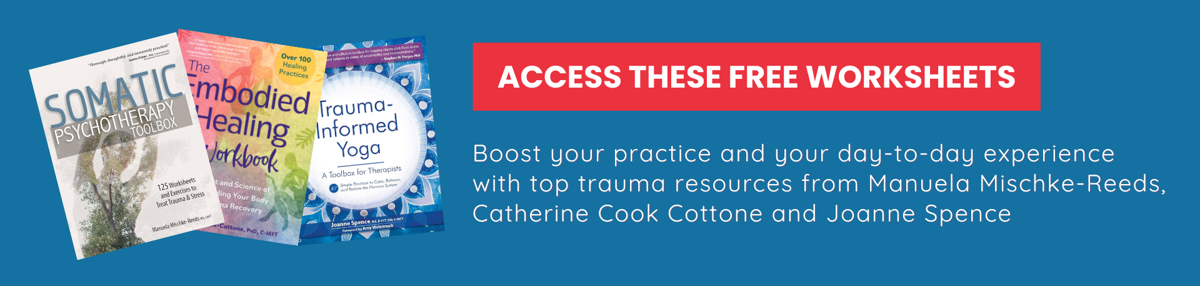
Manuela Mischke-Reeds has created the go-to resource for mental health therapists who want to incorporate somatic techniques into their daily practice.

Designed with both mental health clinicians and clients in mind, Trauma-Informed Yoga offers 47 short, simple practices that regulate the autonomic nervous system, calm the racing mind, and center those of us living chaotic 21st century lives.
In this workbook, renowned trauma therapist Catherine Cook-Cottone provides a step-by-step, sequential process for embodied healing that will teach you to work through your trauma, reconnect to your body, and begin thinking about what is next in your embodied path forward.

Manuela Mischke-Reeds, MA, MFT, is a somatic trauma psychotherapist, author, international teacher of somatic psychology, and senior Hakomi trainer. She is the founder of Embodywise, an international learning community offering professional training in trauma therapy, somatic psychology, and the Hakomi Method, and is a co-founder of the Hakomi Institute of California.
She is the developer of the Innate Somatic Intelligence Trauma Therapy Approach (ISITTA), an integrative somatic psychotherapy framework that supports trauma recovery through nervous system regulation, embodied awareness, movement-based integration, and relational therapeutic processes.
With over 30 years of clinical experience, Manuela has taught professional training programs internationally across North America, Europe, Asia, and Australia. In the field of psychedelic therapy, she offers specialized somatic approaches, including somatic therapy techniques, movement-based integration, and ethical touch practices, to support psychedelic-assisted psychotherapy through a trauma-informed, relational lens.
She is the author of several books, including Embodied Psychedelic Therapy: A Somatic Guide (W. W. Norton, with Joshua Sylvae), Somatic Psychotherapy Toolbox (PESI), Trauma-Sensitive Movement (PESI), and 8 Keys to Practicing Mindfulness (W. W. Norton).
She is also a contributing author to Hakomi Mindfulness-Centered Somatic Psychotherapy: A Comprehensive Guide to Theory and Practice (W. W. Norton), The Complete Trauma Treatment Guide (PESI), and The Praeger Handbook of Community Mental Health Practice (Praeger), for which she authored the chapter "The Role of Trauma in Community Health: A Somatic Perspective."
Speaker Disclosures:
Financial: Manuela Mischke-Reeds is the founder of Embodywise and has an employment relationship with Embodylab. She receives compensation as a consultant and royalties as a published author. She receives a speaking honorarium, recording, and book royalties from PESI, Inc. She has no relevant financial relationships with ineligible organizations.
Non-financial: Manuel Mischke-Reeds has no relevant non-financial relationships.


