Highly Sensitive People & Gaslighting


And then there are some clients who fall into another category of sensitivity altogether, known as the highly sensitive person (HSP). Researcher Elaine Aron (1998), who coined the term, defines an HSP as someone who has heightened awareness and responsiveness to sensory stimuli. Thought to make up 15 to 20 percent of the population, HSPs are not necessarily emotionally reactive, but they do tend to feel things very deeply and pick up on emotional energy to a much greater degree. Their threshold for noticing tangible and intangible stimulation is much lower than the average person, meaning they can intuitively notice the unspoken worries, moods, and needs in others. For the HSP growing up in a narcissistic family, there is quite a lot to feel.
This increased ability to sense emotional energy can have several benefits. The HSP can more accurately anticipate the narcissist’s moods, which allows them to sometimes avoid being the target of anger or manipulation. HSPs are also natural chameleons, adapting to the needs of those around them as fits the situation. These traits can endear the HSP to their narcissistic parent.
However, there are also drawbacks to being highly sensitive. Some HSPs find it overwhelming to constantly be aware of others’ moods. They may feel compelled to solve others’ problems, even when they are too depleted to meet their own needs. HSPs may also overidentify with their narcissistic loved one because they recognize the other person’s pain and feel guilty if they don’t try to fix it. In addition, their ability to accurately read the subtext of the unspoken can make them more susceptible to manipulation, gaslighting, and people-pleasing.
When working with highly sensitive clients, it is very important to help them differentiate between compassion and emotional caretaking. Compassion involves having care and concern for someone else’s pain without feeling compelled to resolve it. Emotional caretaking involves the expectation that being aware of another’s pain obligates one to fix it. Many adult children of narcissists conflate these concepts and struggle with guilt or shame if they do not follow their usual pattern of trying to manage another’s emotions. In fact, HSPs sometimes self-identify as empaths and need extra support in developing emotional boundaries.
While some clinicians are skeptical of the concept of heightened sensitivity, we encourage you to consider the expert on their own experience. Anecdotally, we have observed a high rate of crossover between adult children of narcissists and those who strongly identify with being an HSP.
Clients and therapists alike sometimes find it hard to identify gaslighting when it happens, which makes sense, as the point of gaslighting someone is to create confusion and self-doubt. It can be particularly challenging to differentiate between gaslighting and genuinely different experiences of an event, as any two people may perceive the same incident very differently. In our new book, we’ve created the Gaslighting Decision Tree to help you clarify whether a client is experiencing gaslighting or a simple variance between how two or more people perceive something. Download the PDF of this worksheet here.
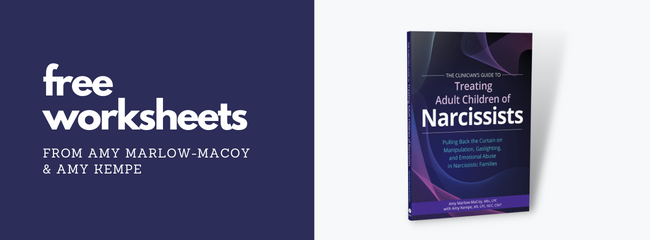
This blog is an excerpt from The Clinician’s Guide to Treating Adult Children of Narcissists. Learn more about the book here!

Adult children of narcissists have been conditioned to downplay, dismiss, and ignore their experiences. This survival skill of staying below the radar can cause even very skilled clinicians to miss subtle opportunities to connect. As a clinician, it is paramount that you understand the scope of what these clients have endured so you can avoid inadvertently repeating the cycle of invalidation.
Drawing from decades of specialized clinical practice and illustrated with rich client stories, this essential guide provides a thorough walk-through of the assessment and treatment of narcissistic abuse.

Amy Kempe, LPC, NCC, CSAT, is the owner and founder of a private practice specializing in narcissistic abuse recovery and complex post-traumatic stress disorder. She is also a certified sex addiction therapist and works with individuals and couples suffering from out-of-control sexual behaviors. Amy has a wealth of experience supporting adult children of narcissists in healing and recovering from their abusive relationships. She earned her master's degree from Villanova University and is trained in Internal Family Systems, Brainspotting, and EMDR.
Speaker Disclosures:
Financial: Amy Kempe is the owner of CLIMB Health & Wellness and Authentic Life Therapy. She receives royalties as a published author. Amy Kempe receives a speaking honorarium, recording, and book royalties from PESI, Inc. She has no relevant financial relationships with ineligible organizations.
Non-financial: Amy Kempe has no relevant non-financial relationships.

Amy Marlow-MaCoy, LPC, focuses her practice on treating complex and developmental trauma in adults raised in narcissistic, emotionally immature, and toxic families of origin.
She is the author of the Amazon best-selling book The Gaslighting Recovery Workbook: Healing from Emotional Abuse (Callisto Media, 2020), a workbook designed to help individuals identify, understand, and begin to heal from emotional trauma and abuse caused by gaslighting in interpersonal relationships.
Amy has been trained in Level 1 Internal Family Systems therapy. She also provides supervision to LPC candidates and regularly consults with other clinicians regarding treatment of adult children of narcissists. She earned her Mast of Education in counseling psychology degree from Temple University.
Speaker Disclosures:
Financial: Amy Marlow-MaCoy maintains a private practice. She receives royalties as a published author and receives a speaking honorarium and recording royalties from PESI, Inc. She has no relevant financial relationships with ineligible organizations.
Non-financial: Amy Marlow-MaCoy is a member of the American Counseling Association.


