Enhancing Self-Regulation Through Play Therapy


However, children who didn’t get these repetitions of co-regulation due to neglect, maltreatment, or a multitude of other adverse childhood experiences never learn the ability to self-soothe, even in their later years. For example, a ten-year-old child who can get a perfect score on a math test when her neocortex is in charge may throw massive tantrums at home when she is stressed, making her present more like a two-year-old in terms of social-emotional development.
Children with neurodivergent development may also have a hair-trigger amygdala alarm that kicks them out of their window of tolerance much more quickly than their peers. This lack of self-regulation sets them up for negative interactions with their classmates and caregivers that can ultimately damage their self-esteem.
Many children with big behaviors need help learning how to regulate themselves more quickly or more effectively. To do so, we want them to take advantage of all sorts of sensory-soothing experiences while also learning how to pay attention to their sense of interoception, or what their bodies are telling them. We frequently check in with clients about how hot or cold they are feeling, and we invite clients to use their words to ask for what they need.
An important concept within the TraumaPlay model is that we are not working simply to calm the client, but to teach them to calm themselves. We help them to recognize more deeply when they are moving out of their optimal arousal zone and to determine the strategies that work best to help them return to this zone (i.e., to downregulate when they are in a state of hyperarousal or to upregulate when they are in a state of hypoarousal).
The following intervention can be particularly helpful for children who struggle to close their eyes and relax due to the fear of impending danger.
Download a free copy of the Still-the-Struggle Sock exercise from my new book: Big Behaviors in Small Containers: 131 Trauma-Informed Play Therapy Interventions for Disorders of Dysregulation.
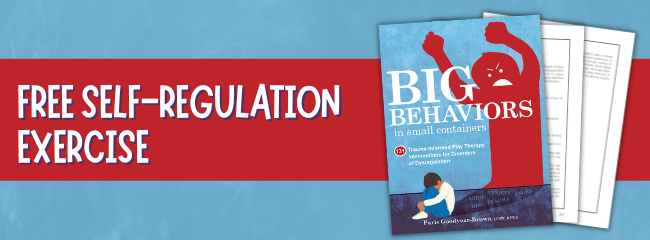

From tantrums and defiance to self-injury and withdrawal, even the most skilled professionals find themselves focused on extinguishing the troubling behavior rather than stepping back to ask: What is the underlying emotional need?
In Big Behaviors in Small Containers, you’ll find 131 practical, fun, and ready-to-use play therapy interventions that shift the paradigm around problematic behaviors to allow for therapeutic growth and healing. Based on TraumaPlay®, a treatment approach that prioritizes attachment, co-regulation, and the science of the stress response system, the interventions inside will help kids:
- Develop a sense of safety and security
- Expand their window of tolerance
- Cope adaptively with anger, anxiety, and other strong emotions
- Enhance their emotional literacy
- Strengthen social skills and self-esteem
- Challenge and overcome unhelpful thoughts
- Develop a coherent narrative around trauma and other difficult experiences
- And more!
Whether you’re a therapist, teacher, doctor, caregiver, or trusted grown-up in a child’s life, the tools inside will allow you to become the co-regulating, nurturing, and consistent presence that your “small container” needs to remain grounded in the face of stress, big feelings, and difficult situations.

Paris Goodyear-Brown, MSSW, LCSW, RPT-S™ and approved EMDR consultant, is the creator of TraumaPlay™, the executive director of the TraumaPlay Institute, the clinical director of Nurture House, and an adjunct instructor of psychiatric mental health at Vanderbilt University. She is a Ted Talk speaker, a master clinician, a thought leader in the fields of child trauma and play therapy globally, has received the APT award for Play Therapy Promotion and Education, and served as the executive director of the Lipscomb Play Therapy and Expressive Arts Center. She is on the board of TNAPT and has written over twenty chapters and articles as well as twelve books, including Trauma and Play Therapy, Parents as Partners in Child Therapy, Big Behaviors in Small Containers, and her newest edited volume Polyvagal Power in the Playroom. Paris delights in serving traumatized children and families locally, loves to travel with her family, and finds great joy in equipping child trauma therapists all over the world.
Speaker Disclosures:
Financial: Paris Goodyear-Brown maintains a private practice and has employment relationships with TraumaPlay Institute, Vanderbilt University, and Nurture House. She receives royalties as a published author and compensation as a consultant. Paris Goodyear-Brown receives a speaking honorarium and recording royalties from PESI, Inc. She has no relevant financial relationships with ineligible organizations.
Non-financial: Paris Goodyear-Brown is a member of the Association for Play Therapy and the National Association of Social Workers.


