Ask a Therapist: Parenting through the Chaos of Today’s World


-Perturbed Parent
Things are hard right now. Hard is an interesting word because it holds different meaning for different people. Here’s the thing about that: We don’t need to make comparisons. We can hold space for one another without trying to determine the hardest version of hard.
Does that make sense? A lot of young people tell me when they speak up and share their stuff, people say things like, “it could be worse” or, “at least you don’t have to deal with…” This can actually trigger feelings of guilt and shame, which adds to emotional overload.
Another common response is to name tools and strategies to cope with the feeling right away. It’s great to have a toolbox to cope with big feelings, but processing emotions takes time.
We have to learn to slow down our responses to give young people time to sit with their emotions. It’s okay to just be, to allow ourselves to feel.
We are socialized to look for solutions to problems, but this mindset can push us to sweep away our feelings before we’ve fully processed them. This can actually lead to poor coping patterns—if we’re always looking for the right strategy, we might miss important thoughts that occur during the processing phase.
Teens often tell me that they keep things private because they need time to think before someone tells them how to move forward. That’s important information. In this fast-paced, instant-gratification world we’re living in, we all need to remember how to take time to think.
Anyway, slow down. Sit together and just be. Show support by just being present.
You don’t have to have all the answers. You don’t even have to have any answers.
Sometimes just being there, or being on the other end of the line, is the best thing you can do to help another human process hard things.
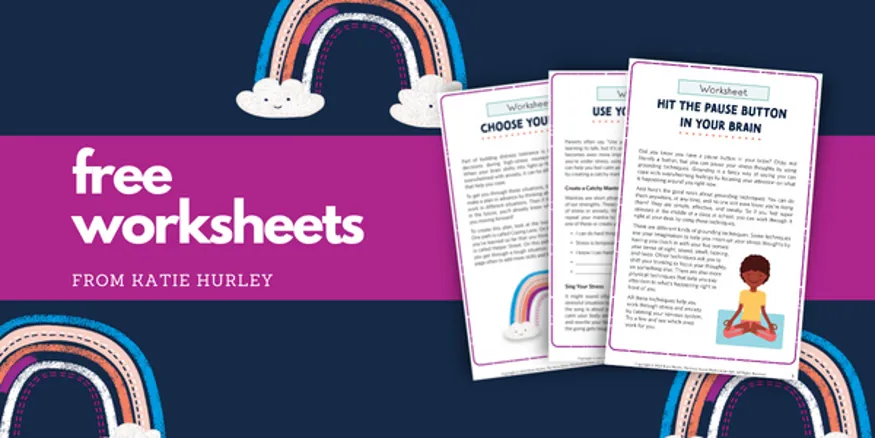
Mutual empathy occurs when we slow down and endure together. We can do this. I believe in us. Last year I released The Stress-Buster Workbook for Kids, which is filled with strategies to help kids regulate emotions, build coping skills, and tap into positive thinking. You can download a selection of worksheets here that can be used with the kids and teens in your life.
Thanks for reading.
-Katie Hurley, LCSW

Designed to offer a myriad of stress-busting solutions – as every kid is different and needs different tools that work for them – this book is an ideal resource for parents, teachers, therapists, and any other professional working with kids ages 4-11. Being a kid isn’t always easy, but with these tried-and-true strategies, they’ll learn how to conquer their biggest obstacles and realize that they can do hard things.

Katie Hurley, DSW, LCSW, is a child and adolescent psychotherapist, parenting educator, public speaker, and writer. She is the founder of “Girls Can!” empowerment groups for girls between ages 5-11.
Dr. Hurley is the senior clinical advisor of The Jed Foundation (JED), a nonprofit dedicated to youth and young adult mental health and suicide prevention.
Dr. Hurley is the author of the award-winning No More Mean Girls: The Secret to Raising Strong, Confident, and Compassionate Girls, The Depression Workbook for Teens: Tools to Improve Your Mood, Build Self-Esteem, and Stay Motivated, and The Happy Kid Handbook: How to Raise Joyful Children in a Stressful World.
Dr. Hurley covers mental health, child and adolescent development, and parenting for The Washington Post, PBS Parents, CNN and NBC, among other places.
Dr. Hurley practices psychotherapy in the South Bay area of Los Angeles and earned her BA in psychology and women’s studies from Boston College, her MSW from the University of Pennsylvania, and her Doctor of Social Work from Simmons University. She splits her time between Los Angeles, California and coastal Connecticut with her husband and two children.
Speaker Disclosures:
Financial: Dr. Katie Hurley maintains a private practice and receives compensation as a consultant, public speaker, and journalist. She receives royalties as a published author. Dr. Hurley receives a speaking honorarium and book royalties from PESI, Inc. She has no relevant financial relationships with ineligible organizations.
Non-financial: Dr. Katie Hurley has no relevant non-financial relationships.


