5 Tips for Telehealth with Kids


What can you do to keep your clients engaged in telehealth sessions? The following five tips are essential to boosting your practice in a world of online therapy.
1. Be Honest About the Experience
- Although telehealth sessions will follow the same general outline and as any “normal” in-person session, the change will be an adjustment for the therapist and the client.
Make a point to reassure your clients that you are there for them and that they can still have sessions, but tell them honestly that you will be “learning together” as you transition to telehealth. Be realistic about challenges you might face and open with your own emotions about the situation.
Because of your own transparency, clients will feel more comfortable sharing their questions and concerns with you, and you can use the opportunity to model communication and regulation skills.
2.Be Flexible With Your Interventions
- If you use a non-directive therapeutic approach, you are used to giving your young clients some level of control over their sessions. This helps clients engage because they have a say in the activities.
Ask children what they want their session to look like, what they wish they could do in therapy, or which games or activities they enjoy. Then, see how you can incorporate that into your sessions. You may find brand new activities that you can share across clients!
As a child therapist, your goal should not be to force a specific intervention, but to make whatever happens organically in the session therapeutic. You can pull treatment goals into a myriad of games and activities.
3.Get Creative
- Creativity is one of the most important aspects of child therapy, as every young client learns, develops, and copes differently. At first, telehealth sessions can feel limiting because you and your clients are not sharing physical space, but if you think about it, the Internet actually expands your options!
What kinds of activities does your client enjoy doing on their tablet, phone, or laptop? How can you make those activities therapeutic? What skills does the child need to play those games, and how can those skills tie into their treatment goals?
Do not be afraid to try something new in a session or experiment with interventions you have not tried before. The possibilities in a telehealth session are endless!
4.Make Technical Issues Therapeutic
- Technical issues can be the most frustrating part of telehealth sessions. Dropped calls, audio or video problems, and low bandwidth interfere with our sessions at any time and are incredibly annoying for you and your clients.
However, technical issues offer yet another opportunity for intervention! When faced with an issue, a client must engage in problem-solving during their session. In real time, the client might have to ask an adult for help, try different things to find a solution, or cope with feelings of frustration, annoyance, or anger.
When technical difficulties arise in a session, you can see it as an intervention and pull for these skills, making the moment therapeutic. You also get to show your clients that you are going to stick with them and work through challenges together.
5.Have an Arsenal of Interventions
- Although your clients can provide great ideas for their sessions, it is your job as therapist to guide them and to introduce things that will help them move toward their treatment goals.
Even when children are unsure about what they want to do in session, they can be picky about the activities you suggest. When a child lets you choose a game, give them a couple of options rather than simply picking something. It is helpful to have several activities on deck to suggest if a child does not take to your first idea or needs to practice a specific skill.
I use keywords and therapy skills to label my various telehealth interventions. This helps me decide which choices are the best fit for the client and streamlines writing my notes.
Having your sessions online doesn’t have to upend your entire process when working with young clients. Although telehealth adds challenges to therapy with kids, it also creates opportunities for innovation, flexibility, and connecting with your clients. After transitioning your clients online and adding some new interventions to your repertoire, you can reinvent your therapy process—wherever it may be!
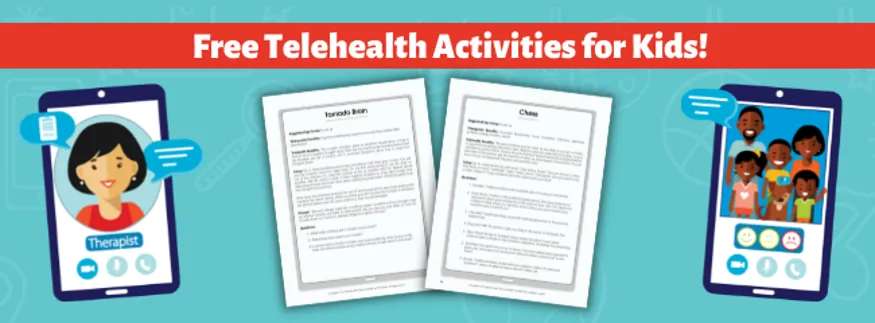
Check out two of my favorite telemental health interventions here – completely free!
Want more kid-friendly resources? Discover new strategies to keep children and teens engaged in online. Check out Zoom Fatigue, It's Real

As clinicians increasingly make the switch to remote therapy, the need for kid-friendly telehealth interventions has become more crucial than ever. In Telemental Health with Kids Toolbox, Dr. Amy Marschall has created an arsenal of flexible, creative, and fun virtual interventions that will allow you to provide effective, evidence-based treatment while still capturing the attention of even the youngest of clients. Inside you’ll find over 100 ready-to-use telehealth games, exercises, and activities that offer the same therapeutic benefits as your in-person sessions. Each intervention includes suggested age ranges and step-by-step instructions, equipping you with the tools you need to effectively (and confidently!) provide treatment through a screen. You’ll also receive guidance on how to create your own kid-friendly, virtual intervention that are unique to your practice!

Amy Marschall, PsyD, is a licensed clinical psychologist in South Dakota, working primarily with children and adolescents. She is trained in trauma-informed care as well as cognitive behavioral therapy, and in 2017 became certified in trauma-focused cognitive behavioral therapy. In her clinical practice, Dr. Marschall works with survivors of abuse, families in the foster care system, children with incarcerated parents, clients dealing with high-conflict divorce or separation, and those growing up with other chronic stressors and traumas.
Dr. Marschall was diagnosed in adulthood as AuDHD (Autistic and ADHD), which informs her deeply empathetic and lived understanding of neurodivergence.
She is also the author of three professional resources: A Clinician’s Guide to Supporting Autistic Clients, Telemental Health with Kids Toolbox, and Telemental Health with Kids Toolbox, Volume 2. These publications reflect her commitment to providing accessible, neurodiversity-affirming, and trauma-informed tools for clinicians working with children and adolescents in both in-person and virtual settings.
Speaker Disclosures:
Financial: Amy Marschall is the founder of Resiliency Mental Health and has employment relationships with RMH Therapy, ADHD Online, Prosper Health, AuDHD Therapists, A Change for Better, A Change for Better Fund, Grayce, and DotDash Meridith. She receives royalties as a published author. Amy Marschall receives a speaking honorarium, recording, and book royalties from PESI, Inc. She has no relevant financial relationships with ineligible organizations.
Non-financial: Amy Marschall is a blogger with Resiliency Mental Health, Psychology Today, DotDash Meridith, and Everyday Health.


