3 Tips to Improve Social Anxiety in Young Children
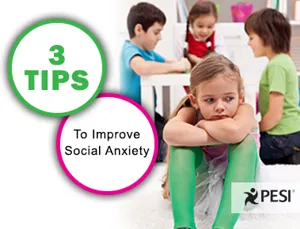
My child appears to be afraid of meeting new friends, going to dance class and even playing with new kids at the park. Why is that so, and how can I help?
Children with social anxiety are uncomfortable exploring new things. Rather than becoming excited by novel opportunities, new places, people and activities, they are more likely to be scared, agitated or withdrawn.
Here are three steps to helping your anxious child.
1. Help your anxious child by previewing what is expected in a new situation. Discuss who will be there, what you will be doing, whether or not you will be at the event with your child and what will happen when the event is completed.
- "We'll be going to Sam's house."
- "His mom, dad and brothers will be there."
- "We'll have a bar-b-que and play with toys."
- "When you get to the dance class, you will go in with Miss Clara, and Mommy will watch through
the window." - "I will stay there the entire time."
- "You'll be able to see me."
Using your child’s “thinker,” the part of the brain used for decision making and problem solving, will help calm anxiety.
Download the handout: Helping Anxious Children
Lynne Kenney, PsyD, is a mom, pediatric psychologist, international educator and co-author with Wendy Young of BLOOM: 50 Things to Say, Think and Do with Anxious, Angry and Over-the-Top Kids. Lynne integrates neuroscience, nutrition, exercise and music research to enhance brain function and learning in children. For more “Think it Out” “Walk it Out” and “Play it Out” ideas visit www.lynnekenney.com.
Dr. Lynne Kenney is the nation’s leading pediatric psychologist in the development of classroom cognitive-physical activity programs for students grades K-8. She develops curriculum, programming, and activities to improve children’s cognition through coordinative cognitive-motor movement, executive function skill building strategies, and social-emotional learning. Her current educational program is CogniMoves®, a classroom cognitive-motor movement program, co-developed with Benjamin S. Bunney, MD, Former Chairman Department of Psychiatry at Yale University. CogniMoves® is designed to strengthen executive function skills in K-3 students.
Dr. Kenney is a pediatric psychologist on the language & cognition team at Wellington-Alexander Center for the Treatment of Dyslexia, Scottsdale, Arizona. She has advanced fellowship training in forensic psychology and developmental pediatric psychology from Massachusetts General Hospital/Harvard Medical School and Harbor-UCLA/UCLA Medical School. As an international educator, researcher, and author, she is dedicated to improving the trajectory of children’s learning, particularly in high-need, under-resourced communities. Dr. Kenney’s books include Brain Primers, 2020 (Kuczala & Kenney); 70 Play Activities for Better thinking, Self-Regulation, Learning and Behavior (Kenney & Comizio, 2016); the Social-Emotional Literacy program, Bloom Your Room™; Musical Thinking™, and Bloom: 50 Things To Say, Think and Do with Anxious, Angry and Over-the-Top Kids (Kenney & Young, 2015). Her most recent endeavor is Cognitivities™, an original collection of portable mats that combine music, art, and movement developed with Fit and Fun Playscapes. Launched in 2024, this is the first Roll-Out Activities® mat of its kind, helping children with cognitive skills, executive function, and self-regulation in a calming and engaging way. In development, FlowMoves™ cognitive-motor movement cards for high-need communities and families to support co-regulation and self-regulation.
Since 1985, Dr. Kenney has worked as an educator in community services with national organizations including the Neurological Health Foundation, Head Start, Understood.org, HandsOn Phoenix, SparkPE, the First Nations in Canada, and Points of Light (Generation On). Dr. Kenney values working with Title I Schools.
Speaker Disclosures:
Financial: Dr. Lynne Kenney is the creator of CogniSuite & The Kinetic Classroom and the co-creator of 5n45. She is the co-owner of Move2Learn, LLC and has an employment relationship with Wellington-Alexander Center for the Treatment of Dyslexia and receives compensation as a consultant. Dr. Kenney receives royalties as a published author. She receives a speaking honorarium and recording royalties from PESI, Inc. She has no relevant financial relationships with ineligible organizations.
Non-financial: Dr. Lynne Kenney is Play Math Ambassador.


