

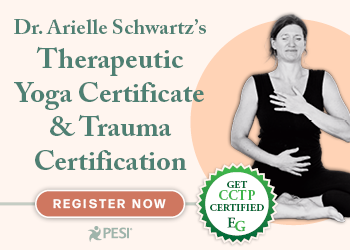
This all-new dual certificate in trauma-informed yoga and Clinical Trauma Professional Certification (CCTP) course gives you everything you need to confidently work with a traumatized nervous system…
…without becoming a yoga teacher overnight or sacrificing your clinical foundation.
Developed with renowned traumatologist, bestselling author, and registered yoga teacher Dr. Arielle Schwartz, this training blends Polyvagal Theory, somatic psychology, and trauma-informed yoga into a practical, step-by-step approach.
PLUS, you'll even get integrative strategies from EMDR, CBT, and narrative therapy.
No fluff. No guesswork. No jargon. Just a clear path to help clients feel safe in their bodies and regulated in their nervous systems – using tools you can apply right away.
Whether you've been practicing yoga for years or you're just thinking about expanding your skillset in this area, this one-of-a-kind course offers you 18 hours of intensive trauma training and 18 hours of somatic, body-based yoga insights — and it's designed specifically for you!
By the end of this course, you'll move beyond simply ‘using techniques’ to embodying trauma-informed yoga as a confident, integrated part of your clinical presence.
Register now to expand what's possible for healing in every session.
Inside this course, you'll learn…
- How trauma-informed yoga concepts can complement clinical practice
- Somatic strategies that increase interoception, grounding, and emotional regulation
- Polyvagal-informed approaches to supporting nervous system flexibility and resilience
- How to incorporate breath, movement, and mindfulness practices into treatment planning
- Ways to blend yoga-informed techniques with EMDR, IFS/parts work, and other evidence-based interventions
BONUS: your Certified
Clinical
Trauma Professional application fee is included… that's $99.99 completely
FREE!
*Professional standards apply.
Click Here to Learn More About CCTP Certification
Therapeutic Yoga Certificate & Trauma Certification
Credit details | Course objectives and outline
Here's what's included…
Two credentials, bonus training and take-home tools in one registration
Certificate of Completion & Digital Badge
In Dr. Arielle Schwartz's Therapeutic Yoga for Trauma Recovery Training
CCTP Application Fee
For Certified Clinical Trauma Professional certification.
*Professional
standards apply
2 FREE Bonus CE Trainings
Start learning with Dr. Schwartz the moment you register
Trauma-Informed Yoga PDF
A free downloadable resource to use with clients
…all yours immediately when you register now!
Therapeutic Yoga for Clinicians Certificate Outline
Eight modules, from foundations to live sessions
Foundational Skills
Treating Trauma Through the Body
Discover how somatic psychology reframes trauma as something the body can both carry and release.

Key takeaways
- View trauma on a continuum so you can treat the whole story
- Zero in on deep-rooted attachment wounds from childhood and developmental trauma
- Expand your lens to work with legacy burdens and intergenerational trauma
- Understand the impact of cultural, systemic, and ancestral weight in collective trauma and collective memory
- Tailor your approach to PTSD, C-PTSD, and dissociative symptoms
Demonstrations & experiential exercises
The Integration of Clinical Trauma Recovery Models & Yoga
See how the 8 limbs of yoga align with phase-based trauma recovery for safe, structured healing.
Key takeaways
- Get grounded in a phase-based approach to trauma recovery
- Explore the 8 limbs of yoga through a trauma-informed lens
- Assess clients’ self-relationship with the Watts Connectedness Scale
- Hold ‘sacred’ space for your clients' sense of meaning — without crossing into religious territory
- Harness mindfulness to help clients shift from reactivity to regulation
- Understand trauma as a value-based search for meaning and learn how to help clients rewrite their narratives with depth, dignity, and purpose
Demonstrations & experiential exercises
Somatic Therapy, Polyvagal Theory, and Interpersonal Neurobiology for Trauma Treatment
Learn to read the nervous system in real time and guide clients toward safety and connection.

Key takeaways & skill acquisition
- Polyvagal theory to help clients navigate between states of activation and rest
- Learn how to co-regulate effectively
- Tune into subtle cues around boundaries so you can adjust your presence and pacing
- Turn therapeutic ruptures into moments of growth and reconnection
- Use compassion-based practices that help clients move through internal blocks
Demonstrations & experiential exercises
Clinical Application
Neuroplasticity & Natural Vagus Nerve Stimulation in Trauma Recovery
Rewire the nervous system and build resilience with breathwork, movement, and Polyvagal-informed practices.
Key takeaways
- Understand how to harness neuroplasticity to create change
- Work with heart rate variability (HRV) as a marker of regulation and resilience
- Support clients in building a more flexible, responsive nervous system through vagal tone
- Create relational safety with client-centered practices from Deb Dana’s polyvagal work
Demonstrations & experiential exercises
Integrate Mindful Movement and Stillness in Trauma-Informed Yoga
Master trauma-sensitive yoga, posture, and movement to activate safety, release tension, and rebuild nervous system resilience.

Key takeaways
- Explore how gentle myofascial release can unlock stored emotions
- Use bilateral movements to enhance brain integration
- Introduce dual awareness practices that bridge inner and outer experience
- Restore stability with spinal movements, seated grounding, and power poses
- Support vestibular integration with wall presses and balance-based exercises
- Promote reflex integration and reset the body’s natural rhythms with rhythmic motions like cat-cow, twists, and rocking
- Offer deeply calming restorative yoga poses allowing for nervous system repair
Demonstrations & experiential exercises
Yoga Therapy in Practice
Start-to-Finish Structuring of Trauma-Informed Yoga Sessions
Design inclusive, trauma-sensitive yoga sessions that expand regulation and connection for clients of all abilities.
Key takeaways
- Adapt your approach for clients with a range of abilities, backgrounds, and histories
- Master the art of using invitational language instead of commands
- Know how to respond to emotional overwhelm with grounding and support
- Use somatic movement to help clients expand their ability to experience and regulate emotional states
- Apply parts work on the yoga mat to help clients navigate inner conflict
Demonstrations & experiential exercises
Practical Considerations When Doing Trauma-Informed Yoga
Gain confidence integrating trauma-informed yoga with safe, ethical, adaptable session design – in person or telehealth.

Key takeaways
- Set up your virtual or in-person office to support relaxation, openness, and body awareness
- Feel confident with informed consent
- Use screen tools effectively to ensure clients are safe to participate
- Set and maintain clear boundaries, especially around physical touch
- Create clear documentation that collaborative care teams can understand
- Set clear goals and intentions for each therapeutic yoga session
In-Session Demonstrations of Therapeutic Yoga for Trauma Recovery
Sit alongside Dr. Schwartz as she guides you through three yoga-therapy sessions with differing clients. You’ll see how to navigate common and uncommon challenges to doing therapeutic yoga both online and in-office.

Demonstration 1Pacing, Co-Regulation, Rewriting Inner Narratives
Go inside the session as Dr. Schwartz works with a client who is navigating life after abuse and a recent divorce. Through themes of support vs. freedom and rebirth after loss, you’ll see how yoga therapy gently helps Liz move from performance to authentic confidence.
Skill acquisition
- Learn how to pace a trauma-informed yoga session to match your client’s nervous system
- Practice effective types of co-regulation
- Explore therapeutic yoga movements for safety and empowerment
- Support clients in finding peace with conflicting inner parts
- Help clients restructure limiting beliefs formed through trauma

Demonstration 2Somatic Yoga & Parts Work (online session)
Join Dr. Schwartz and a volunteer navigating legacy trauma as a Black American. Through online yoga therapy, witness how embodied practices help her explore the tension between authenticity and relational safety — grounding parts work in somatic presence.
Skill acquisition
- Learn how to troubleshoot and adapt yoga therapy sessions virtually
- Guide clients through shame and internal conflict using embodied techniques
- Shift between fear and safety cues in real time
- Help clients isolate and work through core inner conflicts
- Move clients toward cognitive integration of childhood trauma

Demonstration 3Chair-Based Yoga, EMDR Integration & Somatic Reprocessing
Step into the room with Dr. Schwartz as she supports a client living with chronic pain, adoption trauma, and neurodivergence. Through integrative EMDR and somatic interventions, you’ll learn how to deepen trauma processing — right from the therapy chair.
Skill acquisition
- Use therapeutic yoga from the chair — no mat needed
- Combine EMDR with somatic tracking and bilateral stimulation
- Work with moment-to-moment Subjective Units of Distress (SUDs)
- Identify and repair “missing” early developmental experiences
- Support neurodivergent clients and chronic pain presentations through embodied work

Therapist Cleansing Practice for Rejuvenation
A short practice to let go of clients after each session, based in parts work, somatic resonance, lifeforce energy and countertransference.
Therapeutic Yoga Certificate & Trauma Certification
Intensive Trauma Treatment Certification (CCTP) Outline
EMDR, CBT and Somatic-Based Interventions & More
Connect Clients to a Diagnosis: Trauma Assessment Tools
- Simple vs. complex trauma
- Intergenerational trauma
- Symptom clusters and physical manifestations
- CAPS-5 and PCL-5
- Primary Care PTSD Screen
- Dual diagnosis
The Neuroscience of Trauma and Mechanisms of Change
- Key brain areas involved in trauma
- Fight, flight, freeze, fawn survival responses
- Clinical implications of the freeze response
- The neuroscience of EMDR, exposure therapy and cognitive therapy
Stabilize Your Clients Prior to Trauma Work
- Trauma treatment roadmap – order of operations
- Bottom-up techniques to reconnect and feel safe in the body
- Self-soothing techniques
- Grounding strategies
- Breathwork
- Gauge when a client is ready for intense trauma/cognitive work
The Therapeutic Alliance as a Brain-Based Approach
- Explore the power of right brain psychotherapy
- Applied polyvagal theory as co-regulation in psychotherapy
- Embedded relational mindfulness as a foundation of presence
Dyad Work
- Explore proximity awareness between therapist and client
- Skillfully work with push-pull dynamics with clients
EMDR vs EFT vs Neuromodulation Including Gratitude Practice
- Practices to enhance vagal tone
- Practice EFT tapping for Trauma Recovery
Narrative Therapy Exercises: Rewrite Traumatic Experiences with Small Group Integration
- Interventions to help clients talk about hotspots
- Reclaim identity with the “Tree of life” exercise
- Awareness and closure – create life stories
Solutions to Trauma Treatment Roadblocks
- How to handle the angry client
- Strategies for the resistant trauma client
- Boundary concerns
- Dealing with crises, suicidality, substance use
- How parts, ego states and defenses create walls to change
- Compassionate strategies for “Resistant” clients
- Skill: Understand emotional dysregulation as a “part”
- Skill: Build allies for a part of self
- Skill: Connect to the adult self
- Skill: Facilitate repair scenarios
Session Demos, Video Demos
- Strategies to help clients manage emotional dysregulation in session
- Describe the co-regulation tools of pacing and orienting for resource development
Group Discussion
- Deepen your knowledge of the application of this work as applied to your practice sessions
- Explore how to bring mind-body interventions into your clinical work
Somatic Movement to Integration
- Somatic repatterning movements for trauma recovery
- Discover the satisfaction cycle from body-mind psychotherapy
Somatic Approaches: Address Physical Symptoms of Trauma
- Relevance of Polyvagal theory and early trauma
- Assess for readiness to apply somatic tools
- Teach body awareness
- Manage unease with “Felt sense” exercises
- Resourcing strategies to create a safe space
CBT Coping Skills: Manage Emotions
- Identify inaccurate trauma-related cognitions
- Exposure, titration and pendulation to slow emotions
- Cognitive reframing and reappraisal interventions
- Memory reconstruction techniques
- Develop emotion regulation strategies to build resilience
EMDR-Based Techniques: Resolve Traumatic Memories
- Adaptive Information Processing Theory
- EMDR vs EFT vs neuromodulation
- Resourcing strategies
- Combine memory reprocessing with cognitive restructuring
- Using “restricted processing” with complex trauma
Reintegration and Post-Traumatic Growth with Practice Work & Small Group Discussion
- Better than normal – the neuroscience of post-traumatic growth
- The therapeutic alliance as a brain-based approach
- The power of forgiveness in moving forward
- Meaning making exercises
- Cultivating resilience and personal growth through reintegration strategies
Therapeutic Yoga Certificate & Trauma Certification
Credit details | Course objectives and outline
BONUS! FREE CE, Certification, PDF, Digital Badge & MORE!
Over $400 Value, YOURS IMMEDIATELY!
Neuroplasticity in Trauma Recovery
Empower yourself with Dr. Schwartz’s practical tools, such as the six pillars of resilience, to facilitate a strength-based approach to trauma recovery. Learn to guide clients in revising their trauma narratives and building protective factors that prevent PTSD.

Somatic Trauma Therapy in Action
Join Dr. Schwartz for an in-depth exploration of somatic repatterning using integrative mind-body approaches that help to heal stubborn trauma. Walk away with powerful somatic and imaginal resources to support clients in trauma processing.

6-Week Trauma-Informed Yoga Download
Even more… Get a full downloadable yoga sequence from Dr. Schwartz’s book, Therapeutic Yoga for Trauma Recovery: Applying the Principles of Polyvagal Theory for Self-Discovery, Embodied Healing, and Meaningful Change. Use it for individual or group therapeutic yoga sessions, maybe even for your own personal growth!
Downloadable Digital Badge
Let everyone know you’ve completed this training course! Download your digital badge of completion to share with colleagues, employers, and potential clients. Add it to your personal website, resume, social media… wherever you promote your incredible practice!

Application Fee for Certified Clinical Trauma Professional
That’s right, a $99.99 value, included! *Professional standards apply
Elevate your career with a new certification, and walk away from this training eligible to earn your new CCTP credential!*
Certification made simple
- Watch this online course.
- Complete the CE test(s) and instantly print your certificate(s) of completion.
- Submit the Certification Questionnaire included in this training, and your application is complete.*
That’s it! No hidden fees. No catch. Just certification made EASY.
*Professional standards apply. Click Here to Learn More About CCTP Certification

Meet Dr. Arielle Schwartz
When Dr. Schwartz teaches – therapists listen, because her tools not only work – they’ve redefined what therapists are doing in their sessions.
Dr. Schwartz's unique and integrative expertise has set her apart in the field of psychotherapy. She founded the Center for Resilience Informed Therapy and developed Resilience Informed Therapy, an integrative model of care facilitating recovery from childhood trauma, PTSD, complex-PTSD and dissociation. She’s a Certified Complex Trauma Treatment Professional Level II, an EMDR consultant, somatic psychology expert, trained in mindfulness-based therapies and relational psychotherapy.
Beyond this, Dr. Schwartz is a renowned Polyvagal Theory expert. Even Dr. Stephen Porges has praised Arielle’s work, which focuses on addressing imbalances within the autonomic nervous system that underlie most mental and physical health conditions.
A Registered Yoga Teacher, Dr. Schwartz has been teaching therapeutic yoga since 2008 and is the author of Therapeutic Yoga for Trauma Recovery, one of the most widely referenced guides to applied Polyvagal Theory in trauma recovery.
A sought-after international speaker, Dr. Schwartz's work can be found at Psychotherapy Networker, Art of Living, Omega Institute, and many other places.
Therapeutic Yoga Certificate & Trauma Certification
Credit details | Course objectives and outline
Frequently Asked Questions
Is this the right course for me?
This course was personally designed by Dr. Arielle Schwartz for mental health professionals who want to add yoga and somatic healing strategies to their trauma-informed clinical toolbox. Whether you’re new to yoga, practicing for decades or even a registered yoga teacher yourself, this course is specifically created to help bridge the gap between clinical interventions and “on the mat” (or in the chair!) movements. Dr. Schwartz’s experience, wisdom and charisma will take you further no matter where you are in your journey as a therapist interested in body-based approaches to lasting recovery.
Does this course offer both a certificate and a certification?
Yes! You’ll be eligible to earn a certificate of completion for the yoga portion of the course (Part 1) and a Certified Clinical Trauma Professional (CCTP) certification for Part 2 of the course. Note that professional standards apply to earn CCTP certification, read more here: CCTP Certification
What's the difference between a “certificate” and “certification”?
A certificate is a document issued upon the completion of a training program. It signifies that you have trained on specific skills, have trained with a particular individual, or have acquired knowledge in a particular subject.
Certification, on the other hand, often requires you to meet specific standards, pass exams, and many even include additional practice, consultation, supervision, evaluations, and ongoing continuing education requirements. This course contains both a certificate and meets the requirements for you to be eligible to earn a Certified Clinical Trauma Professional credential.
This certificate does distinguish you as a professional who has trained more extensively in therapeutic yoga with Dr. Arielle Schwartz. Plus, you'll be eligible to apply to earn your Certified Clinical Trauma Professional (CCTP) certification. The best of both worlds - all in one course!
If I sign up today, when do I get access?
Immediately! You can start your training as soon as you register. You will have on-demand and Unlimited Access to all the materials – including videos, handouts, slides, and bonus materials.
100% Satisfaction Guarantee
Register for this intensive training course without risk. If you’re not completely satisfied, give us a call at 800-844-8260.
We’re that confident you’ll find this learning experience to be all that’s promised and more than you expected.
Therapeutic Yoga Certificate & Trauma Certification
Credit details | Course objectives and outline