
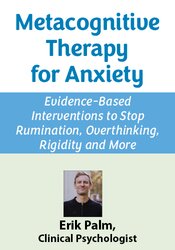
Metacognitive Therapy for Anxiety
Evidence-Based Interventions to Stop Rumination, Overthinking, Rigidity and More
- Speaker:
- Erik Palm
- Duration:
- Approx 6 Hours
- Format:
- Audio and Video
- Copyright:
-
Jul 23, 2026
- Product Code:
- POS150794
- Media Type:
- Digital Seminar

Description
- Identify the invisible rules driving anxiety – and break the cycles that fuels it
- Clinical interventions that interrupt worry spirals on the spot
- Exercises to teach clients to observe anxious thoughts without reacting
- Real world relapse prevention plans that clients remember, use, and trust
For many clients, anxiety persists not because their thoughts are true, but because worry feels useful—then dangerous and hard to stop.
They believe worry helps them prepare; while fearing they can’t control it or that their mind is out of control.
So challenging thoughts isn’t the strategy that leads to relief.
But Metacognitive Therapy (MCT) is different.
Because it gives clinicians a highly effective, evidence-based approach to target the processes that maintain anxiety — changing how clients think and feel about worry, rumination, and danger….
…breaking patterns CBT often can’t reach.
Now, with this one-day training, you can learn to start using MCT with your own clients—and begin seeing faster progress, fewer stuck cases, and more durable results.
You’ll join Erik Palm, Clinical Psychologist and Metacognitive Specialist. He’ll show you—step by step—how to use MCT to uncover clients’ hidden “rules” about anxiety, and how to break the thinking patterns that keep them stuck, even when they’re doing everything “right” in CBT.
Join this 6-hr training and walk away with:
• Practical tools to interrupt worry and rumination spirals—fast
• Detached mindfulness techniques that help clients notice thoughts without engaging or reacting
• A clear relapse prevention plan with strategies that actually stick beyond the therapy room
Go beyond the basics—and become the therapist who helps clients break free from thinking traps for good.
Register today!
Credit
Speaker

Erik Palm Related seminars and products
Erik is a highly skilled clinical psychologist specializing in cognitive and metacognitive therapy, recognized for his extensive experience across adult psychiatry and primary care services. Over the course of his career, he has worked with a broad spectrum of mental health concerns, from common challenges such as stress, anxiety, low mood, and sleep problems to more complex psychiatric disorders requiring comprehensive assessment, treatment, and follow-up.
His background also includes substantial experience teaching, advising, and leading cognitive and psychoeducational groups, equipping him to translate complex psychological concepts into practical, evidence-based strategies for clients and professionals alike. Specializing in anxiety disorders, depression, trauma related conditions, and sleep difficulties, Erik is additionally recognized for his work with burnout, workplace stress, and psychological coaching for leaders in high-pressure environments. With a deep understanding of the challenges faced by minority groups, he tailors his therapeutic approach to meet diverse needs with cultural sensitivity and respect.
Fluent in English, Swedish, Norwegian, and German, Erik offers therapy across multiple languages and cultural contexts. His therapeutic philosophy centers on ensuring clients feel heard, understood, and empowered, creating sessions that are meaningful, comprehensible, and effective.
Speaker Disclosures:
Financial: Erik Palm is the co-founder of metacognitivetherapy.com. He receives a speaking honorarium from PESI, Inc. He has no relevant financial relationships with ineligible organizations.
Non-financial: Erik Palm has no relevant non-financial relationships.
Additional Info
Access for Self-Study (Non-Interactive)Access never expires for this product.
Questions?
Visit our FAQ page at www.pesi.com/faq or contact us at www.pesi.com/info
Objectives
- Distinguish the core theoretical assumptions of Metacognitive Therapy (MCT) from traditional therapeutic approaches
- Identify key metacognitive processes (e.g., worry, rumination, threat monitoring) that maintain anxiety across diagnostic categories.
- Determine when MCT is clinically indicated by assessing metacognitive beliefs and patterns of preservative thinking in adult clients.
- Apply MCT case conceptualization principles to formulate treatment targets based on metacognitive processes.
- Choose core MCT interventions (detached mindfulness, modification of positive and negative metacognitive beliefs, meta-level dialogue) appropriate to common anxiety presentations.
- Analyze common challenges and barriers in implementing MCT techniques.
Outline
Foundational Principles of MCT – The Game Changers
- Core concept of MCT: It’s not what clients think it’s how they think that keeps them stuck
- Metacognition: The mind’s control hub that keeps the worrying alive
- CAS: The Toxic loop and its five self-defeating strategies that fuel distress
- Anxiety’s hidden rules: Unseen beliefs that lock the cycle in place
Crack the Code: Assessment with the A-M-C Model
- A-M-C formulation: Identify triggers and pattens that sustain anxiety
- Assessment goal: Mapping triggers, thinking patterns, and the go-to strategies that keep symptoms alive
- Elicit metacognitions technique: Reveal why clients believe worry helps or hurts them
- Mode distinction techniques: Train clients to see thoughts as mental events, not facts
Core Skills in Metacognitive Therapy
- CAS detection skills: Spot and stop worry and rumination in session
- Socratic dialogue skills: Shift from “is this thought true?” to “how do I respond?’
- Detached mindfulness training: Train clients to notice thoughts without reacting
- DM experiments: Show that letting go makes thoughts fade with suppression vs. non-engagement experiments
The MCT Model for GAD
- GAD core mechanism: What activates and increases worrying and rumination
- Case conceptualization: A road map to unveil triggers and belief patterns in GAD
- Socialization goal: Use two-minds strategy to expose conflicting beliefs and worrying traps
- Uncontrollability challenge: Identify client’s internal “worrying breaks”
NMB Modification: Uncontrollability and Danger
- DM and worry postponement: Delay worrying and apply DM to distress
- Loss-of-control experiment: Show clients they are in control of their worrying
- Danger experiment: Target beliefs that worrying is dangerous
- Target NMBs: Work with beliefs about uncontrollability and danger
- Going crazy experiments: Evoke worrying and test danger predictions
PMB Modification and Relapse Prevention
- Target PMB: Help clients see the belief “worrying helps me cope” for what it is – unhelpful and ineffective
- Worry mismatch: Prove that worry-fueled predictions are widely off
- New plan summary: Build a personalized plan that replaces old worry habits with powerful coping skills
- Relapse prevention: A step-by-step therapy blueprint to keep progress locked in
- Limitations and risks of research
Target Audience
- Counselors
- Marriage and Family Therapists
- Psychologists
- Addiction Counselors
- Case Managers
- Psychiatrists
- Psychiatric Nurse Practitioners
- Other Mental Health Professionals



Reviews
Satisfaction Guarantee
Your satisfaction is our goal and our guarantee. Concerns should be addressed to: PO Box 1000, Eau Claire, WI 54702-1000 or call 1-800-844-8260.
ADA Needs
We would be happy to accommodate your ADA needs; please call our Customer Service Department for more information at 1-800-844-8260.
PESI Mobile App
Access CE trainings on your phone or tablet through our free mobile app. Choose video or audio-only versions of online courses from the world’s best instructors, and complete your CE requirements anywhere, anytime, at your own pace.




Please wait ...