5 Signs Your Client's Trauma May Stem from Narcissistic Abuse

I have sat with clients who come into my office and my therapist spidey senses are tingling. Something feels off in how they're describing a relationship. And then the next week, they're in love again and their partner or friend or family member is amazing, and I'm sitting there thinking, wait, am I reading this right?
That's the thing about narcissistic abuse. It is so incredibly subtle and insidious. It's hard for clients to identify when it's happening, and honestly, it can be hard for us as clinicians too, even after years of doing this work.
One thing worth naming up front: when we talk about narcissistic abuse, most of us default to thinking about intimate partner relationships. But in my private practice, I've had countless clients walk through my door clearly experiencing narcissistic abuse in a friendship, with a colleague, with a family member. They never considered the dynamic could apply outside a romantic relationship. So hold these signs loosely across every kind of relationship your client might describe.
Here are five signs I've learned to listen for, and why the tools many of us reach for first often aren't built for this particular kind of wound.
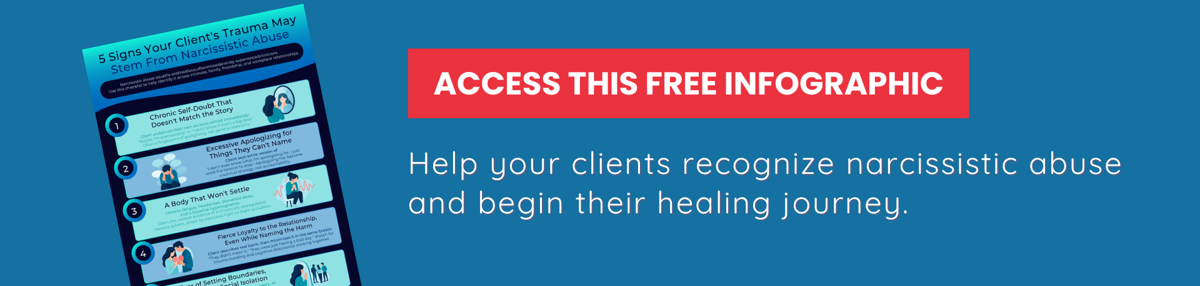
1. Chronic Self-Doubt That Doesn't Match the Story
Your client will describe a situation, and then almost immediately undercut their own account of it. "But maybe I'm overreacting." "I don't even know if that's a big deal." This isn't garden-variety insecurity. It's the fingerprint of gaslighting, where a perpetrator has spent months or years intentionally distorting the client's perception of reality until the client no longer trusts their own memory or their own emotions.
Standard approaches that focus purely on cognitive restructuring can actually stumble here, because the issue isn't just a distorted thought. It's a nervous system and a sense of self that have been trained, over time, to defer to someone else's version of events.
2. Excessive Apologizing for Things They Can't Name
Listen for clients who say some version of, "I don't even know what I'm apologizing for. I just want the tension to stop." This is a client who has been on the receiving end of a relationship cycle where they are blamed for conflict that isn't theirs to own. Over time, apologizing becomes less about accountability and more about survival, a way to de-escalate before things get worse.
This is where general conflict-resolution or communication-skills work can fall short. Teaching a client to communicate more assertively doesn't address the deeper belief sitting underneath it: that they are responsible for managing someone else's moods and reactions.
3. A Body That Won't Settle
Chronic fatigue. Headaches. Trouble falling or staying asleep. A baseline sense of being on edge, hypervigilant, walking on eggshells. These aren't incidental complaints your client mentions in passing. They're often the clearest evidence you'll get that narcissistic abuse has created a chronically dysregulated nervous system.
We know the constant activation of the fight-or-flight response leads to real neurobiological changes: an overactive amygdala, a suppressed prefrontal cortex. That combination impairs a client's ability to regulate emotion and make effective decisions, which is exactly why standard talk therapy alone, without any body-based or skills-based regulation component, tends to move painfully slowly with this population. You can't think your way out of a dysregulated nervous system. You have to help the body find safety first.
4. A Fierce Loyalty to the Relationship, Even While Naming the Harm
This is the one that trips up a lot of clinicians, myself included, earlier in my career. A client will describe genuinely painful, manipulative behavior, then in the next breath minimize or deny what they just told you. "They didn't mean it." "They were just having a bad day." This isn't a client being untruthful with you. It's a self-protective mechanism, often driven by two things working together: trauma bonding, where intermittent moments of affection keep the client emotionally invested, and cognitive dissonance, where two conflicting truths (this person hurts me, this person also shows me kindness) become nearly impossible to hold at once.
If we approach this the way we'd approach a client simply struggling to leave an unhealthy situation, we risk pushing too hard, too fast, and rupturing trust in the therapeutic relationship. This isn't about willpower. It's a genuinely confusing psychological bind, and untangling it usually takes longer than we'd like.
5. Fear of Setting Boundaries, Paired With Social Isolation
Clients experiencing narcissistic abuse often describe a specific kind of fear around boundaries: not just discomfort, but a real belief that they aren't worthy of having them, or that asserting one will blow up the relationship entirely. Alongside this, you'll often notice social isolation. Sometimes this happens because a perpetrator has slowly, quietly pulled the client away from their support system. Other times, the client withdraws on their own, out of shame, because they feel they should have seen the signs sooner.
Standard boundary-setting exercises, the kind that work well for a client with generally healthy self-worth, tend to fall flat here. You can teach the script, but if the belief underneath it is "I am not worthy of asking for this," the client won't use it. The work has to start with rebuilding a sense of self-worth before the assertiveness skills have anywhere to land.
Why This Calls for a Different Kind of Toolkit
Here's what ties all five of these signs together: narcissistic abuse doesn't just create painful memories. It creates a dysregulated nervous system, a fractured relationship with one's own emotions, and a deep uncertainty about what's even real. That's a lot more than a standard cognitive or insight-oriented approach was built to address on its own.
What these clients need is something that holds two things at once: validating that what happened was real and painful, while equipping them with concrete skills to regulate emotion, tolerate distress, and rebuild trust in their own perceptions. That combination of validation and skill-building is worth exploring further for anyone regularly sitting across from clients whose stories don't quite fit the relationship template they came in expecting to talk about.
Healing from narcissistic abuse is not brief work, and it's not linear. But every client I've worked with who has experienced it is capable of healing and moving forward. They might not be able to see that yet. Our job is to hold that hope for them until they can hold it themselves.
By integrating these skills into therapy, clinicians can empower clients not just to cope, but to actively reclaim their lives and build resilience in the face of narcissistic abuse.

This one-of-a-kind course will give you the strong foundation you need to identify this hidden abuse, effectively respond to it as a therapist, and help these clients reclaim their lives.

Katelyn Baxter-Musser, LCSW, C-DBT is a licensed clinical social worker in private practice in Maine where her areas of expertise include domestic violence, abuse, trauma, PTSD, depression, anxiety, grief, personality disorders and relationship issues.
Her clinical experience includes working for ten years in various roles as a case manager, child and family therapist, and trauma therapist for several agencies and Native American reservations. Ms. Baxter-Musser served as the Trauma Healing Services Clinical Coordinator for La Frontera Arizona, a non-profit organization dedicated to providing behavioral health counseling, crisis intervention and support to families and individuals facing domestic violence, abuse, hate crimes and other issues.
Ms. Baxter-Musser is certified in Dialectical Behavioral Therapy and EMDR. She is a member of the National Association of Social Workers, the American Academy of Experts in Traumatic Stress, the National Center for Crisis Management and EMDRIA. She sits on the EMDRIA Standards and Training Committee and part of the Southern Maine EMDR Coalition.
Speaker Disclosures:
Financial: Katelyn Baxter-Musser is the owner, operator, trainer of Inner Awakening Counseling & Consulting and receives royalties a published author. She receives a speaking honorarium and recording royalties from Psychotherapy Networker and PESI, Inc. She has no relevant financial relationships with ineligible organizations.
Non-financial: Katelyn Baxter-Musser is a member of EMDRIA, the National Association of Social Workers, the American Academy of Experts in Traumatic Stress, the National Center for Crisis Management, and the International Society for the Study of Trauma and Dissociation.
PESI and Katelyn Baxter-Musser are not affiliated or associated with Marsha M. Linehan, PhD, ABPP, or her organizations.


