
★★★★★
“This was the BEST training I’ve attended in a LONG time! I have learned SO much and I’m excited to use this material with my clients!”
— Community Mental Health Counselor
Please wait ...

Your clients often come in with a mix of anxiety, trauma, perfectionism, or personality traits that make rigid treatment protocols miss the mark.
Reality is, rigid conformity to a protocol won’t cut it… therapists like you need the flexibility to see the full picture and adapt your approach to the person in front of you.
…and that’s exactly what you’ll learn in this 1-day live online webinar with Jon Hershfield, MFT, director of the Center for OCD and Anxiety at Sheppard Pratt.
Jon Hershfield’s integrative approach to OCD treatment has been honed over 15 years as a national leader, he knows how to create a framework that helps clients move forward. In this training you’ll learn how to…
And so much more… Walk away from this training with elevated confidence and training in treating OCD.
Purchase now and deliver gold standard, personalized care!
Choose how you want to attend
“This was the BEST training I’ve attended in a LONG time! I have learned SO much and I’m excited to use this material with my clients!”

Five connected modules — the meat-and-potatoes of ERP and CBT done well, then the pieces of DBT, RO-DBT and ACT that keep real, messy clients in the work.
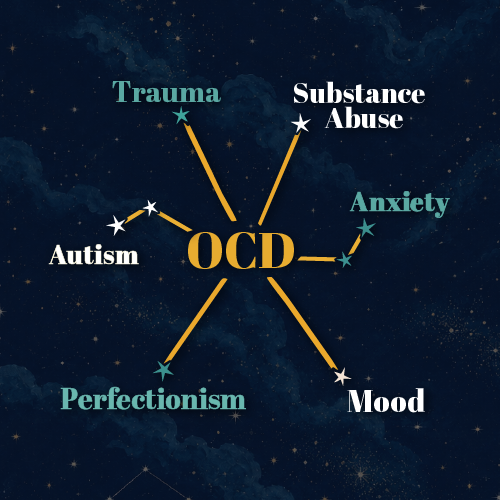
Each condition is a star. What you're actually treating is the shape they make together. Once you can see that shape, the work gets clearer — and, honestly, a lot more interesting.
“OCD almost never travels alone.” — Jon Hershfield, MFT
OCD almost never travels alone. Learn to read the shape your client's diagnoses make together — and treat the person in front of you, not the checklist.
Choose how you want to attend

Treating OCD can be deceptively simple. People tell you how their OCD makes them suffer, and together you reverse engineer it, changing the thinking and the behavior that keep it running. If you found your way here, it’s because you got so good at this that it made you mad the first time you met someone you couldn’t seem to help. That someone almost certainly had the audacity to draw outside the lines of the little DSM box provided for OCD. Then you started noticing how many of them there are, and wondering why.
That person in front of you isn’t a tidy textbook case of contamination or checking. They arrive with anxiety, trauma, perfectionism, mood difficulties, neuro-differences — a whole weather system. So you might refer out for all the non-OCD messiness (“Get thee to a DBT-ary!”), only to find that splitting up the work worsens the very OCD you offered to treat. And if you go the other way and just treat the OCD diagnosis instead of the whole person, the OCD ducks behind whatever’s standing next to it.
So here’s what we’ll do for a full day together. Not a rigid manualized protocol you have to force your clients into, but a way of seeing the person in front of you. We’ll cover the meat and potatoes: ERP and CBT done well. Then I’ll show you how to smuggle in the pieces of DBT, RO-DBT, and ACT that keep a dysregulated or over-controlled client actually able to do the exposure work.
We’ll explore eight common OCD themes and the exact questions I ask to tell OCD apart from the things that only look like it. And we’ll get into the stuff that’s harder to fit in an outline: why self-criticism is itself a compulsion, why reassurance quietly turns into “proving,” and how to keep your compassion alive when a client’s behavior makes no sense to you at all.
You’ll walk away with a framework you can use Monday morning with the messy, real, wonderfully complicated people who actually sit down across from you. I appreciate your passion for reducing suffering. Let’s do this.
“It was one of the best trainings I've been to. The presenter was very knowledgeable, and reviewed the material in a way that helped me to understand aspects of OCD and treatment considerations.”
“Jon went above and beyond with answering questions. I've already told colleagues about it and hope many more people can get this training!”
“Great presenter loved how it was more clinical based… didn't use too much jargon”
Where and when do the in-person days take place?
Both in-person days run 8:00 AM – 4:00 PM ET, with lunch from 11:50 AM – 1:00 PM ET and 15-minute breaks in the morning and afternoon.
Please note: You will have access for 90 days after the program for review. For live CE credit, you must watch the live presentation in its entirety at its scheduled time and complete the CE quiz and evaluation within one week. Please note that this requirement may vary by credit type. Please see detailed credit information for specific requirements for each credit type.
What CE credit is available?
PESI works with a variety of boards, and credit may vary by state and profession. Click here for full CE details.
Choose how you want to attend