
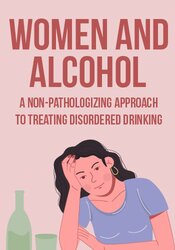
Women and Alcohol
A Non-Pathologizing Approach to Treating Disordered Drinking
- Speaker:
- Amanda E. White, LPC, LMHC
- Duration:
- 1 Hour 02 Minutes
- Format:
- Audio and Video
- Copyright:
-
May 01, 2026
- Product Code:
- POS150790
- Media Type:
- Digital Seminar

Description
Most women in therapy don’t think they have a drinking problem – and they’re probably right by traditional standards. They’re not “alcoholics,” they’re exhausted and they’re over-functioning and they’re using wine exactly as marketed: as self-care, as a reward, as their “off switch.”
And because alcohol serves such an important function, it’s hard for them to talk with you about changing how much and how often they drink.
In this session, Amanda White, LPC, LMHC – author of the acclaimed Not Drinking Tonight and creator of the popular Instagram account @therapyforwomen – will show you how to approach gray-area drinking in a way that bypasses defensiveness and shame. You’ll learn:
- Key curiosity-based questions to understand patterns of disordered drinking
- How to collaborative exploration creates more change than confrontation ever could
- Why moderation fails and what to do instead to break the perfectionism-exhaustion-wine-anxiety cycle
Credit
Speaker

Amanda E. White, LPC, LMHC Related seminars and products
Therapy For Women Center
Amanda E. White, LPC, LMHC, is a therapist, author of the acclaimed Not Drinking Tonight and companion workbook, and host of the podcast, Nuance Needed. As a founder and owner of the Therapy for Women Center in Philadelphia she has developed innovative approaches to treating the full spectrum of problematic alcohol use. Her clinical expertise comes from diverse experience including years working in traditional abstinence-based treatment settings, developing harm reduction protocols in private practice, and treating clients who fall into the “disordered drinking” category. She brings both professional expertise and lived experience with over 10 years of sobriety, giving her unique insight into the resistance and ambivalence clients face. She has trained clinicians nationwide on moving beyond binary thinking in addiction treatment and is known for her practical, immediately applicable clinical strategies. Amanda’s work has been featured in The New York Times, Forbes, The Washington Post, Women’s Health, Cosmopolitan, and Shape.
Speaker Disclosures:
Financial: Amanda White has an employment relationship with Therapy for Women and receives royalties as a published author. She receives a speaking honorarium and book royalties from PESI, Inc. She has no relevant financial relationships with ineligible organizations.
Non-financial: Amanda White has no relevant non-financial relationships.
Additional Info
Access for Self-Study (Non-Interactive)Access never expires for this product.
For a more detailed outline that includes times or durations of time, if needed, please contact cepesi@pesi.com.
Questions?
Visit our FAQ page at www.pesi.com/faq or contact us at www.pesi.com/info
Additional CE Info
For a more detailed outline that includes times or durations of time, if needed, please contact cepesi@pesi.com.
Objectives
- Evaluate a function-based approach versus a disease-based approach to treatment of disordered drinking.
- Identify common patterns of disordered drinking in women.
- Utilize curiosity-based and compassion-focused interventions to decrese shame, defensiveness, and resistance.
Outline
“Are You An Alcoholic?” and “How Often Do You Drink?”
How the Wrong Questions Stop Therapeutic Exploration
- Wine mom culture and the normalization of gray area drinking
- Important differences in alcohol use between women and men
- Common patterns: “borrowing from tomorrow” and the “off switch” phenomenon
Clinical Skills for Disordered Drinking in Women
From Diagnosis & Defensiveness to Curiosity & Control
- Get more information with the question: “Would your life be better without alcohol?”
- Use of language that bypasses shame
- Key methods to reveal function vs. pathology
- Help clients see their patterns of alcohol use
- How to use “I don’t a have a problem” as information
- Why moderation fails and what to do about it
- Open doors to sustainable change
- Case study: the perfectionism-exhaustion-wine-anxiety cycle
Additional Clinical Considerations
Collaboration over Confrontation
- Risk of minimizing serious drinking problems
- What if there is severe alcohol use disorder or safety concerns?
- Importance of medical evaluation
- When to refer to a higher level of care
- Relevant cultural and socioeconomic factors
- Research limitations and potential risks
Target Audience
- Counselors
- Social Workers
- Psychologists
- Psychiatrists
- Marriage and Family Therapists
- Addiction Counselors
- Other Mental Health Professionals



Reviews
Satisfaction Guarantee
Your satisfaction is our goal and our guarantee. Concerns should be addressed to: PO Box 1000, Eau Claire, WI 54702-1000 or call 1-800-844-8260.
ADA Needs
We would be happy to accommodate your ADA needs; please call our Customer Service Department for more information at 1-800-844-8260.
PESI Mobile App
Access CE trainings on your phone or tablet through our free mobile app. Choose video or audio-only versions of online courses from the world’s best instructors, and complete your CE requirements anywhere, anytime, at your own pace.




Please wait ...