
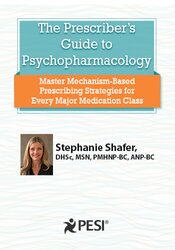
The Prescriber's Guide to Psychopharmacology
Master Mechanism-Based Prescribing Strategies for Every Major Medication Class
- Speaker:
- Stephanie L. Shafer, DHSc, MSN, PMHNP-BC, ANP-BC
- Duration:
- Approx 12 hours
- Copyright:
-
Dec 14, 2026
- Product Code:
- POS079001
- Media Type:
- Digital Seminar - Also available: Live Webinar

Description
- Mechanism-based frameworks to choose, switch, and combine meds
- Antidepressants, anxiolytics, antipsychotics, mood stabilizers, ADHD meds, and more
- A stepwise switch-and-augment algorithm for partial med responders
- Screen for bipolarity, trauma, and comorbidities before treatment derails
- Newest FDA approvals and guideline updates across major conditions
- Recognize exactly when referral is truly the right call
As a PCP, you’re often the one managing depression, anxiety, ADHD, and mood instability – in 15-minute visits. When a first medication doesn’t fully work, the next step might feel limited to raising the dose or switching to another agent in the same class. This two-day intensive delivers a true mechanism-based approach. Discover ways to understand why a medication isn’t working and which medication actually makes sense to try next, across antidepressants, anxiolytics, antipsychotics, mood stabilizers, and ADHD medications, including the newest FDA approvals and guideline updates actively reshaping prescribing right now.
This is specialty-level psychopharmacology, translated for primary care practice. Leave with the prescribing strategies to select, switch, combine, dose-adjust, and augment medications. Your patients will get real relief faster, instead of cycling through months of trial and error while they wait for a psychiatry appointment that may be months out. Access advanced frameworks to manage comorbidities and the skills to recognize exactly when referral is truly the right call – so you can manage more, refer less.
This course is led by Stephanie Shafer, DHSc, MSN, PMHNP-BC, ANP-BC, a dual board-certified nurse practitioner with psychopharmacology prescribing expertise, a post-master’s in psychiatric mental health from the Johns Hopkins University, and NEI Master Psychopharmacology certification. Her background includes primary care roles that later lead her focus into psychiatry, giving her firsthand understanding of real PCP challenges. Purchase now … and you’ll immediately be incorporating new ways to prescribe with precision.
Credit
Speaker

Stephanie L. Shafer, DHSc, MSN, PMHNP-BC, ANP-BC Related seminars and products
Stephanie Shafer, DHSc, MSN, PMHNP-BC, ANP-BC, founded Neurobehavioral Health and Wellness, a private mental health practice in Okemos, Michigan, recognized as the "Best Mental Health Clinic" several years in a row. The practice serves adults, adolescents, and children with psychiatric disorders, including ADHD, bipolar disorder, depression, anxiety, obsessive-compulsive tendencies, schizophrenia, autism spectrum disorder, traumatic brain injury, PTSD, and personality disorders.
Central to her success is a structured model of care built around thorough clinical and background histories, careful identification of psychosocial stressors, and a mechanism-based approach to treatment - a framework that has proven essential to the effective delivery of psychiatric medications within her practice.
Clinically, Dr. Shafer's background spans emergency medicine, primary care, and psychiatry, across settings ranging from a large urban hospital to community-based practices, clinics, and private practice. A transition from primary care to psychiatry followed naturally, driven by a commitment to serving a growing population of underserved patients with psychiatric disorders. The past decade has been devoted to refining her skills in outpatient psychiatry.
She has completed graduate studies at UCLA, followed by a specialized post-master's degree in psychiatric mental health from The Johns Hopkins University in Baltimore, MD. Dual certification as a nurse practitioner and an NEI Master Psychopharmacology certification round out her clinical accomplishments. In demand as a speaker, she regularly shares her expertise with multidisciplinary healthcare audiences nationwide, including resident physicians at Michigan State University.
Speaker Disclosures:
Financial: Stephanie Shafer maintains a private practice and receives a speaking honorarium from Collegium pharmaceuticals. She receives a speaking honorarium and recording royalties from PESI, Inc. All relevant financial relationships with ineligible organizations have been mitigated.
Non-financial: Stephanie Shafer is a member of the American Association of Nurse Practitioners.
Additional Info
Access for Self-Study (Non-Interactive)Access never expires for this product.
For a more detailed outline that includes times or durations of time, if needed, please contact cepesi@pesi.com.
Questions?
Visit our FAQ page at www.pesi.com/faq or contact us at www.pesi.com/info
Objectives
- Examine the neurobiological mechanisms underlying the major neurotransmitter systems (serotonin, norepinephrine, dopamine, GABA, and glutamate) as they relate to psychotropic medication action.
- Relate the neurobiology and receptor subtypes involved in depression, anxiety, mood disorders, ADHD, and psychotic disorders to the mechanism of action of medications used to treat them.
- Differentiate antidepressant classes: MAOIs, TCAs, SSRIs, SNRIs, NDRIs/SARIs/NaSSAs, SPARIs, and novel-mechanism agents, based on binding profile, efficacy, and side-effect risk.
- Evaluate newer and adjunctive antidepressant treatment options, including recently approved agents, for patients with an inadequate response to first-line therapy.
- Compare anxiolytic medication classes: buspirone, alpha-2-delta ligands, benzodiazepines, and beta blockers to determine the most appropriate option for a given patient presentation.
- Formulate a benzodiazepine tapering plan consistent with current clinical practice guidelines for patients on long-term therapy.
- Analyze the binding profiles and mechanisms of first- and second-generation antipsychotics to differentiate their efficacy and side-effect risk.
- Differentiate bipolar depression from unipolar major depressive disorder to determine appropriate mood-stabilizing pharmacotherapy.
- Categorize ADHD pharmacotherapy options: stimulants, non-stimulants, and alpha-agonists based on mechanism of action and patient-specific factors.
- Evaluate newly approved ADHD medications and their comparative role relative to established stimulant and non-stimulant options.
- Develop a first-line and augmentation treatment sequence for PTSD pharmacotherapy consistent with current clinical practice guidelines.
- Formulate an individualized treatment strategy for patients with overlapping or comorbid psychiatric diagnoses, prioritizing the fewest effective medications.
- Combine medications across pharmacological classes based on presenting symptoms and individualized treatment response.
- Determine when a patient’s clinical presentation requires psychiatric referral versus continued management within a primary care setting.
Outline
Behind Every Psychotropic Class: The Neurobiology and Mechanisms of Action
- Neurotransmitter systems behind drug classes: Serotonin, norepinephrine, dopamine, GABA, glutamate
- A repeatable framework for reading binding profiles to predict efficacy and risk
- Primary Care Reality: Prescribing by habit and comfort zone, not mechanism
- Your Takeaway: A framework to choose the best medication, case by case
Antidepressants: Matching Mechanism to Patient Presentation
- Depression pathophysiology tied directly to how each drug class works
- Class-by-class differentiation: MAOIs, TCAs, SSRIs, NDRIs/SARIs/NaSSAs, SPARIs, AND newer agents like Auvelity
- Evidence Update: Expanded lumateperone as an adjunctive MDD option
- Primary Care Reality: Manage “partial responders” with no clear next step
- Your Takeaway: A stepwise switch-and-augment algorithm
Anxiety Disorders and Anxiolytics: The Right Agent for the Patient
- The anxiety spectrum (GAD, panic, OCD, social anxiety) and overlapping neurobiology
- Anxiolytics compared: Buspirone, alpha-2 delta ligands, benzodiazepines, beta blockers
- Primary care Reality: Inheriting long-term benzo prescriptions with no taper plan
- Your Takeaway: A ready-to-use taper framework and risk-benefit talking points
Antipsychotics: Binding Profiles, Benefits, and Side-Effect Trade-Offs
- Mechanism of action by binding profile: D2 affinity, 5-HT2A antagonism, and more
- First vs. second generation agents, compared in practical terms
- Evidence Update: Newest atypical antipsychotic, Bysanti, for bipolar I and schizophrenia
- Primary Care Reality: Hesitating to start or adjust with no psychiatry backup
- Your Takeaway: Clear criteria on treatment vs. (urgent) referral, prescribing as an augmenting agent
Mood Stabilizers: Differentiate Bipolar Depression from Unipolar MDD
- Differentiating bipolar depression from unipolar MDD changes the treatment
- Lithium and AEDs: Monitoring requirements and safety windows
- Primary Care Reality: Misclassifying bipolar depression as MDD
- Your Takeaway: A fast bipolarity screen and confidence prescribing lamotrigine, etc.
ADHD Across the Lifespan: Compare Stimulant and Non-Stimulant Options
- A neurodevelopmental condition, common comorbidities, and lifelong effects if untreated
- Stimulants, non-stimulants, and alpha agents compared
- Evidence Update: Centanafadine, the first triple-reuptake ADHD medication
- Primary Care Reality: Initiate adult ADHD treatment without formal training
- Your Takeaway: A framework to select the best first-line agent, stimulant or not
Efficacious and Safe Insomnia Treatments: Newer Options vs. Older Options
- Rethink the benzo: Risks of long-term use and safer, evidence-based alternatives
- DORA drugs and Z-drugs compared for evidence-based, mechanism-driven selection
- Primary Care Reality: Defaulting to the same sedative-hypnotic refill, visit after visit
- Your Takeaway: A decision tree to choose between DORAs, Z-drugs, and tapering off benzos
Trauma, PTSD, and Difficult-to-Treat Conditions: A First Line-to-Augmentation Approach
- First-line and augmentation strategies for PTSD and other resistant conditions
- Evidence Update: APA’s Clinical Practice Guideline for PTSD in Adults
- Primary Care Reality: Treatment stalls without a first-line-to-augmentation sequence
- Your Takeaway: A practical, sequenced PTSD treatment approach
Manage Comorbidity and Combination Therapy: Treat the Whole Patient with the Fewest Medications
- Evaluate and triage patients with multiple comorbid psychiatric disorders
- Combining medications across classes by symptoms, not just diagnosis
- Primary Care Reality: Comorbidity is the norm; treatment plans rarely are
- Our Takeaway: A symptom-triage, minimum-effective-regimen approach
Target Audience
- Primary Care Providers
- Nurse Practitioners
- Physician Assistants
- Physicians
- Pharmacists
Reviews
Satisfaction Guarantee
Your satisfaction is our goal and our guarantee. Concerns should be addressed to: PO Box 1000, Eau Claire, WI 54702-1000 or call 1-800-844-8260.
ADA Needs
We would be happy to accommodate your ADA needs; please call our Customer Service Department for more information at 1-800-844-8260.
PESI Mobile App
Access CE trainings on your phone or tablet through our free mobile app. Choose video or audio-only versions of online courses from the world’s best instructors, and complete your CE requirements anywhere, anytime, at your own pace.




Please wait ...