
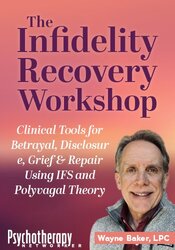
The Infidelity Recovery Workshop
Clinical Tools for Betrayal, Disclosure, Grief & Repair Using IFS and Polyvagal Theory
- Speaker:
- Wayne Baker, LPC
- Copyright:
-
Dec 03, 2026
- Product Code:
- NOS096771
- Media Type:
- Digital Seminar - Also available: Live Webinar

Description
Infidelity puts a therapist in impossible positions from the first session, where every move toward one partner's need feels like a cost to the other. Wayne Baker, LPC, spent 22 years building a way through. In this two-day intensive, the founding clinician at Affair Recovery teaches a trauma-informed framework integrating IFS, neuroscience, and Polyvagal Theory, beginning with the impact of betrayal on the nervous system and moving through a five-stage recovery model designed specifically for infidelity. He shows you how to help clients regulate first, create the conditions for productive parts work, and care for every part involved so the pressure to force an outcome eases. From there, a path forward emerges, whether that means rebuilding the relationship or letting it go.
Credit
Speaker

Wayne Baker, LPC Related seminars and products
Wayne Baker, LPC is a psychotherapist, speaker, yoga teacher, and group leader with over two decades of experience working with individuals and couples in the aftermath of betrayal and relational trauma. He teaches and consults with clinicians across the country and is currently developing a comprehensive model for infidelity recovery that integrates clinical rigor with real-world application. He maintains a private practice in Colorado, where he offers therapy and multiday intensives.
Speaker Disclosures:
Financial: Wayne Baker maintains a private practice. He receives a speaking honorarium from PESI, Inc. He has no relevant financial relationships with ineligible organizations.
Non-financial: Wayne Baker is a member of the EMDR International Association, American Association of Marriage and Family Therapists, and American Psychological Association.
Additional Info
Questions?Visit our FAQ page at www.pesi.com/faq or contact us at www.pesi.com/info
Objectives
-
Differentiate betrayal trauma responses from general relationship distress.
-
Evaluate readiness and safety for conjoint infidelity recovery work.
-
Identify protector and vulnerable parts commonly activated by betrayal.
-
Apply IFS-informed unblending interventions in high-intensity conjoint sessions.
-
Utilize a five-phase model to structure therapeutic disclosure.
-
Distinguish disclosure details that support narrative coherence from those that escalate distress.
-
Apply regulation and containment strategies during escalation, shutdown, or dissociation.
-
Differentiate accountability from shame, defensiveness, and self-condemnation.
-
Implement interventions that build empathic, Self-led presence between partners.
-
Define grief processes that follow betrayal, including delayed and nonlinear presentations.
-
Differentiate forgiveness from reconciliation, trust, excusing, and forgetting.
-
Develop interventions that support new relational agreements after betrayal.
-
Evaluate cultural, relational, and therapist factors that influence infidelity treatment.
Outline
DAY ONE — From Rupture to Reality
Understanding Betrayal Trauma
- Betrayal as attachment injury, nervous system disruption, grief, and loss of shared reality
- Assumed safety, hypervigilance, anger, shame, and protective responses
- Differentiating betrayal trauma from general relationship distress
Culture, Identity, and Relationship Context
- Gender, sexual orientation, culture, religion, and family expectations
- Monogamy assumptions, consensual nonmonogamy, and agreement violations
- Power, stigma, secrecy, and social consequences
- Asking: “What did fidelity mean in this relationship?”
- Identifying therapist assumptions and bias
Creating Safe Enough
- Physical, emotional, informational, relational, and internal safety
- Readiness for conjoint work
- Stabilization before deeper processing
- Therapist regulation and co-regulation
IFS Mapping of the Couple
- Protector and vulnerable parts in the betrayed partner
- Protector and vulnerable parts in the unfaithful partner
- Hypervigilance, minimization, shame, defensiveness, pursuit, and withdrawal
- Unblending and increasing Self-led presence
Therapeutic Disclosure
- Purpose of disclosure: coherence, not interrogation
- Readiness assessment and preparation
- What belongs in disclosure and what may increase distress
- Five-phase IFS-informed disclosure model
- Managing escalation, shutdown, shame, and dissociation
- Post-disclosure containment and aftercare
- Clinical case application
DAY TWO — From Truth to Repair
Empathy and Accountability
- Empathy versus compassion
- Defensive, performative, and shame-based responses
- Accountability without annihilation
- Compassion without exoneration
- Increasing capacity to remain present to the injured partner’s pain
Grieving the Losses
- Grief for trust, identity, future, intimacy, and shared story
- Losses experienced by both partners
- Emotional knowing and persistent protective responses
- Memory reconsolidation informed interventions
Forgiveness
- Forgiveness versus reconciliation, trust, acceptance, or forgetting
- Parts that resist, fear, or desire forgiveness
- Avoiding premature or therapist-driven forgiveness
Creation of a New Relationship
- Moving beyond rebuilding
- Trust, transparency, boundaries, intimacy, connection, and shared meaning
- Developing new relational agreements
- Attachment versus connection
- When healing leads to reconciliation and when it leads to separation
Integration and Clinical Application
- The Betrayal Recovery Arc:
- Safe Enough → Discovery → Empathy → Grieving → Forgiveness → Creation
- Culture and context revisited across each phase
- Self of the Therapist
- • Case formulation and treatment planning across the recovery arc
Target Audience
- Counselors
- Social Workers
- Psychologists
- Psychiatrists
- Addiction Counselors
- Nurses
- Marriage and Family Therapists
- Other Mental Health Professionals



Reviews
Satisfaction Guarantee
Your satisfaction is our goal and our guarantee. Concerns should be addressed to: PO Box 1000, Eau Claire, WI 54702-1000 or call 1-800-844-8260.
ADA Needs
We would be happy to accommodate your ADA needs; please call our Customer Service Department for more information at 1-800-844-8260.
PESI Mobile App
Access CE trainings on your phone or tablet through our free mobile app. Choose video or audio-only versions of online courses from the world’s best instructors, and complete your CE requirements anywhere, anytime, at your own pace.




Please wait ...