
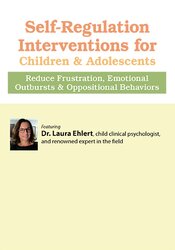
Self-Regulation Interventions for Children & Adolescents
Reduce Frustration, Emotional Outbursts & Oppositional Behaviors
- Speaker:
- Laura Ehlert, PsyD
- Duration:
- Full Day
- Product Code:
- LWC053740
- Brochure Code:
- PWZ96261
- Media Type:
- Live Webinar - Also available: In-Person Seminar | Live Webcast | Digital Seminar

Description
A Clinical Framework for Kids Whose Nervous Systems Work Differently
Working with children who struggle with emotional and behavioral regulation can feel overwhelming – even for seasoned clinicians.
Impulsivity, explosive tantrums, refusal to wait, constant frustration … these behaviors can challenge your clinical skills, your patience, and sometimes your confidence.
But here’s what I’ve learned in over 45 years of working with these kids: the behavior is only a symptom of the real problem.
Underneath the meltdowns, the shutdowns, the resistance – there’s usually an unaddressed sensory, language, or executive functioning difference driving their dysregulation. When we miss that, we’re stuck managing symptoms. When we find it, everything begins to shift.
In this course, I’ll walk you through the clinical framework I use to identify what’s actually driving dysregulation and how to intervene at is source to reduce emotional and behavioral challenges.
This is for mental health professionals, OTs, SLPs, school psychologists, teachers, and anyone working with children diagnosed with Autism, ADHD, Learning Disabilities, Developmental Language Disorders or Sensory Processing Disorders and you’ll learn:
- The sensory, language, and executive functioning differences that rigger emotional distress – and what to do about each
- De-escalation strategies that actually work (and why some backfire)
- The “set-up problem”: how well-meaning expectations create failure before kids even start
- Language-based interventions that build self-regulation from the inside out
- How to end power struggles without giving in or giving up
- Problem-Solving Strategies for improved regulation, flexibility, and social connection
You’ll leave with specific insights and approaches that you can put to work right away – the kind of practical tools and understanding that you’ll find yourself reaching for with clients the very next day.
I hope to see you there.
Dr. Laura Ehlert
Credit
Speaker

Laura Ehlert, PsyD Related seminars and products
Laura Ehlert, PsyD, is a child clinical psychologist who has worked with children and adolescents with severe emotional/behavioral issues for over 25 years. She maintains a private practice in Burnsville, Minnesota, where she specializes in working with clients who struggle with information and sensory processing deficits and associated emotional, behavioral and mental health issues. Over the years, Dr. Ehlert has worked with thousands of youths in a variety of settings including hospitals, residential treatment centers, partial hospital programs, school day treatment and outpatient mental health settings. She holds a doctorate degree in clinical psychology where her training focused on developmental issues of childhood, and child psychopathology issues. Professionals who have worked with Dr. Ehlert in the past have often commented that interventions she offers succeeded where others have failed.
Speaker Disclosures:
Financial: Laura Ehlert maintains a private practice. She receives a speaking honorarium and recording royalties from PESI, Inc. Laura has no relevant financial relationships with ineligible organizations.
Non-financial: Laura Ehlert is a member of the Minnesota Psychological Association.
Additional Info
Access Period for Live WebcastFor live CE credit, you must watch the live webcast in its entirety at its scheduled time and complete the CE quiz and evaluation within one week. You will have access for 90 days after the program for review.
Webcast Schedule
Please note: There will be a 70-minute lunch and two 15-minute breaks; one in the morning and one in the afternoon. Lunch and break times will be announced by the speaker and at their discretion. A more detailed schedule is available upon request.
Questions?
Visit our FAQ page at www.pesi.com/faq or contact us at www.pesi.com/info
Objectives
- Communicate how sensory, language, and executive skills impairments create fight/flight/freeze and defensive responses that lead to dysregulation and related behavioral issues in children.
- Choose the appropriate intervention strategies to improve student skills including self-control, social success, emotional regulation and task completion.
- Employ behavior modification techniques and problem-solving strategies to diffuse students’ escalated and oppositional behavior.
- Implement environmental strategies to accommodate children’s processing deficits and emotional regulation needs.
- Utilize problem-solving strategies to develop appropriate behavioral expectations and coping mechanisms for improved self-regulation skills in students.
- Apply cognitive restructuring strategies to reduce frequency, severity and duration of children’s behavioral and emotional outbursts.
Outline
Perspective-Taking and Meaning to Improve Behavior
The intersection of sensory, cognitive, affect and motor systems
- The “Set-up”: Child’s expectation + delayed development = failure
- Develop appropriate expectations: Pitfalls and strengths of developmental models
- Strategies for de-triggering triggers: Reinforcing desired behavior
- De-escalation strategies and precursors to problem-solving
Sensory Deficits
How sensory processing, perception, and self-regulation are interconnected
- Choosing strategies based on assessment
- Interventions to reduce sensory triggers
- Desensitizing strategies to reset the “panic switch”
- Manage the environment to reduce sensory overload
- Experience your own dysregulation to sensory challenges
Language/Learning Deficits
Insight into the most overlooked deficit that leads to behavioral and emotional dysregulation
- Your misinterpretation about their language challenges
- Recognize, validate and problem-solve common language deficit triggers
- The language of social pragmatics – insight and behavior
- Suggestions for support at school and home
Executive Functioning Deficits
How EF Skills Shape Daily Taks – and Why We Misread Kids’ Struggles
- Problem-solving strategies to improve organization, working memory and metacognitive deficits
- Environments that manage fidgeting, restlessness and inattention and provide positive social-emotional regulation
- Experience how we might set kids up to fail without realizing
Behavioral Strategies
Empower children to make positive choices and take responsibility for their behavior
- Create realistic expectations through better understanding of the child’s process
- Successful “resetting” through behavior modification and skills coaching
- Environmental structures and nurturing words that regulate
- Reduce tantrums and emotional dysregulation through cognitive restructuring
Problem-Solving Strategies
Teach flexibility, tolerance and decision-making
- End power struggles and the blame game
- Improve child’s acceptance and personal responsibility for behavior
- Create realistic expectations
- Use language as a self-regulation tool
Limitations of the Research and Potential Risks
Target Audience
- Counselors
- Social Workers
- Psychologists
- Psychotherapists
- Psychiatrists
- Therapists
- Marriage and Family Therapists
- Speech-Language Pathologists
- Teachers
- Physicians
- School Guidance Counselors
- Case Managers
- Nurses
- School Administrators
- Educational Paraprofessionals
- Occupational Therapists
- Occupational Therapy Assistants
- Addiction Counselors
- Other Helping Professionals who Work with Children



Reviews
| 5 |
|
| 4 |
|
| 3 |
|
| 2 |
|
| 1 |
|
Overall: 4.2
Total Reviews: 13
Satisfaction Guarantee
Your satisfaction is our goal and our guarantee. Concerns should be addressed to: PO Box 1000, Eau Claire, WI 54702-1000 or call 1-800-844-8260.
ADA Needs
We would be happy to accommodate your ADA needs; please call our Customer Service Department for more information at 1-800-844-8260.
PESI Mobile App
Access CE trainings on your phone or tablet through our free mobile app. Choose video or audio-only versions of online courses from the world’s best instructors, and complete your CE requirements anywhere, anytime, at your own pace.




Please wait ...