
Digital Version Available
Get immediate lifetime access to this content by purchasing the digital seminar/online course instead that you can access using a variety of devices, and one CE certificate is included with purchase! Click the “Digital Seminar” or "Online Course" link below to learn more!
DVD Purchasers please note: In order to view the content, you will be required to have a DVD player or a DVD drive on your computer. Your CE is a separate fee.
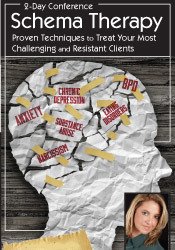
Schema Therapy
Proven Techniques to Treat Your Most Challenging and Resistant Clients
- Speaker:
- Wendy T. Behary, MSW, LCSW
- Duration:
- 11 Hours 58 Minutes
- Copyright:
-
Nov 12, 2015
- Publisher:
- PESI, Inc.
- Product Code:
- RNV048780
- Media Type:
- DVD
Description
- Anxiety
- Chronic Depression
- Eating Disorders
- BPD
- Substance Abuse
- Narcissism
Schema therapy is an innovative, integrated therapeutic approach, originally developed (by Dr. Jeffrey Young) as an expansion of traditional cognitive-behavioral treatments. The schema therapy approach draws from cognitive-behavioral therapy, attachment theory, psychodynamic concepts, and emotion-focused therapies. In comparison to cognitive-behavioral therapy, schema therapy emphasizes lifelong patterns, affective change techniques, and the therapy relationship, with special emphasis on limited and adaptive re-parenting.
Schema therapy is particularly well suited for difficult, resistant clients with entrenched, chronic psychological challenges, including personality disorders (such as BPD and Narcissism), eating disorders, intractable relationship problems, and criminal offenders. It is also effective for relapse prevention in depression, anxiety, and substance abuse.
The results of a major comparative outcome study have shown schema therapy to be highly effective with a large percentage of outpatients with Borderline Personality Disorder, with a low dropout rate. Clients who have spent years gaining valuable insight with psychodynamic treatments, but who are frustrated by their lack of progress, often respond well to the active, systematic, flexible, and depth-oriented schema approach.
This workshop will include a combination of teaching methods, including lectures, handouts, videotapes of master schema therapists, live demonstrations, question-and-answer periods, group discussion, assessment and change strategies practice exercises, discussion of obstacles in treatment including therapist’s own schemas, and small group exercises.
Credit
Speaker

Wendy T. Behary, MSW, LCSW Related seminars and products
The Cognitive Therapy Center of New Jersey and The Schema Therapy Institutes of NJ-NYC-DC
With 25 + years of professional experience and advanced level certifications, Wendy Behary is the founder and director of The Cognitive Therapy Center of New Jersey and the Schema Therapy Institutes of NJ-NYC-DC. She has been treating clients, training professionals and supervising psychotherapists for more than 20 years. Wendy was on the faculty of the Cognitive Therapy Center and Schema Therapy Institute of New York (until the Institutes merged in 2012), where she trained and worked with Dr. Jeffrey Young since 1989.
She is a founding fellow and consulting supervisor for The Academy of Cognitive Therapy (Aaron T. Beck’s Institute). Wendy served as the President of the Executive Board of the International Society of Schema Therapy (ISST) from 2010-2014 and served as the Training and Certification Coordinator for the ISST Executive Board from 2008-2010. She is currently the chair of the Schema Therapy Development Programs Sub-Committee for the ISST.
Wendy Behary has co-authored several chapters and articles on Schema Therapy and Cognitive Therapy. She is the author of an international bestselling book, Disarming the Narcissist: Surviving and Thriving with the Self-Absorbed, translated in 15 languages. The Third Edition was released on October 1, 2021. Wendy has a specialty in treating narcissists and the people who live with and deal with them. As an author and an expert on the subject of narcissism, she is a contributing chapter author of several chapters on schema therapy for narcissism for professional readers. She lectures both nationally and internationally to professional and general audiences on schema therapy, narcissism, interpersonal relationships, anger, and dealing with difficult people. She receives consistent high praise for her clear and articulate teaching style and her ability to bring the therapy to life through dramatic demonstrations of client interactions in the treatment room.
Her work industry business speaking engagements focus on interpersonal conflict resolution. Her private practice is primarily devoted to treating narcissists, partners/people dealing with them, and couples experiencing relationship problems.
Speaker Disclosures:
Financial: Wendy Behary is the co-founder of The Cognitive Therapy Center of New Jersey and The Schema Therapy Institutes of NJ-NYC-DC. She receives royalties as a published author. Wendy Behary receives a speaking honorarium and recording royalties from Psychotherapy Networker and PESI, Inc. She has no relevant financial relationships with ineligible organizations.
Non-financial: Wendy Behary is the board president of The Jeff Young Schema Therapy Association. She is a member of the NJ Association of Cognitive-Behavior Therapists and the International Association of Cognitive-Behavior Therapists. She is a founding fellow of The Academy of Cognitive Therapy.


Additional Info
Access for Self-Study (Non-Interactive)Access never expires for this product.
Questions?
Visit our FAQ page at www.pesi.com/faq or contact us at www.pesi.com/info
Target Audience
Addiction Counselors, Counselors, Marriage & Family Therapists, Nurses, Psychologists, Social Workers, and other Mental Health ProfessionalsObjectives
- Illustrate how to assess and conceptualize challenging cases in Schema terms.
- Discuss Schema Modes and activating conditions, individually and in their primary relationships.
- Develop a robust treatment formulation based on the linking of current problems with client’s innate makeup, early unmet needs, schemas, and coping styles.
- Identify strategies for maintaining a sturdy, genuine, and healthy adult mode and model within the therapeutic setting.
- Demonstrate how to apply strategies such as: Imagery, Mode Dialogues, Empathic Confrontation, Bypassing Avoidance, Setting Limits, Adaptive (limited) Re-Parenting Stance and Behavioral Pattern-Breaking.
- Evaluate the adaptive value of coping styles by listing the pros and cons of self-defeating habituated modes.
- Incorporate visual and audio aids into therapy to fortify empathic attunement.
- Explain how to implement the Inventories: The YSQ (Young Schema Questionnaire), The YPI (Young Parenting Inventory), and the SMI (Schema Mode Inventory).
- Outline how to bypass “detached protector” modes to access necessary emotions in clients.
- Differentiate the Anger Modes and their treatment implications.
- Practice specific schema mode profiles and evidence-based treatment strategies for Borderline Personality Disorder and Narcissistic Personality Disorder.
- Identify the implications of early maladaptive schemas and self-defeating coping styles on significant others in relationships and partner selection.
Outline
Schema Theory
- Defined, Outcome Research, Designed for Personality Disorders, Chronic, and Rigid Symptom Problems
Schema Clusters
- Developmental Domains and Attachment Ruptures
18 Early Maladaptive Schemas
- Traits Derived from Unmet Needs and Temperament
Therapy Relationship
- Self-Disclosure
- Empathy
- Genuineness
Demonstrations & Group Exercises
Limited Re-Parenting / Meeting Unmet Needs
- Therapist’s Posture, Gesture, Language, Flexibility
- Empathic Confrontation and Limit Setting
Emotion-Focused Strategies
- Imagery
- Dialogues
Cognitive Strategies:
- Evidence For / Against Schemas, Dialogues
Behavioral Strategies / Breaking Self-Defeating Patterns
- Role-Plays
- Mindful Awareness
- Self-Regulating Skills
Role Play with Practice Exercises
Introduction to Schema Modes
- Innate Emotional States
- Constructed Coping Styles
- Habituated Reactions
- Self-Defeating Behavioral Patterns
Schema Modes (Continued)
- Self-Disclosure
- Empathy
Case Conceptualization With Modes
- Hypotheses and Detailing the Client in Schema Terms
Advanced Demonstrations & Group Exercises
BPD – Mode Profile (Overview)
NPD – Mode Profile (Overview)
Specific Styles and Strategies – Using Empathic Confrontation
- Implicit Assumptions
- Benefit of the Doubt
- Preemptive Measures
Bypassing Detached Protector Modes
- Use of Imagery and Mode Dialogue
Anger Modes
- Angry Child Mode
- Bully Mode
- Defiantly Avoidant Mode
- Linking Anger vs. Setting Limits: When? Why?
Advanced Role Play
Therapist’s Schema Activation and Self-Regulation Strategies
- Sturdy and Real in the Treatment Chair
Reviews
| 5 |
|
| 4 |
|
| 3 |
|
| 2 |
|
| 1 |
|
Overall: 4.7
Total Reviews: 21
Satisfaction Guarantee
Your satisfaction is our goal and our guarantee. Concerns should be addressed to: PO Box 1000, Eau Claire, WI 54702-1000 or call 1-800-844-8260.
ADA Needs
We would be happy to accommodate your ADA needs; please call our Customer Service Department for more information at 1-800-844-8260.
PESI Mobile App
Access CE trainings on your phone or tablet through our free mobile app. Choose video or audio-only versions of online courses from the world’s best instructors, and complete your CE requirements anywhere, anytime, at your own pace.




Please wait ...