
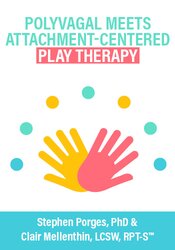
Polyvagal Meets Attachment-Centered Play Therapy: Engaging the Nervous System for Resilient and Socially Connected Children & Teens
- Speakers:
- Stephen Porges, PhD | Clair Mellenthin, PhD, LCSW, RPT-S™
- Duration:
- 1 Hour 31 Minutes
- Format:
- Audio and Video
- Copyright:
-
Jun 04, 2025
- Product Code:
- POS150159
- Media Type:
- Digital Seminar

Description
You’ve likely witnessed moments in the playroom when a child suddenly withdraws, becomes anxious, or reacts defiantly, even while engaged in play therapy.
These reactions highlight the critical influence of biobehavioral states in the play therapy process.
In an engaging conversation with Dr. Stephen Porges, the developer of Polyvagal Theory, and Clair Mellenthin, creator of Attachment-Centered Play Therapy, you’ll gain essential insights into recognizing and adjusting these states to achieve better play therapy outcomes.
Through the lens of Polyvagal Theory, you’ll explore how your voice, facial expressions, posture, and movements affect both your and your client’s emotional states. By applying practical, play therapy strategies you’ll foster a calm, safe, and connected environment, empowering your young clients to fully engage in therapy and minimizing actions that could heighten defensiveness and hinder progress.
Join us for this transformative session and walk away with powerful, play-based tools to create meaningful breakthroughs for your young clients—don't miss the opportunity to elevate your play therapy practice!
Credit
Speaker

Stephen Porges, PhD Related seminars and products
Kinsey Institute, Indiana University and Department of Psychiatry at the University of North Carolina- Chapel Hill
Stephen W. Porges, PhD, is a distinguished University Scientist at Indiana University, where he is the founding director of the Traumatic Stress Research Consortium within the Kinsey Institute. He holds the position of Professor of Psychiatry at the University of North Carolina and Professor Emeritus at the University of Illinois at Chicago and the University of Maryland, and is a founder of the Polyvagal Institute. Dr. Porges served as president of both the Society for Psychophysiological Research and the Federation of Associations in Behavioral & Brain Sciences and is a former recipient of a National Institute of Mental Health Research Scientist Development Award. He has published approximately 400 peer-reviewed scientific papers across several disciplines including anesthesiology, biomedical engineering, critical care medicine, ergonomics, exercise physiology, gerontology, neurology, neuroscience, obstetrics, pediatrics, psychiatry, psychology, psychometrics, space medicine, and substance abuse. His research has been cited in more than 50,000 peer-review publications. In 1994, Dr. Porges proposed the Polyvagal Theory, a theory that links the evolution of the mammalian autonomic nervous system to social behavior and emphasizes the importance of physiological state in the expression of behavioral problems and psychiatric disorders. The theory is leading to innovative treatments based on insights into the mechanisms mediating symptoms observed in several behavioral, psychiatric, and physical disorders.
He is the author of The Polyvagal Theory: Neurophysiological foundations of Emotions, Attachment, Communication, and Self-Regulation (Norton, 2011), The Pocket Guide to the Polyvagal Theory: The Transformative Power of Feeling Safe (Norton, 2017), Polyvagal Safety (Norton, 2021), co-author with Seth Porges of Our Body Polyvagal World (Norton, 2023), and co-editor with Deb Dana of Clinical Applications of the Polyvagal Theory: The Emergence of Polyvagal-Informed Therapies (Norton, 2018). Dr. Porges is also the creator of a music-based intervention, the Safe and Sound Protocol™, which currently is used by approximately 3,000 therapists to improve spontaneous social engagement, to reduce hearing sensitivities, and to improve language processing, state regulation, and spontaneous social engagement.
Speaker Disclosures:
Financial: Dr. Stephen Porges is a Courtesy Professor with the University of Florida College of Medicine, a Distinguished University Scientist of Indiana University, and a Professor with the University of North Carolina. He receives royalties as a published author. Dr. Porges is co-owner of Polyvagal Music, LLC. He receives a speaking honorarium, book royalties, and recording royalties from PESI, Inc. He receives royalties and is a stockholder with integrated Learning Systems/Unyte.
Non-financial: Dr. Stephen Porges is an emeritus member of the American Psychological Association, the Association for Psychological Science, and the Society for Psychophysiological Research. He holds a patent on Televagal equipment.
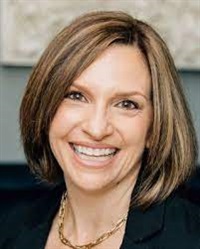
Clair Mellenthin, PhD, LCSW, RPT-S™ Related seminars and products
Clair Mellenthin, LLC
Clair Mellenthin, PhD, LCSW, RPT-S™, is an international speaker, author, psychologist, and Registered Play Therapist Supervisor. Throughout her career, she has specialized in providing play therapy to children, teens, and their families. She is currently the Director of Child & Adolescents at Wasatch Family Therapy. Ms. Mellenthin frequently presents professional play therapy and family therapy trainings on Attachment-Centered Play Therapy, Family, and Trauma issues both nationally and internationally.
Ms. Mellenthin is a sought-after supervisor, training graduate students and interns in play therapy, and an adjunct faculty member at the University of Southern California MSW program. She is the past-president of the Utah Association for Play Therapy and remains an active member on the Board of Directors. She is the author of the books Attachment Centered Play Therapy; Play Therapy: Engaging & Powerful Techniques for the Treatment of Childhood Disorders; My Many Colors of Me Workbookand has authored several chapters and articles. In addition to being an experienced play therapist and professor, Ms. Mellenthin also appears on local and national TV and radio as an expert on children and family issues. She holds a master’s degree in Social Work from the University of Southern California.
Speaker Disclosures:
Financial: Clair Mellenthin has an employment relationship with Wasatch Family Therapy. She is a published author and receives royalties. Clair Mellenthin receives a speaking honorarium, recording royalties, and book royalties from PESI, Inc. She has no relevant financial relationships with ineligible organizations.
Non-financial: Clair Mellenthin is a member of the National Association of Social Workers, the Association for Marriage and Family Therapy, the American Psychological Association, and the Association for Play Therapy.


Additional Info
Access for Self-Study (Non-Interactive)Access never expires for this product.
For a more detailed outline that includes times or durations of time, if needed, please contact cepesi@pesi.com
Questions?
Visit our FAQ page at www.pesi.com/faq or contact us at www.pesi.com/info
Objectives
- Determine the specific biobehavioral state of the client through voice, facial, expression, muscle tone, and posture in play therapy.
- Utilize signals of accessibility and calmness in play therapy that would promote in the client an optimal biobehavioral leading to a positive clinical outcome.
- Apply play therapy strategies to foster a calm, safe, and connected environment, empowering your young clients to fully engage in therapy.
Outline
Core Concept of Polyvagal Theory
- Biobehavioral state profoundly shapes behavior
S-O-R Model - Stimulus-Organism-Response
- Shift from Stimulus-Response to S-O-R emphasizes how a child’s autonomic state mediates response to stimuli
Three Autonomic States & Behavioral Implications in Play Therapy
- Social Engagement: calm, connected
- Fight-Flight: aggressive, oppositional
- Shutdown: withdrawn, avoidant
- Guide children into social engagement to support therapy and peer connection
Behavioral Manifestations in Children
- Resilient and Socially Connected: engage, co-regulate
- Aggressive, Oppositional: irritable, easily triggered
- Withdrawn, Avoidant: freeze, dissociate under stress
- Identify underlying states to tailor play therapy intervention
Neuroception - “Risk Detection System”
- Automatic process that senses safety or danger, adjusting autonomic state
- Create a safe, predictable play therapy space to promote calm and enable open engagement
Calming Autonomic State to Support Regulation in Play Therapy
- Grounding techniques, sensory tools, and routines help move a child toward regulation
Intervention Insight for Play Therapy
- Reducing sensory hypersensitivity is possible by calming the autonomic state
Risks & Limitations in Play Therapy
- Trauma histories may cause safety signals to unintentionally trigger vulnerability and defensiveness.
Target Audience
- Play Therapists
- Psychologists
- Physicians
- Marriage & Family Therapists
- Nurses
- Social Workers
- Counselors
Reviews
Satisfaction Guarantee
Your satisfaction is our goal and our guarantee. Concerns should be addressed to: PO Box 1000, Eau Claire, WI 54702-1000 or call 1-800-844-8260.
ADA Needs
We would be happy to accommodate your ADA needs; please call our Customer Service Department for more information at 1-800-844-8260.
PESI Mobile App
Access CE trainings on your phone or tablet through our free mobile app. Choose video or audio-only versions of online courses from the world’s best instructors, and complete your CE requirements anywhere, anytime, at your own pace.




Please wait ...