
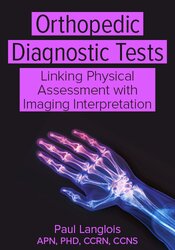
Orthopedic Diagnostic Tests
Linking Physical Assessment with Imaging Interpretation
- Speaker:
- Paul Langlois, APN, PhD, CCRN, CCNS
- Duration:
- 2 Hours 02 Minutes
- Format:
- Audio and Video
- Copyright:
-
May 22, 2024
- Product Code:
- POS078843
- Media Type:
- Digital Seminar

Description
A variety of tests can be used to diagnose and screen for orthopedic conditions. Some diagnostic tests help determine the location and severity of the condition, while others may help rule out other possible causes of the symptoms.
There are continuous updates on when to order and not order specific tests. In 2024, the American College of Radiology (ACR) updated their “Appropriateness Criteria” for several diagnostic tests and procedures. In this presentation, the changes to the guidelines as well as the established practices will be presented on assessment and imaging of the following musculoskeletal parts: cervical, thoracic and lumbar-spine; elbow, hand, wrist, hip, ankle and soft tissue conditions. Topics will include when to order the following tests: x-ray, CT scan, MRI, ultrasound, bone density, myelogram, bone scan and fluoroscopy
With a definitive diagnosis, the clinician can develop an individualized treatment plan to address the specific orthopedic condition and get the patient to their optimal level of functioning.
Credit
Speaker

Paul Langlois, APN, PhD, CCRN, CCNS Related seminars and products
Paul Langlois, APN, PhD, CCRN, CCNS, is a critical care clinical specialist in the surgical, medical, neurologic, burn, CCU, and trauma ICUs of Cook County Hospital, Chicago. Drawing on over 40 years of experience assessing and managing patients with life-threatening diseases, Dr. Langlois provides advanced-level training to nurses, nurse practitioners, physician assistants, respiratory therapists, and physicians.
Dr. Langlois is committed to providing the highest quality of care to patients through advanced education. His presentations are evidence-based, timely, and go beyond content review to sharpen the clinical reasoning underneath it, using illness scripts, anticipatory thinking, and layered case studies to help experienced clinicians reason out loud rather than simply recall answers. As a bedside clinical nurse specialist, he has developed several institution-wide protocols for the multidisciplinary assessment and management of patients.
His presentations are enthusiastically delivered and offer highly practical tips that help make the most challenging concepts easy to understand, from cognitive-bias traps that shape a shift to the SBAR calibration that gets a "come now" call heard the first time. Linking knowledge to clinical practice is the goal of every educational program, and Dr. Langlois builds that link through near-miss scenarios and "what would you do?" cases designed to sharpen judgment, not just test it.
Speaker Disclosures:
Financial: Dr. Paul Langlois has employment relationship with Cook County Hospital and Emergency Care Consultants. He receives a speaking honorarium and recording royalties from PESI, Inc. He has no relevant financial relationships with ineligible organizations.
Non-financial: Dr. Paul Langlois is a member of the American Nurses Association, the American Association of Critical Care Nurses, and the Society of Critical Care Medicine.
Additional Info
Access for Self-Study (Non-Interactive)Access never expires for this product.
Questions?
Visit our FAQ page at www.pesi.com/faq or contact us at www.pesi.com/info
Objectives
- Determine five key factors when performing an orthopedic physical assessment.
- Analyze the appropriateness of non-invasive tests to be performed based on the patient’s presentation for the following: Cervical spine pain, thoracolumbar pain, painful joints (shoulder, elbow, wrist, knee, hip and ankle).
- Evaluate presentations that would require a clinician to order radiographic tests (x-ray, CT, MRI, fluoroscopy, bone scan, myelography) versus non-radiographic tests (ultrasound, electrodiagnostic/EMG)) for bone and joint pain.
Outline
Conducting an Orthopedic History and Physical Assessment
- Medication classes that affect orthopedic history and assessment
- Clinicians can do better than the acronym AMPLE (allergies, medications, past medical history, last eaten, events leading to symptoms) in history taking
- The two most missed assessments on your orthopedic patient
- Pain: Differentiate between point tenderness versus nerve transmission
- Distinguishing features of bone, nerve, joint and soft tissue damage or inflammation
- Is RICE (rest, ice, compression and elevation) enough or are further tests warranted?
Physiotherapy Tests and Maneuvers Which Can be Performed in the Outpatient Setting
- Cervical radiculopathy versus a neck muscle strain
- Shoulder instability and dislocation – perform this non-invasive procedure
- Diagnosing lateral epicondylitis in your patient without x-rays
- Is this carpal tunnel, arthritis or tendonitis?
- How to diagnose the most common injury of the knee without radiation
- Lumbar radiculopathy: Is it disc herniation or something else
- Strategies to differentiate Achilles tendon rupture or Aspergilloma – they may present similarly
Cervical Spine Maladies
- Does this patient warrant a radiograph, CT or MRI?
- When should contrast be used for the CT and MRI?
- Four must-consider factors before imaging the cervical spine
- Situations that require a radiographic odontoid view on your patient
Thoracic and Lumbar Spine Injuries
- Always get an MRI when the patient’s history and assessment reveal this finding
- When is the axial or sagittal view best for diagnosis
- Determine when a myelogram should be ordered on your patient
Stress Fractures
- Bedside ultrasound is all that may be warranted for a diagnosis
- When is bone scan, CT or MRI needed?
- Frequent fractures: Bone mineral density scan can provide the diagnosis with T- and Z- scores
Painful Joints
- Fluoroscopy is better than CT or MRI when the patient presents with these findings
- Physical exam suggests carpal tunnel syndrome; when to get electrodiagnostic testing (electromyography, EMG)
Case studies
Reviews
Satisfaction Guarantee
Your satisfaction is our goal and our guarantee. Concerns should be addressed to: PO Box 1000, Eau Claire, WI 54702-1000 or call 1-800-844-8260.
ADA Needs
We would be happy to accommodate your ADA needs; please call our Customer Service Department for more information at 1-800-844-8260.
PESI Mobile App
Access CE trainings on your phone or tablet through our free mobile app. Choose video or audio-only versions of online courses from the world’s best instructors, and complete your CE requirements anywhere, anytime, at your own pace.




Please wait ...