
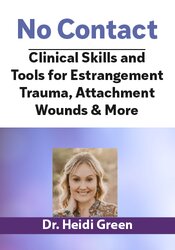
No Contact: Clinical Skills and Tools for Estrangement Trauma, Attachment Wounds & More
- Speaker:
- Heidi Green, PsyD
- Duration:
- Full Day
- Product Code:
- LWC150911
- Brochure Code:
- PWZ96232
- Media Type:
- Live Webinar - Also available: Digital Seminar

Description
- Know what to do when clients ask, “Should I go no contact?”
- Work ethically and neutrally without pushing an agenda
- How to support being “in contact” without normalizing abuse, coercion or manipulation
- Tools to process shame, guilt, grief, and attachment injury
- Dozens of practical strategies you can use immediately
Exhausted and confused, so many clients have tried everything – sometimes for decades – to get their family member to change, understand, or take responsibility.
Cycling through hope, disappointment and self blame, they’re looking to you for guidance.
But going no contact isn’t simple boundary setting – it’s a life altering decision …
… one you likely spent little time learning about in grad school.
That’s why clinical psychologist, trauma therapist and author Dr. Heidi Green created this training after years of working with toxic and estranged family systems.
In just one day, she’ll make the dynamics of toxic family relationships easy to understand and apply to your clients PLUS give you the clinical tools you need to treat these clients so they can get the best possible outcome …
… whether they choose to go no-contact or not.
You’ll leave this training with dozens of tools, strategies and:
- Insights from attachment theory and family systems to support ethical, client-centered decision making
- Boundary setting skills that help clients maintain safety and self-respect
- Tips to support clients who stay engaged – without normalizing abuse or coercion
- Guidance on naming “no contact” as an option while staying clinically neutral
- Tools to help process attachment injury, shame, guilt, and the grief of estrangement
Estrangement has become one of the biggest issues showing up in therapy right now …
and this training will have you feeling ready when these clients walk into your office.
So don’t wait. Register now!
Credit
Speaker

Heidi Green, PsyD Related seminars and products
Dr. Heidi Green, is a highly respected clinical psychologist and a leading expert in trauma healing and personal empowerment. The author of The Path to Self-Love and World Domination (2020) and You Don’t Have to Love Yourself (2026).
Dr. Green’s therapeutic specialties include trauma, self-esteem, codependency, body image, boundaries, healthy sexuality, depression, anxiety, crisis intervention, and more. Using some of today’s most in-demand evidence-based treatments like DBT and EMDR, Dr. Green is recognized for her remarkable ability to connect with individuals and guide them on a transformative journey of self-discovery, personal growth, and improved well-being. In addition, Dr. Green is a registered yoga teacher and enjoys incorporating yoga practices into her trauma healing work with clients.
Speaker Disclosures:
Financial: Dr. Heidi Green maintains a private practice and receives royalties as a published author. She receives a speaking honorarium and recording royalties from PESI, Inc. She has no relevant financial relationships with ineligible organizations.
Non-financial: Dr. Heidi Green is a member of the American Psychological Association.
Additional Info
Access Period for Live WebcastYou will have access for 90 days after the program for review. For live CE credit, you must watch the live webcast in its entirety at its scheduled time and complete the CE quiz and evaluation within one week. Please note that this requirement may vary by credit type. Please see detailed credit information for specific requirements for each credit type.
Webcast Schedule
Please note: There will be a 70-minute lunch and two 15-minute breaks; one in the morning and one in the afternoon. Lunch and break times will be announced by the speaker and at their discretion. A more detailed schedule is available upon request.
Questions?
Visit our FAQ page at www.pesi.com/faq or contact us at www.pesi.com/info
Objectives
- Identify three patterns of family estrangement (e.g., trauma-driven no contact, family cutoff, conflict-avoidant distancing).
- Examine the principles of attachment theory and their relevance to understanding parent-child relationships and psychosocial development.
- Differentiate protective boundary-based estrangement from avoidance-based disengagement using attachment and trauma-informed criteria.
- Evaluate safety, re-traumatization risk and psychological harm in estranged family systems.
- Choose clinical tools to help clients in unhealthy family dynamics with boundary setting, grief processing, and emotional regulation.
- Evaluate ethical risks and therapist bias toward reconciliation.
Outline
What Estrangement Is – and What It Isn’t
- Defining estrangement, no contact, low contact, cutoff, enmeshment and distancing
- Common pathways to and patterns of estrangement
- Cultural and social narratives about family loyalty
- Why estrangement is increasing – empirical trends
Attachment, Family Systems and the Neurobiology of No Contact
- Attachment injury and relational trauma in family systems
- Family systems, roles (e.g., scapegoat, golden child) and power mapping
- Nervous system survival responses
- When proximity perpetuates harm vs. when distance supports regulation
Assessment and Case Formulation
- Assessing safety, re-traumatization risk, and psychological harm
- Abuse, neglect, and coercive control
- Differentiating protective estrangement from avoidance-based disengagement
- Naming “no contact” as an option without directing client decisions
Boundary Setting and Communication Tools for Clients Who Choose Ongoing Contact
- Why boundary scripts often fail with manipulative or abusive family members
- Teaching boundary skills that preserve safety and self-respect
- Preparing clients for backlash, guilt, and relational retaliation
- Supporting low contact, structured contact, or no contact boundaries
- Skills for disengaging from coercion, triangulation, and emotional hooks
- Helping clients tolerate ambiguity
- Research, risks and treatment limitations
Treating the Grief, Shame, and Attachment Wounds of Estrangement
- DBT emotion regulation skills to use during guilt spikes or reconciliation pressure
- Ambiguous loss mapping exercises for grief
- Empty-chair dialogues to process internalized blame
- Strategies for working with attachment injury and rebuilding self-trust
- Narrative tools to support meaning-making
- Supporting clients under pressure to reconcile
- Research, risks and treatment limitations
Ethics, Risks and Countertransference Issues
- Working with multiple family members
- Neutrality versus harm minimization
- Informed consent and documentation
- Managing therapist countertransference
Target Audience
- Counselors
- Social Workers
- Marriage & Family Therapists
- Psychologists
- Physicians
- Case managers
- Addiction Counselors
- Other Mental Health Professionals



Reviews
Satisfaction Guarantee
Your satisfaction is our goal and our guarantee. Concerns should be addressed to: PO Box 1000, Eau Claire, WI 54702-1000 or call 1-800-844-8260.
ADA Needs
We would be happy to accommodate your ADA needs; please call our Customer Service Department for more information at 1-800-844-8260.
PESI Mobile App
Access CE trainings on your phone or tablet through our free mobile app. Choose video or audio-only versions of online courses from the world’s best instructors, and complete your CE requirements anywhere, anytime, at your own pace.




Please wait ...