
Digital Version Available
Get immediate lifetime access to this content by purchasing the digital seminar/online course instead that you can access using a variety of devices, and one CE certificate is included with purchase! Click the “Digital Seminar” or "Online Course" link below to learn more!
DVD Purchasers please note: In order to view the content, you will be required to have a DVD player or a DVD drive on your computer. Your CE is a separate fee.
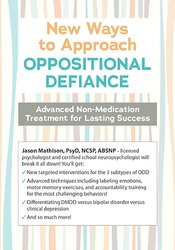
New Ways to Approach Oppositional Defiance
Advanced Non-Medication Treatment for Lasting Success
- Speaker:
- Jason D Mathison, PsyD, NCSP, ABSNP
- Duration:
- 6 Hours 32 Minutes
- Copyright:
-
Dec 16, 2022
- Publisher:
- PESI Inc.
- Product Code:
- RNV059057
- Media Type:
- DVD - Also available: Digital Seminar

Description
Kids are more volatile, more isolated, and more anxious than ever before!
And we know the challenging behaviors that coincide with these issues - tantrums, meltdowns, non-compliance, arguing, yelling…
With these behavioral and social/emotional problems increasing, coupled with staff shortages, it’s more vital than ever that you have efficient and effective strategies to support the kids you work with.
Watch Dr. Jason Mathison, school and licensed psychologist who has worked with the most challenging kids in clinical and school settings for over 18 years. He’ll bridge the clinical and educational worlds and share novel approaches for both environments so you can achieve long-term success!
Learn targeted treatment approaches for:
- 3 subtypes of ODD
- Trauma
- Pandemic fueled school refusal
- Anxiety and depression
- Autism spectrum disorder
You’ll walk away with advanced techniques that will help your young clients learn self-control, self-monitoring, and better organization in a matter of weeks! Purchase today to gain confidence in treating your most oppositional clients!
Credit
Speaker

Jason D Mathison, PsyD, NCSP, ABSNP Related seminars and products
Jason Mathison, PsyD, NCSP, ABSNP, is a licensed psychologist and certified school neuropsychologist in Maryland and Virginia who has worked with children and adolescents for over 20 years. Dr. Mathison is also the owner and director of Psychoeducational Consultants where he provides neuropsychological testing and conducts workshops on brain-behavior relationships for educational staff, mental health professionals and families. Dr. Mathison spends much of his time providing executive functioning coaching for both clients and their families.
In addition to multiple publications on executive functioning, Dr. Mathison has served on an expert panel at National Institute of Mental Health (NIMH) on the teenage brain. He has served as a school psychologist for Prince George’s County Public Schools for 20 years where he works with students and teachers to diagnose and provide interventions to enhance executive functioning and maximize academic success.
Dr. Mathison earned his doctorate in school psychology from the Philadelphia College of Osteopathic Medicine, where he published with faculty and served as an adjunct professor before graduating and continued adjunct appointments at both Loyola University in Baltimore and the Chicago Professional School of Psychology for several years.
Speaker Disclosures:
Financial: Jason Mathison is the owner of Psychoeducational Consultants and has employment relationships with Prince George’s County Public Schools and The Better Brain Center. He receives a speaking honorarium and recording royalties from PESI, Inc. He has no relevant financial relationships with ineligible organizations.
Non-financial: Jason Mathison has no relevant non-financial relationships.
Additional Info
Access for Self-Study (Non-Interactive)Access never expires for this product.
For a more detailed outline that includes times or durations of time, if needed, please contact cepesi@pesi.com
Questions?
Visit our FAQ page at www.pesi.com/faq or contact us at www.pesi.com/info
Objectives
- Construct a variety of evidence-based treatment approaches (e.g., labeling emotions, motor memory strategies, and accountability training) within functional activities to address challenging behaviors.
- Demonstrate effective communication on the biological basis of maladaptive behaviors to families, caregivers, and teachers to promote effective collaboration and support.
- Formulate targeted interventions for subtypes of oppositional behaviors in school and home environments.
- Reflect and assess your clinical judgment and reasoning within evaluation and intervention processes to address challenging behaviors disrupting school performance.
- Determine how and when to implement IEPs and 504 plans and how to effectively write goals and objectives for them.
- Apply strategies for Harvard’s 3 levels of executive functioning in school and at home to promote functional performance.
Outline
The 3 Types of ODD- Angry/Irritable subtype
- Overactive amygdala strategies
- Apply and optimize the anger thermometer
- Handy biofeedback strategies in school
- How to use sensory paths
- Strategies for labeling emotions
- Motor memory strategies to avoid tantrums
- Techniques to stop kids from eloping from class
- Argumentative/Headstrong subtype
- Apply the 3-second rule to stop arguments in class
- Teach kids how to read micro expressions
- Nonverbal strategies to diffuse conflict
- REBT techniques to challenge their schemas
- Vindictive subtype
- How to use the accountability pie
- Implement the best behavioral report card for any behavior
- Change the narrative by “spitting in their soup”
- How to channel their anger in productive ways
- ADHD and ways to overcome the heterogeneity problem
- The ubiquity of sensory processing dysfunction
- DMDD versus bipolar disorder versus clinical depression
- Anxiety disorders
- Disorders of trauma
- The spectrum in autism spectrum disorder (ASD)
- Using the cerebellum to treat the most challenging behaviors
- Overactive versus the underactive amygdala child: 20 strategies for each!
- Gray matter versus white matter problems and solutions
- The role of neurotransmitters in childhood pathology
- Sensory processing dysfunction
- Executive functioning development and treatment for each level
- Ways to stop classroom tantrums and meltdowns
- Muscle memory strategies for lower functioning children
- How to create a task analysis for any behavior in school!
- Develop the ultimate self-report card for any disruptive behavior
- 10 proven ways to label emotions to reduce volatility
- Teach kids how to read microexpressions and other nonverbal gestures to improve social skills
- Executive functioning strategies for selfcontrol, working memory, and mental flexibility
- Teach personal responsibility using the “accountability pie”
- Self-report cards to bridge home and school
- Ways to stop tantrums and meltdowns at home
- Integrating clinical assessments for schools to create IEPs and 504 plans
- Artful thinking routines for perspective taking and reasoning
- Executive functioning strategies for selfcontrol, working memory, and mental flexibility
- Social Pragmatic Communication Disorder
- Treatment strategies tailored to divorced parents
- Pandemic fueled abuse and trauma
- Foster care and adoption issues
- Ways to work with parent dysfunction
Target Audience
- Psychologists
- Counselors
- Social Workers
- School-based Psychologists
- School-based Counselors
- School-based Social Workers
- Marriage & Family Therapists
- School Administrators
- Educators
- School Guidance Counselors
- Occupational Therapists
- Speech-Language Pathologists
- Educational Paraprofessionals
- School Nurses
Reviews
Satisfaction Guarantee
Your satisfaction is our goal and our guarantee. Concerns should be addressed to: PO Box 1000, Eau Claire, WI 54702-1000 or call 1-800-844-8260.
ADA Needs
We would be happy to accommodate your ADA needs; please call our Customer Service Department for more information at 1-800-844-8260.
PESI Mobile App
Access CE trainings on your phone or tablet through our free mobile app. Choose video or audio-only versions of online courses from the world’s best instructors, and complete your CE requirements anywhere, anytime, at your own pace.




Please wait ...