
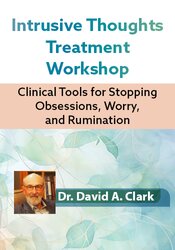
Intrusive Thoughts Treatment Workshop
Clinical Tools for Stopping Obsessions, Worry, and Rumination
- Speaker:
- David A Clark, B.SC, MA, M.PHIL, PhD
- Duration:
- 6 Hours 28 Minutes
- Format:
- Audio and Video
- Copyright:
-
Jun 19, 2026
- Product Code:
- POS150678
- Media Type:
- Digital Seminar

Description
- Unlock the skills that stop intrusive thoughts, rumination and worry
- Get tailored protocols that are easy-to-use AND effective
- Walk away knowing exactly how to help clients break relentless thought cycles
Helping Clients Break Free from the Grip of Negative Repetitive Thinking
You’ve been there – sitting with a client who’s made real progress in therapy, yet they remain trapped in an exhausting cycle of worry, rumination, or obsessive thoughts.
The intrusive thoughts keep coming, and you’re feeling powerless to help them.
This training gives you specialized tools to change the narrative for good.
You’ll watch Dr. David A. Clark, a pioneer of cognitive therapies, who studied with CBT developer Aaron T. Beck. With over 30 yeas of teaching, research and clinical experience, Dr. Clark is one of the most outstanding and influential voices, having taught thousands of clinicians and students alike.
Walk away with Dr. Clark’s best techniques you can apply immediately to make a difference, you’ll learn:
- What makes intrusive thoughts so toxic and why conventional approaches fall short
- Tailored case formulations that pinpoint unique factors maintaining your client’s distressing mental intrusions
- Targeted cognitive-behavioral interventions that address the heart of the problem: uncontrollability
- How to de-toxify the meaning clients attach to their intrusions
By the end of this program, you’ll be able to help clients re-engineer their mental control paradox and provide genuine relief from the relentless torrent of unwanted spontaneous thoughts.
… giving your clients the freedom they’ve been searching for.
Gain the specialized skills you need, purchase now!
Credit
Speaker

David A Clark, B.SC, MA, M.PHIL, PhD Related seminars and products
Dr. David A. Clark, clinical psychologist, researcher, therapist and Professor Emeritus of Psychology at the University of New Brunswick, Canada received his formal training in behavior therapy and a PhD in 1984 at the Institute of Psychiatry, University of London, England. He then proceeded to postdoctoral research and clinical training under Dr. Aaron T. Beck at the Center for Cognitive Therapy, University of Pennsylvania. The author of 19 academic books and self-help workbooks on anxiety, depression and OCD, he has offered close to 100 training workshops globally on various facets of CBT. He has coauthored several books with Dr. Beck, the founder of cognitive therapy, including Cognitive Therapy of Anxiety Disorders: Science and Practice (Guilford, 2012) and The Anxiety & Worry Workbook: The Cognitive Behavioral Solution (2e, Guilford, 2023). Other publications include The Anxious Thoughts Workbook (2018, New Harbinger), The Negative Thoughts Workbook (New Harbinger, 2020), This is What Anxiety Looks Like (New Harbinger, 2024), and most recently Overcoming Paralyzing Doubt and Indecision (New Harbinger, 2026). He maintains a blog with Psychology Today called The Runaway Mind.
Speaker Disclosures:
Financial: David Clark receives royalties as a published author. He receives a speaking honorarium from PESI, Inc. He has no relevant financial relationships with ineligible organizations.
Non-financial: David Clark is a member of the International OCD Beliefs Working Group. He serves as an editorial board member for Canadian Psychologist and the Journal of Obsessive-Compulsive and Related Disorders. David Clark is a peer reviewer for several publications, for a complete list contact PESI, Inc.
Additional Info
Access for Self-Study (Non-Interactive)Access never expires for this product.
Questions?
Visit our FAQ page at www.pesi.com/faq or contact us at www.pesi.com/info
Additional CE Info
For a more detailed outline that includes times or durations of time, if needed, please contact cepesi@pesi.com.
Objectives
- Identify the mental processes that turn some forms of unwanted mental intrusions into irresistible obsessions, depressive rumination, or worry.
- Choose interventions that capitalize on the paradox of mental control to counter the uncontrollability of unwanted distressing intrusive thoughts, images, and impulses.
- Modify CBT assessment and case formulation to guide the use of targeted treatment strategies for mental intrusions in OCD, depression, and anxiety.
- Utilize cognitive interventions that defuse the faulty beliefs and appraisals causing the experience of unwanted and uncontrollable intrusions.
- Use focused distraction and disengagement interventions for treatment of obsessions, worry, and rumination.
- Develop relapse prevention and maintenance strategies that focus on a healthy acceptance of the inevitability of unwanted intrusive thinking.
Outline
The Brain’s Default Mode: Why Certain Thoughts Are So “Sticky”
- Meet the Brain’s Default Mode (BDM), it’s role in survival & creativity
- Intrusive thinking: positive, negative, or benign
- How to know when thoughts become uncontrollable, unwanted intrusions
- The cascade of negative thoughts: (obsessions, worry, rumination)
- The shortcomings of CBT when it comes to intrusions
- Risks and limitations
- Exercises: Contrast wanted and unwanted mental intrusions
Treatment Plans for Obsessions, Worry and Rumination: Making Room for Unwanted Intrusions
- Address the core issues: Self-regulation, control fears & dysfunctional beliefs
- The self-regulation model and genesis of unwanted intrusions
- Unwanted intrusions in the pathogenesis of worry, rumination, and obsessions
- How to highlight what’s important in case formulation
- Methods of assessment and individualized case formulation
- Methods of assessment and individualized case formulation
- Case conceptualization examples for obsessions, worry, and rumination
Targeted Interventions for Unwanted Distressing Intrusions
- Self-monitoring exercises that highlight the normality of mental intrusions
- Detoxification strategies: guided discovery, inductive questioning, inferential confusion, and more
- Mental control paradox exercises: the white bear experiment, cognitive restructuring, graded in vivo mental challenges and more
- Explore goals: acceptance and letting go
New Treatment Protocols for Worry, Rumination, and Obsessions
- 5-Step protocol for worry: awareness, differentiating, modifying, exposure, de-catastrophizing
- 4-Step protocol for obsessive thoughts: normalizing, challenging, working with, acting against through experiential exercises
- 4-Step protocol for rumination: self-monitoring, restructuring, shifting why to how, gratitude
Cautious Optimism in Treatment of Negative Repetitive Thought
- “Evidence-based” versus “evidence-informed” treatment strategies
- The importance of the therapeutic alliance, especially with “scary thoughts’
- What can go wrong and how to respond
- How to promote greater well-being and build on the BDM
Target Audience
- Counselors
- Social Workers
- Psychologists
- Psychotherapists
- Therapists
- Marriage & Family Therapists
- Addiction Counselors
- Case Managers
- Physicians
- Nurses
- Other Mental Health Professionals



Reviews
Satisfaction Guarantee
Your satisfaction is our goal and our guarantee. Concerns should be addressed to: PO Box 1000, Eau Claire, WI 54702-1000 or call 1-800-844-8260.
ADA Needs
We would be happy to accommodate your ADA needs; please call our Customer Service Department for more information at 1-800-844-8260.
PESI Mobile App
Access CE trainings on your phone or tablet through our free mobile app. Choose video or audio-only versions of online courses from the world’s best instructors, and complete your CE requirements anywhere, anytime, at your own pace.




Please wait ...