
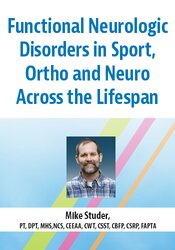
Functional Neurologic Disorders in Sport, Ortho and Neuro Across the Lifespan
- Speaker:
- Mike Studer, PT, DPT, MHS, NCS, CEEAA, CWT, CSST, CBFP, CSRP, FAPTA
- Duration:
- 6 Hours 48 Minutes
- Format:
- Audio and Video
- Copyright:
-
Feb 20, 2025
- Product Code:
- POS065510
- Media Type:
- Digital Seminar

Description
If you find that you're not encountering patients with functional neurological disorders (FND), it’s because you're not recognizing them.
FND are unfortunately very common yet poorly understood, representing a spectrum of conditions often hidden in plain sight. They manifest as movement disorders, seizures, and cognitive disruptions, but without visible causes or clear diagnostic markers, many patients feel misunderstood by the healthcare system.
This applications-based training equips you to overcome the inherent barriers in recognizing FND, enabling effective management of their diverse and variable manifestations.
Functional Movement Disorders (FMD) * Functional Seizures (non-epileptiform seizures)
Drop Attacks * Persistent Postural Perceptual Dizziness (PPPD) * Functional Cognitive Disorders
“The Yips” * “The Twisties”
Bridge the gap between complex neurologic symptoms and effective, personalized treatment strategies as you deepen your expertise:
- Gain an understanding of the underlying mechanisms, how FND develops and the neurological processes involved
- Assessment tips to effectively differentiate dystonia and FND
- Specific interventions that have proven efficacy in treating symptoms like functional seizures and PPPD
- Integrative approaches for all ages and settings
- Tools to manage psychological components such as performance anxiety or nervousness, which interfere with the execution of sport skills
- Soft skills for handling sensitive patient interactions, fostering trust with patients who feel passed over by the healthcare system
By the end of this course, you'll not only enhance your clinical acumen but also gain strategic approaches to treatment planning and patient communication that respect the complex nature of FND.
Transform your practice and become a leader in managing and understanding Functional Neurological Disorders, ensuring that no patient feels overlooked.
Credit
Speaker
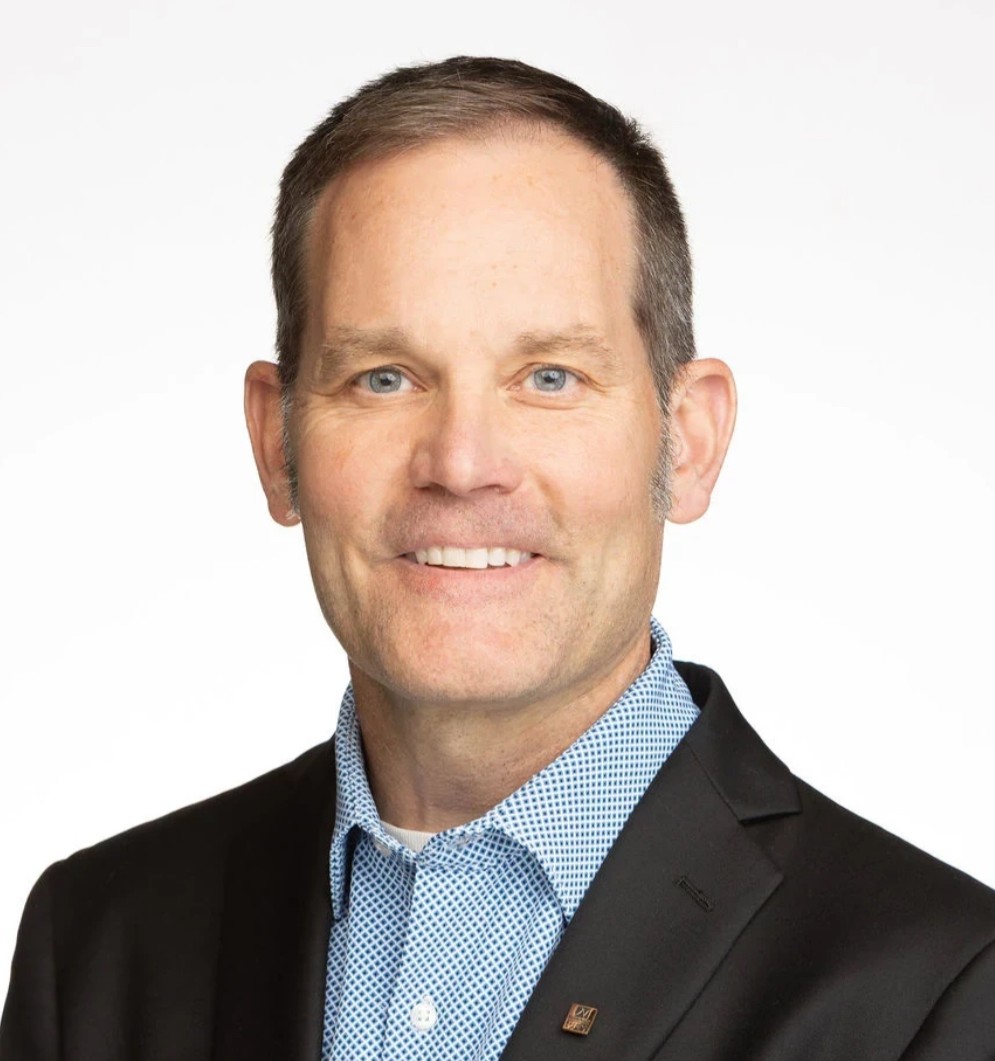
Mike Studer, PT, DPT, MHS, NCS, CEEAA, CWT, CSST, CBFP, CSRP, FAPTA Related seminars and products
Mike Studer, PT, DPT, MHS, NCS, CEEAA, CWT, CSST, CBFP, CSRP, FAPTA has been a PT since 1991, board certified in neurologic PT in 1995, and a private practice owner since 2005. Dr. Studer has been an invited speaker covering all 50 states, 13 countries, and 5 continents speaking on topics ranging from cognition and psychology in rehabilitation, aging, stroke, motor learning, motivation in rehabilitation, balance, dizziness, neuropathy and Parkinson Disease. Dr. Studer was the founder and operator of Northwest Rehabilitation Associates in Oregon for 18 years and is now a co-founder and co-owner of Spark Rehabilitation and Wellness in Bend, OR. He is an adjunct professor at Touro University and additional appointment at UNLV. Dr. Studer assists the USC-led national network of neurologic PT residencies (Neuroconsortium) as well.
In 2011, Mike was recognized as Clinician of the Year in the Neurologic and (in 2014) the Geriatric Academies of the APTA. He received the highest honor available in PT in 2020, being distinguished as a Catherine Worthingham Fellow of the APTA in 2020, joining a group of under 300 persons at the time for the history of the profession. Mike’s honors additionally reflect his service for Vice Presidency of the Academy of Neurologic PT, the Mercedes Weiss award for service to the Oregon chapter of APTA. He holds a trademark in dual task rehabilitation and has a patent pending on the same. Over his career, Mike has authored over 40 articles, 7 book chapters, and routinely has clinical research projects in affiliation with one of many universities. He is a consultant to professional athletes including Major League Baseball players, competitive divers, and some of the most prolific climbers in world history. As a very fun and lighthearted note, Mike is the four time and current WR holder for the fastest underwater treadmill marathon, a mark that was set most recently in January 2022. Most recently, Mike authored The Brain That Chooses Itself, a practical and applications-based guide to increasing both healthspan and lifespan for laypersons and medical professionals alike.
Speaker Disclosures:
Financial: Mike Studer is the co-founding member and co-owner of Spark Rehabilitation and Wellness and has employment relationships with Touro University, the University of Nevada, and Post Acute Medical. He previously received a speaking honorarium from SMARTFit. Mike Studer receives a speaking honorarium, recording royalties, and a consulting fee from PESI, Inc. He has no relevant financial relationships with ineligible organizations.
Non-financial: Mike Studer is a member of the American Physical Therapy Association, the Vestibular Disorders Association, and the Oregon Physical Therapy Association. He serves on the advisory board of Rehab Management and ADVANCE.
Additional Info
Access for Self-Study (Non-Interactive)Access never expires for this product.
Questions?
Visit our FAQ page at www.pesi.com/faq or contact us at www.pesi.com/info
Objectives
- Differentiate movement errors that are functional in nature from those that interfere with ADLs versus those of primary musculoskeletal etiology.
- Identify the forms of Functional Neurologic Disorders.
- Choose person-specific plans of care for persons with Functional Gait and Movement Disorders that are idiopathic and involve daily mobility/ADLs.
- Determine person-specific, sport-specific, and condition-specific, plans of care for athletes with an FND, with emphasis on functional outcomes.
- Develop multidisciplinary resourcefulness toward a comprehensive management of patients that present with an FND.
- Identify educational tools and condition-specific management using soft skills for persons with an FND.
Outline
The Umbrella of FNDs: What conditions are included?
- Functional Movement Disorders (FMD)
- Functional Seizures (non-epileptiform seizures)
- Drop Attacks
- Persistent Postural Perceptual Dizziness (PPPD)
- Functional Cognitive Disorders
- “The Yips”
- “The Twisties”
The Physiology of FNDs: How does an FND start, where does it 'live'?
- Neural pathways involved in FND
- Explore brain areas frequently associated with symptom manifestation
- Do we “blame” the brain or the mind?
- How is this different from a conversion disorder, psychosomatization
Functional Movement Disorders and Functional Gait Disorders
- Identification and management of involuntary movements
- Occupation-based strategies for improving gait patterns and mobility in ADLs
Functional Seizures (Non-Epileptiform Seizures or Psychogenic NES)
- Differentiation from epileptic seizures
- Effective communication strategies for crisis management
Drop Attacks
- Recognizing triggers and patterns of sudden syncopal and drop attacks
- Is exposure therapy an effective intervention?
- Integrate functional therapies to enhance safety and independence
Functional Cognitive Disorders
- Understanding cognitive symptoms without neurological damage
- Tailoring cognitive therapies to support daily tasks and productivity
The Origin and Presentations of FNDs in Performance Athletes
- Link between high-performance stress and FND symptoms
- The vicious cycle of an error
Examination and Confirming an FND: This is a rule-in condition
- Tools and techniques for diagnosing FND
- Importance of functional evaluations to guide treatment
The Soft Skills: Analogies, Autonomy, Education and Awareness
- Including the patient in the diagnosis and treatment plan
- The expectations: Progression/course for persons with FND
- Who is to blame?
- The need for an answer through imaging
Putting it into Action: Case Studies Across the Lifespan:
- Case studies:
- Performance Athletes
- Post-Surgical
- Spontaneous
- Those presenting alongside another condition
Focus on achieving occupation-based outcomes through therapy
Q&A
Target Audience
- Athletic trainers
- Chiropractors
- Exercise Physiologists
- Nurse Practitioners
- Nurses
- Occupational Therapists
- Occupational Therapy Assistants
- Physical Therapists
- Physical Therapy Assistants
- Physician Assistants
- Physicians
- Speech-language Pathologists
- Other Rehabilitation and Healthcare Professionals
Reviews
Satisfaction Guarantee
Your satisfaction is our goal and our guarantee. Concerns should be addressed to: PO Box 1000, Eau Claire, WI 54702-1000 or call 1-800-844-8260.
ADA Needs
We would be happy to accommodate your ADA needs; please call our Customer Service Department for more information at 1-800-844-8260.
PESI Mobile App
Access CE trainings on your phone or tablet through our free mobile app. Choose video or audio-only versions of online courses from the world’s best instructors, and complete your CE requirements anywhere, anytime, at your own pace.




Please wait ...