
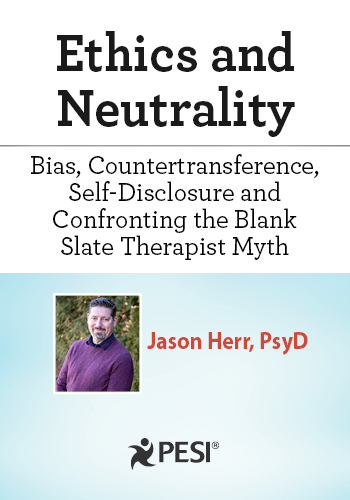
Ethics and Neutrality
Bias, Countertransference, Self-Disclosure and Confronting the Blank Slate Therapist Myth
- Speaker:
- Jason Herr, PsyD
- Duration:
- Approx 6 hours
- Copyright:
-
Nov 18, 2026
- Product Code:
- POS151012
- Media Type:
- Digital Seminar - Also available: Live Webinar

Description
- Strategies for improving clinical judgement and self-awareness
- Evidence-informed techniques to support ethical, client-centered practice
- Tools for cultural competency and case-based clinical reasoning
Neutrality sounds simple in theory. But in the therapy room, it can be one of the hardest clinical skills to sustain.
A client’s story may connect with your own experiences, challenge your values, or bring up strong emotional responses over time. When those reactions go unexamined, countertransference and bias can begin shaping the work, shifting the focus away from the client’s experience and toward the therapist’s perspective.
That’s why we created this training with Dr. Jason Herr, PsyD, who has spent decades developing the clinical judgment this work requires: recognizing when your own perspective enters the room and knowing when neutrality serves the client and when it doesn’t.
You’ll learn how to:
- Apply neutrality as disciplined curiosity, not emotional distance
- Recognize when unexamined bias begins shaping a client’s story
- Catch confirmation bias, anchoring, and in-group bias before they affect your judgment
- Identify persecutor-savior dynamics and over-identification early
- Offer empathy and validation without slipping into value alignment
- Judge, case by case, when neutrality serves the client and when it doesn’t
This training isn’t about becoming a blank slate. It’s about developing the awareness and judgment to understand your own perspective and knowing when neutrality needs to give way to something else.
Purchase today.
Credit
Speaker

Jason Herr, PsyD Related seminars and products
Mindset Health PC
Jason Herr, PsyD, is a licensed clinical psychologist with more than 20 years of clinical training and experience and over 13 years in private practice. His professional interests include ethics in psychotherapy, therapist neutrality, clinical bias, countertransference, self-disclosure, and the ways therapists’ personal experiences, values, and emotional responses can influence clinical judgment and the therapeutic relationship. His recent professional work includes the 2025 presentation Therapist Neutrality in a Polarized World and the development of Ethics of Neutrality in Psychotherapy.
Dr. Herr brings a broad clinical, supervisory, and academic perspective to these topics. As a supervising psychologist, he provided consultation on psychotherapy and assessment cases, led clinical case presentations, participated in the selection and ongoing evaluation of psychology interns, and provided didactic training to developing clinicians. His clinical experience spans private practice, community mental health, hospital, hospice, cancer support, and psychological and neuropsychological settings, working with individuals, couples, and families across a wide range of clinical presentations.
His academic experience further informs his approach. Dr. Herr served as adjunct faculty at both the Illinois School of Professional Psychology and the Chicago School of Professional Psychology, teaching graduate courses including Individual and Relational Therapy, Group Therapy, Cognitive and Affective Processes, Biological Bases of Behavior, Cognitive Assessment, and Introduction to Neuropsychology.
Distinctive to his perspective is his undergraduate background in philosophy. Dr. Herr earned a Bachelor of Science with a major in Philosophy, providing an early academic foundation in ethics, values, moral reasoning, and the examination of how philosophical perspectives shape human thought and behavior. He later earned his M.A. in Clinical Psychology and Psy.D. from the Illinois School of Professional Psychology. His doctoral research examined how significant loss can influence personal development and changes in worldview.
This combination of philosophy, clinical psychology, teaching, supervision, research, and long-term psychotherapy practice provides Dr. Herr with a distinctive interdisciplinary foundation for examining therapist neutrality. His work approaches ethics, bias, countertransference, and self-disclosure not only as matters of professional conduct, but as questions involving values, perspective, self-awareness, clinical judgment, and the complex influence of the therapist as a person within the therapeutic relationship.
Speaker Disclosures:
Financial: Jason Herr maintains a private practice and is the founder of Mindset Health PC. He receives a speaking honorarium from PESI, Inc. He has no relevant financial relationships with ineligible organizations.
Non-financial: Jason Herr has no relevant non-financial relationships.
Additional Info
Access for Self-Study (Non-Interactive)Access never expires for this product.
For a more detailed outline that includes times or durations of time, if needed, please contact cepesi@pesi.com.
Questions?
Visit our FAQ page at www.pesi.com/faq or contact us at www.pesi.com/info
Objectives
- Define neutrality as an ethical and clinical stance.
- Evaluate the influence of countertransference, therapist self-awareness, and self-disclosure on therapeutic boundaries, client autonomy, and the therapeutic relationship.
- Analyze how cognitive biases can influence clinical formulation and decision-making.
- Identify logical fallacies and other reasoning errors that may contribute to inaccurate interpretations of client experiences and clinical information.
- Apply bias-mitigation strategies to reduce the influence of therapist assumptions and reactions on clinical decision-making.
- Integrate research evidence, clinical expertise, and client factors when making client-centered clinical decisions.
Outline
The Role of Neutrality in Psychotherapy
- Neutrality as an ethical and practical cornerstone of client ownership
- How relational and cultural models challenge boundaries and objectivity
- Risks of unexamined bias and countertransference
- Reframing neutrality as curiosity and respect, not emotional distance
- Neutrality’s role in agency, ethical boundaries, and individualized care
- Neutrality vs. advocacy: Clinical judgment grounded in client welfare
Cultural Competency with Objectivity
- Understand diverse backgrounds without assuming shared narratives
- Respect diverse identities and belief systems
- Build awareness of your own cultural framework
- Avoid assumptions about a client’s lived experience
- Keep focus on individual client goals across differences
Countertransference, Self-Disclosure, and Reflective Practice
- Countertransference as the therapist’s emotional and unconscious reactions
- Its risks to interpretation, empathy, and intervention
- Clinical judgment around self-disclosure and its risks
- Tips for separating client material from personal assumptions
- Bias awareness: Beliefs, reactions, rescue impulses, competence limits
- Self-reflection and supervision as tools for balanced engagement
- Decision-making framework for ethical therapist self-disclosure
Cognitive Biases and Logical Fallacies
- Cognitive bias and heuristics as features of clinical judgment
- Tools to minimize confirmation bias
- How availability heuristic can affect clients
- Tricks to avoid anchoring bias
- How to check fundamental attribution error in case formulation
- Methods to interrupt in-group bias toward similar clients
- Common logical fallacies in clinical thinking
- Structured reflection and consultation to reduce bias
Neutral Therapeutic Techniques and Case Vignettes
- Empathy and validation without value alignment
- Processing vs. challenging
- Objective listening to reduce confirmation bias
- Reframing and perspective expansion without imposing interpretation
- The persecuted savior dynamic and over-identification
- Risks: premature assumptions, projection, dependency, urgency
- Stay neutral through reflection, monitoring intensity, consultation
Evidence-Based Practice and Critical Evaluation
- Integrate research evidence, clinical expertise, and client preferences
- Critically evaluating sources rather than relying on narratives
- Recognize research limitations
- Avoid prescriptive assumptions
- Support individualized, evidence-based care
- Limits of neutrality-based and evidence-based approaches
Target Audience
- Counselors
- Social Workers
- Psychologists
- Case Managers
- Therapists
- Marriage & Family Therapists
- Other Mental Health Professionals



Reviews
Satisfaction Guarantee
Your satisfaction is our goal and our guarantee. Concerns should be addressed to: PO Box 1000, Eau Claire, WI 54702-1000 or call 1-800-844-8260.
ADA Needs
We would be happy to accommodate your ADA needs; please call our Customer Service Department for more information at 1-800-844-8260.
PESI Mobile App
Access CE trainings on your phone or tablet through our free mobile app. Choose video or audio-only versions of online courses from the world’s best instructors, and complete your CE requirements anywhere, anytime, at your own pace.




Please wait ...