
Digital Version Available
Get immediate lifetime access to this content by purchasing the digital seminar/online course instead that you can access using a variety of devices, and one CE certificate is included with purchase! Click the “Digital Seminar” or "Online Course" link below to learn more!
DVD Purchasers please note: In order to view the content, you will be required to have a DVD player or a DVD drive on your computer. Your CE is a separate fee.
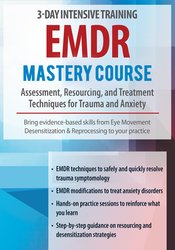
EMDR Mastery Course: Assessment, Resourcing and Treatment Techniques for Trauma and Anxiety
- Speaker:
- Jennifer Sweeton, PsyD, MS, MA
- Duration:
- 16 Hours 05 Minutes
- Copyright:
-
May 22, 2019
- Publisher:
- PESI Inc.
- Product Code:
- RNV054630
- Media Type:
- DVD
Description
EMDR has helped thousands of clients reclaim their lives; quickly and consistently helping them find relief from the trauma and anxiety that plague them.
But without guidance, and hands-on practice, you’re unable to bring this groundbreaking evidence-based treatment to your clients who so desperately need it.
This EMDR Mastery Course recording is your chance to get powerful and proven skills and techniques from EMDR so you can move your clients from surviving to thriving!
You’ll be given a roadmap to help clients manage disturbing feelings, safely process their traumatic memories, reduce fears and anxiety, and help them to develop the resources they need to achieve and maintain recovery.
This intensive training also includes hands-on opportunities for you to practice, reinforcing what you’ve learned and allowing you to gain confidence in using your new skills.
Take your treatment to the next level with EMDR skills and techniques to quickly and safely bring relief from trauma and anxiety to your clients!
Credit
Speaker

Jennifer Sweeton, PsyD, MS, MA Related seminars and products
Dr. Jennifer Sweeton is a licensed clinical psychologist, author, and internationally-recognized expert on trauma, anxiety, and the neuroscience of mental health. Dr. Sweeton has been practicing EMDR for nearly a decade and has treated a variety of populations using EMDR and other memory reconsolidation approaches, including combat veterans, individuals with PTSD and complex trauma, and those suffering from treatment-resistant anxiety. She completed her doctoral training at the Stanford University School of Medicine, the Pacific Graduate School of Psychology, and the National Center for PTSD. Additionally, she holds a master’s degrees in affective neuroscience from Stanford University, and studied behavioral genetics at Harvard University.
Dr. Sweeton resides in the greater Kansas City area, where she owns a group private practice, Kansas City Mental Health Associates. She is a past president of the Oklahoma Psychological Association and holds adjunct faculty appointments at the University of Kansas School of Medicine. She is the president of the Greater Kansas City Psychological Association. Dr. Sweeton offers psychological services to clients in Oklahoma, Kansas, and internationally, and is a sought-after trauma and neuroscience expert who has trained thousands of mental health professionals in her workshops.
Speaker Disclosures:
Financial: Jennifer Sweeton is in private practice. She has an employment relationship with the Oklahoma City VAMC. Dr. Sweeton receives a speaking honorarium from PESI, Inc. She has no relevant financial relationships with ineligible organizations.
Non-financial: Jennifer Sweeton has no relevant non-financial relationship to disclose.

Additional Info
Access for Self-Study (Non-Interactive)Access never expires for this product.
For a more detailed outline that includes times or durations of time, if needed, please contact cepesi@pesi.com.
Questions?
Visit our FAQ page at www.pesi.com/faq or contact us at www.pesi.com/info
Outline
The Neuroscience of Trauma and Anxiety
- Introduction to the autonomic system (ANS)
- Fight, flight, freeze, fawn survival responses
- Polyvagal Theory, and types of freeze responses
- Key brain areas involved in trauma and anxiety
- Clinical implications of the freeze response
Mechanisms of Change: How EMDR and Other Treatment Approaches Work
- The neuroscience of exposure therapy and cognitive therapy
- The neuroscience of relaxation exercises
- EMDR and other “transformative therapies”
- Mechanisms of change
- Why EMDR works so well from a brain perspective
Assessment: Connect Symptoms and Presentations to a Diagnosis
- Nervous system switched on/off – PTSD and Depression
- Underactivations and weakened connections
- Trauma memories and intrusive thoughts
- Phobias, anxiety and insula hyperactivation
- Emotional hijackings and implicit memory: Basal ganglia and amygdala
- Why treating avoidance is critical in anxiety and trauma
- DSM-5® symptoms in a nutshell
- Connect Your Client to a Diagnosis
- Simple vs. complex trauma
- Intergenerational trauma
- Symptom clusters and physical
- manifestations
- CAPS-5 and PCL-5
- Primary Care PTSD Screen
- Dual diagnosis
EMDR as Applied Neuroplasticity
- How EMDR builds dual awareness to treat avoidance
- What you are thinking about is the network you’re in
- You need to activate a network to change it
- Neurons that fire together, wire together (Hebb’s Rule)
- EMDR as neuroentrainment
Practical EMDR Techniques and Protocols to Move Clients from Surviving to Thriving
EMDR Assessment, Resourcing, Eye Movements and More: How to Work with the Original 8-Phase Model
- Client history and treatment planning
- How to resource: Create a safe space
- Assessment: Choose a target, SUDS, connect with the image/emotions/thought
- Desensitization: tactile vs. auditory vs. eye movement
- How to use Touchpoints, Theratapper, CDs
- Positive Cognition Installation: Likert scale 1-7
- Body Scan: Locating tension and distress in the body
- Closure: Closing the neural network and the 6-hour window
- Re-evaluation
When to Use EMDR in Trauma and Anxiety Treatment
- Demonstrations and experiential exercises
- Single event trauma
- Anxiety disorders involving imaginal exposure
- Demonstration of original 8-Phase Model
- ***Experiential exercises with groups of three: client, therapist, observer
- Preparation and assessment
- Desensitization
- Positive cognition and body scan
EMDR for Direct Treatment of Traumatic Memories
- Modifications for complex/developmental trauma
- Do not use standard protocol - Rationale for modifications
- Resourcing strategies:
- Container
- Comfortable place
- Nurturing figure
- Protective figure
- Circle of support
- Techniques to reinforce and activate positive neural networks
- Relevance of Polyvagal Theory, early trauma, and EMDR
- Sensory motor modifications and somatic approaches
- How to build Dual Awareness
- Adaptive Information Processing Theory
- EMDR techniques to bring traumatic memories into the prefrontal cortex
Attachment-Based EMDR for Resolving Relational Trauma
- Strategies to foster the critical connection between client and therapist
- How to emphasize safety during sessions
- Guidance on order of operations:
- Resourcing with multisensory guided imagery
- Activate trauma network
- Desensitization round
- Ask, “What is coming up?”
- How to install positive cognition
- Identify and resolve remaining tension or distress in the body
- Debrief clients to ensure embodiment
EMDR Modifications for Anxiety Disorders
- Modifications for phobias and generalized anxiety
- Resourcing strategies for self-efficacy and control
- Imaginal exposure and exposure through pictures and videos
- Techniques to reinforce and activate positive neural networks
- How to build Dual Awareness and reduce avoidance
EMDR Modifications for Other Disorders
- Borderline Personality Disorder
- Dissociative Identity Disorder
- OCD
- Generalized Anxiety Disorder
EMDR vs Brainspotting vs EFT vs Neuromodulation
- When to use each
- Strengths and limitations of each
- Overview of how to conduct a Brainspotting session
- Overview of how to conduct an EFT session
- Integrating neuromodulation and EMDR for faster, more effective treatment
Research Limitations and Potential Risks
Objectives
- Determine the role of the autonomic nervous system in trauma and anxiety symptomology.
- Articulate the clinical implications of the freeze response in trauma treatment.
- Characterize the potential neurobiological mechanisms of change in the empirically validated EMDR approach.
- Specify how EMDR techniques can build dual awareness in clients to treat the avoidance that makes trauma and anxiety treatment challenging.
- Employ the 8 Phases of the EMDR protocol.
- Determine which clients you should use EMDR with.
- Appraise the relevance of Polyvagal Theory and early trauma in EMDR work.
- Communicate the central principle of the Adaptive Information Processing Theory and establish how it informs the EMDR approach.
- Analyze resourcing strategies from EMDR that clinicians can use to help facilitate the processing of trauma.
- Specify the steps clinicians must take to emphasize safety during EMDR sessions.
- Determine how EMDR can be modified to treat anxiety disorders.
- Differentiate between EMDR strategies recommended for trauma and EMDR strategies recommended for anxiety.
- Characterize how EMDR techniques can be used to reinforce and activate positive neural networks.
- Defend how EMDR can be modified to work with complex/developmental trauma to directly treat traumatic memories.
- Evaluate strategies that can help foster the critical connection between client and therapist in EMDR therapy.
- Formulate the order of operations for attachment-based EMDR treatment to resolve relational trauma.
- Articulate how EMDR can be modified to work with Borderline Personality Disorder, Dissociative Identity Disorder, and Generalized Anxiety Disorder.
- Differentiate between EMDR and Brainspotting by communicating the strengths and limitations of each.
Target Audience
This workshop is intended for masters- and doctoral-level clinicians experienced in working with trauma.
- Counselors
- Social Workers
- Psychologists
- Addiction Counselors
- Marriage and Family Therapists
- Nurses
- Other Mental Health Professionals
Participants will acquire both theoretical knowledge of the current trauma paradigm as well as the practical “hands on” experience of participating in EMDR for resourcing and reprocessing trauma.
Reviews
| 5 |
|
| 4 |
|
| 3 |
|
| 2 |
|
| 1 |
|
Overall: 5
Total Reviews: 5
Satisfaction Guarantee
Your satisfaction is our goal and our guarantee. Concerns should be addressed to: PO Box 1000, Eau Claire, WI 54702-1000 or call 1-800-844-8260.
ADA Needs
We would be happy to accommodate your ADA needs; please call our Customer Service Department for more information at 1-800-844-8260.
PESI Mobile App
Access CE trainings on your phone or tablet through our free mobile app. Choose video or audio-only versions of online courses from the world’s best instructors, and complete your CE requirements anywhere, anytime, at your own pace.




Please wait ...