
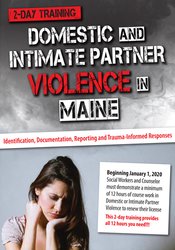
Domestic and Intimate Partner Violence in Maine
Identification, Documentation, Reporting and Trauma-Informed Responses
- Speaker:
- Katelyn Baxter-Musser, LCSW, C-DBT
- Duration:
- 12 Hours 01 Minutes
- Format:
- Audio and Video
- Copyright:
-
Sep 19, 2019
- Product Code:
- POS055110
- Media Type:
- Digital Seminar

Description
Regardless of your area of focus, you’re likely to encounter Domestic and Intimate Partner Violence at some point in your practice.
But abuse can be difficult to detect after the physical signs of violence have faded. What defines abuse and how does one properly assess for it? And when it’s brought into the light, domestic violence can raise professional dilemmas that leave you caught between responsibilities surrounding confidentiality, autonomy, and your wider responsibilities to protect victims.
It’s a complicated situation that can leave you unsure of how to proceed and troubled knowing that failure to recognize and properly respond to domestic violence can have dire consequences.
Starting on January 1st, 2020 social workers and counselors in Maine are required to have completed 12 CE hours of training in domestic or intimate partner violence for renewal of their license or initial licensure.
This recording is your chance to complete all 12 required hours and get the tools and guidance you need to recognize the red flags of domestic and intimate partner violence, properly report and document abuse, and effectively respond and intervene in a trauma-sensitive manner.
Whether you’re a social worker, counselor, psychologist, marriage and family therapist, nurse, or anyone in the helping professions, this program will serve as an indispensable guide for how you can improve outcomes for those impacted by domestic and intimate partner violence.
Credit
Speaker

Katelyn Baxter-Musser, LCSW, C-DBT Related seminars and products
Katelyn Baxter-Musser, LCSW, C-DBT is a licensed clinical social worker in private practice in Maine where her areas of expertise include domestic violence, abuse, trauma, PTSD, depression, anxiety, grief, personality disorders and relationship issues.
Her clinical experience includes working for ten years in various roles as a case manager, child and family therapist, and trauma therapist for several agencies and Native American reservations. Ms. Baxter-Musser served as the Trauma Healing Services Clinical Coordinator for La Frontera Arizona, a non-profit organization dedicated to providing behavioral health counseling, crisis intervention and support to families and individuals facing domestic violence, abuse, hate crimes and other issues.
Ms. Baxter-Musser is certified in Dialectical Behavioral Therapy and EMDR. She is a member of the National Association of Social Workers, the American Academy of Experts in Traumatic Stress, the National Center for Crisis Management and EMDRIA. She sits on the EMDRIA Standards and Training Committee and part of the Southern Maine EMDR Coalition.
Speaker Disclosures:
Financial: Katelyn Baxter-Musser is the owner, operator, trainer of Inner Awakening Counseling & Consulting and receives royalties a published author. She receives a speaking honorarium and recording royalties from Psychotherapy Networker and PESI, Inc. She has no relevant financial relationships with ineligible organizations.
Non-financial: Katelyn Baxter-Musser is a member of EMDRIA, the National Association of Social Workers, the American Academy of Experts in Traumatic Stress, the National Center for Crisis Management, and the International Society for the Study of Trauma and Dissociation.
PESI and Katelyn Baxter-Musser are not affiliated or associated with Marsha M. Linehan, PhD, ABPP, or her organizations.
Additional Info
Questions?Visit our FAQ page at www.pesi.com/faq or contact us at www.pesi.com/info
Objectives
- Employ screening techniques to identify the signs of domestic violence (DV) and intimate partner violence (IPV).
- Establish how evidence-based screenings and assessments can help clinicians determine level of risk and lethality to effectively intervene.
- Ensure proper reporting and documentation when working with clients facing violence in their relationships or homes.
- Characterize the dynamics of domestic violence/intimate partner violence and control tactics used by the perpetrator.
- Evaluate the types of domestic abuse including physical violence, sexual violence, threats and intimidation.
- Connect your clients to domestic violence related services through community resources and appropriate referrals.
- Communicate three barriers that keep people from leaving abusive relationships.
- Characterize how an understanding of cultural factors can help to ensure a competent response to abuse.
- Specify two intervention strategies clinicians can use to enhance treatment of women, men and children who’ve been exposed to domestic violence.
- Develop safety plans with clients to help them leave an abusive or violent home.
- Assess same-gender abuse dynamics and identify aspects of LGBTQ intimate partner violence that may make victims less likely to seek help.
- Employ trauma-informed treatment techniques for survivors of abuse, violence and oppression.
Outline
Victims, Perpetrators and Dynamics of Domestic and Intimate Partner Violence- Myths about domestic and intimate partner violence
- Types of domestic violence
- Dynamics of power, manipulation and control
- Characteristics of perpetrators
- Substance abuse and violence
- Same gender abuse dynamics
- Screening and assessment techniques
- Identify immediate danger
- Injuries and other indicators
- Tools to assess for safety, risk and lethality
- Checklists and advocacy resources
- Technology and domestic/intimate partner violence
- Who’s at risk?
- Warning signs and symptoms
- Emotional manipulation
- Yelling and intimidation
- Inappropriate sexual pressure
- Privacy and confidentiality
- Who is required to report and when?
- Standards for making a report
- Domestic violence contacts and hotlines
- Proper documentation and confidentiality strategies
- When and how to refer to agencies
- Community resources
- Liability issues for failing to report
- Safety plans while living with abusive partners
- Safety planning for children
- Emotional safety planning
- Barriers to leaving
- Plans for leaving and after leaving
- Restraining orders/protective orders
- Recognizing your own biases
- How survivors interpret domestic violence in their culture
- Adapting danger assessments for underserved populations
- Working with LGBTQ survivors
- Assess for PTSD, anxiety, trauma and other mental health issues
- Understand the multilayered impact of DV/IPV
- Processing shame, anger and guilt
- Working with children exposed to domestic violence
- Relaxation skills and guided imagery for anxiety
Target Audience
- Social Workers
- Counselors
- Psychologists
- Marriage & Family Therapists
- Chaplains/Clergy
- Case Managers
- Nurses
- Law Enforcement and First Responders
- Other Mental Health Professionals



Reviews
| 5 |
|
| 4 |
|
| 3 |
|
| 2 |
|
| 1 |
|
Overall: 5
Total Reviews: 1
Satisfaction Guarantee
Your satisfaction is our goal and our guarantee. Concerns should be addressed to: PO Box 1000, Eau Claire, WI 54702-1000 or call 1-800-844-8260.
ADA Needs
We would be happy to accommodate your ADA needs; please call our Customer Service Department for more information at 1-800-844-8260.
PESI Mobile App
Access CE trainings on your phone or tablet through our free mobile app. Choose video or audio-only versions of online courses from the world’s best instructors, and complete your CE requirements anywhere, anytime, at your own pace.




Please wait ...