
California Legal and Ethical Issues for Mental Health Clinicians, 4/26/2021 12:00:00 AM CDT, Digital Seminar More info »
California Legal and Ethical Issues for Mental Health Clinicians, 4/26/2021 12:00:00 AM CDT, DVD More info »
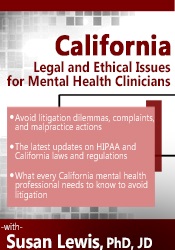
California Legal and Ethical Issues for Mental Health Clinicians
- Speaker:
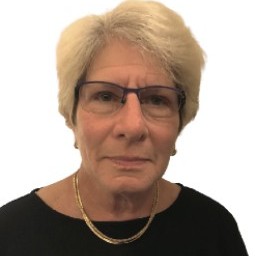
- Susan J Lewis, PhD, JD
- Duration:
- 5 Hours 53 Minutes
- Format:
- Audio and Video
- Copyright:
-
May 12, 2014
- Product Code:
- POS061450
- Media Type:
- Digital Seminar - Also available: Digital Seminar | DVD

Description
- Avoid litigation dilemmas, complaints and malpractice actions
- The latest updates on HIPAA and California laws and regulations
- What every California mental health professional needs to know to avoid litigation!
Join Susan Lewis, psychologist and attorney, for this must-attend seminar that will prepare you for litigation issues which can put your client, your license and your practice at risk. You will learn how to structure your practice to limit exposure of risk, as well as discover simple records, notes and actions that will protect you in the event of a complaint. Susan will provide you with the following take home tools to minimize risk:
- Updates on HIPAA and California laws and regulations
- Risk management strategies
- How to avoid litigation dilemmas, complaints and malpractice actions
- Best practices in the professional relationship, informed consent and office policies
You will learn through problem-solving discussions that are representative of actual ethical decisions you encounter in your clinical practice. The blending of Susan’s experience as a lawyer, work within the court system and extensive clinical experience makes her a hands-on, knowledgeable instructor!
OUTLINE
Clinician-Client Relationship
- Law vs. ethics
- Elements of legal informed consent
- Nuts and bolts of office policies
- Records vs. psychotherapy notes
- What to put in a record
- Limitations on confidentiality
- California case law & danger to others
- California duty to warn potential victims
- HIPAA
- The latest updates you need to know
Practical Approach to Risk Management
- Elements of consent
- Competence & scope of practice
- Boundary violations/crossings
- Issues with modern technology
- Texting, cell phones, e-mail, video psychotherapy
- Perils of supervision
Litigation
- Licensing complaints & malpractice lawsuits
- California specific statues
- California rules and regulations
- Case law and how to find it
Navigate the Legal System
- Roles of attorneys
- Confidentiality/privilege
- Subpoena & disclosure of confidential information
- Depositions, interrogatories, expert testimony
Treatment of Minors
- California age of majority
- Consent to treatment
- Privilege/confidentiality
- Separation & divorce
Case Studies
OBJECTIVES
- Explain the best practices in the professional relationship; informed consent, office policies and California limits on confidentiality.
- Discuss updates on HIPAA and California laws and regulations.
- Identify risk management strategies in clinical practice.
- Describe how to avoid litigation dilemmas, licensing complaints and malpractice actions.
- Summarize the California legal system to better your understanding.
- Outline the differences for treatment of minors.
ABOUT THE SPEAKER
Susan J. Lewis, Ph.D., J.D., is a licensed psychologist, forensic psychologist and an attorney. Susan has 25 years of experience in clinical practice. She is experienced with a varied clinical population that has included: sex offenders, prison inmates, self-injurious individuals, as well as forensic patients. She has held positions as a clinical program director, supervisor for psychiatry residents and psychology doctoral interns. She has conducted trainings on the interface between law and mental health. Susan teaches The Psychology of Criminal Behavior at Harvard University.
She maintains a private clinical practice in Massachusetts. In her role as a consultant, Susan works with attorneys on controversial issues such as dangerousness, competence to stand trial and criminal responsibility evaluations in addition to civil and criminal commitment. She also works with attorneys on strategies and how mental illness might impinge on legal decision making. She has been adjudicated an expert in almost all of the district and superior courts in Massachusetts. In 2010, she appeared on a talk show analyzing the mental health and legal issues facing Amy Bishop, who stands accused of the murder of three academic colleagues at the University of Alabama.
Her extensive clinical experience makes her a hands-on, knowledgeable instructor. She is engaging and has a wonderful sense of humor, which she brings to her seminars.
To order the book, EMDR Made Simple: 4 Approaches to Using EMDR with Every Client, please visit our product store.
To order the book, Psychopharmacology: Straight Talk on Mental Health Medications, 2nd Ed., please visit our product store.
Credit
Alternate Options
|
California Legal and Ethical Issues for Mental Health Clinicians
Copyright: 04/26/2021 - Product Code POS061450 |
Additional Info
Access for Self-Study (Non-Interactive)Access never expires for this product.
Target Audience
Psychologists, Counselors, Social Workers, Case Managers, Addiction Counselors, Marriage & Family Therapists, Nurses, and other Mental Health ProfessionalsReviews
| 5 |
|
| 4 |
|
| 3 |
|
| 2 |
|
| 1 |
|
Overall: 4
Total Reviews: 22
Satisfaction Guarantee
Your satisfaction is our goal and our guarantee. Concerns should be addressed to: PO Box 1000, Eau Claire, WI 54702-1000 or call 1-800-844-8260.
ADA Needs
We would be happy to accommodate your ADA needs; please call our Customer Service Department for more information at 1-800-844-8260.
PESI Mobile App
Access CE trainings on your phone or tablet through our free mobile app. Choose video or audio-only versions of online courses from the world’s best instructors, and complete your CE requirements anywhere, anytime, at your own pace.




Please wait ...