
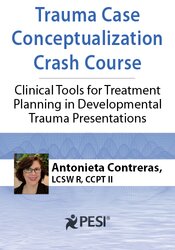
3 Hour Trauma Case Conceptualization Crash Course
Clinical Tools for Treatment Planning in Developmental Trauma Presentations
- Speaker:
- Antonieta Contreras, LCSW R, CCPT II
- Duration:
- 3 Hours
- Product Code:
- LWC150927
- Brochure Code:
- PWZ96332
- Media Type:
- Live Webinar

Description
- Learn the difference between survival adaptations vs. true developmental injury
- Identifying developmental wounds that shape your client’s clinical presentation
- Improve diagnostic clarity to guide effective treatment planning
- Targeting core developmental needs rather than surface level symptoms
So your clients come with what looks like ADHD, BPD, treatment resistant depression but none of the diagnoses fully explain what you’re seeing in the room.
That’s because developmental trauma is at play.
And early developmental trauma is different from trauma later in life. So if you don’t know the difference, you not only won’t know how to treat it.
You are risking harming your clients
That’s why we created this quick training with Antonieta Contreras, LCSW R, BCN and author of How Deep Is the Wound created this hands-on training!
So busy clinicians like you can get a clear developmental trauma framework to allow you to read the presentation, intervene at the right level, and avoid reinforcing the original injury.
Register today and walk away with:
- Assessment tools to separate survival adaptations from true developmental injury
- Clinical skills to spot developmental wounds shaping adult presentation
- Sharper discernment skills to avoid misdiagnosis to create the right treatment
- Practical interventions targeting developmental need – not just symptoms
Cut the guesswork – and learn how to choose the right treatment from the start.
Register today!
Credit
Speaker

Antonieta Contreras, LCSW R, CCPT II Related seminars and products
Antonieta Contreras, LCSW R, CCPT II, is a licensed clinical social worker, trauma specialist, author, and educator with over a decade of clinical experience working with individuals impacted by complex trauma, developmental trauma, dissociation, and relational injury. She is the author of Traumatization and Its Aftermath: A Systemic Approach to Understanding and Treating Trauma Disorders (Routledge, 2023) and How Deep Is the Wound? A Guide to Investigating, Understanding, and Resolving Your Emotional Pain (2025).
Her work focuses on clarifying the full spectrum of emotional injury – from extreme and complex trauma to more common yet highly impactful emotional wounds – through a neurobiological and systemic lens. She supports clinicians in moving beyond oversimplified nervous system explanations toward precise, developmentally informed case conceptualization and effective treatment planning. Her approach integrates neuroscience, attachment theory, dissociation theory, and relational models into clear, accessible frameworks that enhance clinical decision making without sacrificing depth or nuance.
Speaker Disclosures:
Financial: Antonieta Contreras has employment relationships with NY Counseling Services, The Institute for Contemporary Psychotherapy, Instituto Medico Imaya, Instituto Peruano de Psicología Contextual S.A.C, Udima University of Madrid, IPC, and New York University. She is the developer of the Emotional Architecture Model and Structural Emotional Reorganization framework. Antonieta Contreras receives royalties as a published author. Antonieta Contreras receives a speaking honorarium from PESI, Inc. She has no relevant financial relationships with ineligible organizations.
Non-financial: Antonieta Contreras is the co-founder of the New York Association of Trauma therapists and a member of the European Society for Trauma and Dissociation.
Additional Info
Access Period for Live WebcastYou will have access for 90 days after the program for review. For live CE credit, you must watch the live webcast in its entirety at its scheduled time and complete the CE quiz and evaluation within one week. Please note that this requirement may vary by credit type. Please see detailed credit information for specific requirements for each credit type.
Webcast Schedule
Please note: There will be a 15-minute break mid-morning. Actual break start time is at the discretion of the speaker. A more detailed schedule is available upon request.
Questions?
Visit our FAQ page at www.pesi.com/faq or contact us at www.pesi.com/info
Objectives
- Differentiate adversity, developmental disruption, and developmental trauma, including the role of adaptive normalization, to improve diagnostic clarity in complex presentations.
- Identify how chronic relational stress and environmental instability shape the maturation of regulatory, relational, and identity-related domains, to strengthen the accuracy of case conceptualization.
- Analyze how the timing of developmental disruption determines which domains are most affected, to reduce the risk of misdiagnosing developmental presentations as psychiatric disorders.
Outline
Reframing Developmental Trauma in Clinical Practice
- Trauma as a developmental process shaped by chronic stress, relational conditions, and timing
- Recognize early childhood survival-based adaptations to adverse environments
- Understand how the timing of disruption shapes regulation, relationships, and identity
- Link trauma to rigid patterns of impulse control, dissociation, and relational instability
Recognizing Developmental Trauma in Clinical Practice
- Differentiate survival-based patterns from personality, attentional, and mood disorders
- Recognize rigid shame, self criticism, and reenactment of early relational dynamics
- Identify common clinical pitfalls in trauma treatment planning
- Clinical strategies that prevent over pathologizing, premature and trauma processing
- Apply systemic framework for developmental trauma assessment
Utilizing Dynamic Multidimensional Approach for Treatment
- Identify indicators of good regulatory and maturational capacity
- Clinical interventions for strengthening core developmental functions
- Clinical interventions for supporting identity consolidation and executive integration
- Utilize an intuitive approach for stabilization, relational work and trauma processing
- Clinical integration practical exercises
Target Audience
- Counselors
- Social Workers
- Marriage and Family Therapists
- Psychologists
- Addiction Counselors
- Case Managers
- Psychiatrists
- Psychiatric Nurse Practitioners
- Other Mental Health Professionals



Reviews
Satisfaction Guarantee
Your satisfaction is our goal and our guarantee. Concerns should be addressed to: PO Box 1000, Eau Claire, WI 54702-1000 or call 1-800-844-8260.
ADA Needs
We would be happy to accommodate your ADA needs; please call our Customer Service Department for more information at 1-800-844-8260.
PESI Mobile App
Access CE trainings on your phone or tablet through our free mobile app. Choose video or audio-only versions of online courses from the world’s best instructors, and complete your CE requirements anywhere, anytime, at your own pace.




Please wait ...