
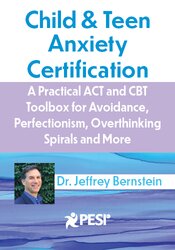
2-Day Child & Teen Anxiety Certification
A Practical ACT and CBT Toolbox for Avoidance, Perfectionism, Overthinking Spirals and More
- Speaker:
- Jeffrey Bernstein, PhD
- Duration:
- Two Full Days
- Product Code:
- LWC150922
- Brochure Code:
- PWZ96275
- Media Type:
- Live Webinar

Tags: APA
Description
- How family accommodation quietly maintains anxiety – and what to do instead
- Evidence-based tools to treat the most common youth anxiety presentations
- Strategies to interrupt overthinking spirals before they derail functioning
- A practical parent coaching model that changes the system between sessions
- Techniques to re-engage resistant, perfectionistic, and emotionally flooded youth
You’re seeing school refusal, perfectionism-driven shutdown, panic symptoms that derail daily functioning – and parents who are caught in reassurance loops that tell you the anxiety is running the whole family.
You only see the child for one hour per week, so you need concrete strategies that support the entire system – even when they’re not in your office.
In this 2-day certification training, celebrated author and anxiety expert Jeffrey Bernstein, PhD shares his decades of clinical experience with children and adolescents, equipping you with practical skills and frameworks to support families navigating the challenges of childhood and adolescent anxiety.
Register today and get a start-to-finish clinical roadmap that includes:
- Tools for effective assessment, case formulation, engagement, and maintenance
- Ready-to-use parent coaching scripts and structured templates
- A complete toolbox of downloadable materials
- Dr. Bernstein’s PACE method – a practical, session-ready approach for emotionally flooded kids
- A certification of completion and digital badge demonstrating your expanded skillset
You’ll leave with effective, ready-to-implement tools AND a certification credential that provides you with an ACT and CBT informed set of skills designed to address the anxiety struggles commonly found in children and teens.
And, when you complete this course you can become certified in Clinical Child & Adolescent Anxiety Treatment Professional (CCATP-CA) through Evergreen Certifications at no additional cost.
These families aren’t resistant. They’re exhausted and out of answers. Your newly expanded skills will help you guide families to regulate emotions and problem-solve amidst anxiety-related stressors.
CERTIFICATION MADE SIMPLE!
- No hidden fees – PESI pays for your application fee (a $99.99 value!)
- Simply complete this live event and the post-event evaluation included in this training, and your application to be certified in Clinical Child & Adolescent Anxiety Treatment Professional *CCATP-CA) through Evergreen Certifications is complete*
Attendees will receive documentation of CCATP-CA designation from Evergreen Certifications 4 to 6 weeks following the program.
Professional standards apply. Visit https://www.evergreencertifications.com/certification/certified-clinical-child-adolescent-anxiety-treatment-professional/ for professional requirements
Credit
Speaker

Jeffrey Bernstein, PhD Related seminars and products
Jeffrey Bernstein, PhD, is a child and family psychologist with over 35 years of clinical experience specializing in anxiety, overthinking, and behavioral challenges in children and adolescents. He is the author of multiple books including, When Overthinking Overtakes Your Child: 10 Days to Ease Anxiety, Quiet Worry, and Tame Runaway Thoughts, and the international bestseller, 10 Days to a Less Defiant Child, which has been published in several countries.
His recent clinical and professional development interests have focused on Acceptance and Commitment Therapy (ACT)-informed interventions, Cognitive Behavioral Therapy (CBT), mindfulness-based strategies, psychological flexibility, and process-focused approaches to address worry, rumination, overthinking, and difficulties with emotional regulation.
Dr. Bernstein is the recipient of the 2025 PSCP: The Psychology Network’s Distinguished Psychologist Award and is widely recognized for translating evidence-based therapy into practical, immediately usable strategies for clinicians, families, and schools.
Speaker Disclosures:
Financial: Jeffrey Bernstein maintains a private practice. He is an author and receives royalties. Dr. Bernstein receives a speaking honorarium, recording, and book royalties from PESI, Inc. He has no relevant financial relationships with ineligible organizations.
Non-financial: Jeffrey Bernstein is a fellow with the Pennsylvania Psychological Association.
Additional Info
Access Period for Live WebcastYou will have access for 90 days after the program for review. For live CE credit, you must watch the live webcast in its entirety at its scheduled time and complete the CE quiz and evaluation within one week. Please note that this requirement may vary by credit type. Please see detailed credit information for specific requirements for each credit type.
Webcast Schedule
Please note: There will be a 70-minute lunch and two 15-minute breaks; one in the morning and one in the afternoon. Lunch and break times will be announced by the speaker and at their discretion. A more detailed schedule is available upon request.
Questions?
Visit our FAQ page at www.pesi.com/faq or contact us at www.pesi.com/info
Objectives
- Differentiate common anxiety presentations in children and adolescents using a developmental, diagnostic, and functional impairment indicators.
- Apply evidence-based assessment and case formulation principles to identify factors that maintain youth anxiety.
- Choose psychoeducational strategies that support treatment engagement and symptom understanding.
- Choose evidence-informed interventions that target repetitive negative thinking processes, including worry and rumination.
- Determine when process-focused interventions may be appropriate in cases where thought-content interventions have been insufficient.
- Apply approach-based intervention strategies for common anxiety presentations, including school refusal, social avoidance, and perfectionism.
- Choose empirically supported parent-based intervention strategies to support treatment goals.
- Evaluate the appropriate use of therapist-supported, digitally augmented, and parent-led intervention models for youth anxiety.
- Evaluate moderators of CBT outcomes (youth severity, parent factors, dosage/contact, and delivery format) to improve case planning and reduce stalled treatment.
- Apply evidence-based relapse-prevention and maintenance strategies to support skill generalization across settings and address future avoidance and overthinking patterns.
- Identify situations in which school collaboration or medical consultation may be indicated
- Use motivational and engagement-focused strategies (including values clarification, discrepancy development, and autonomy-supportive language) to reduce treatment resistance in anxious youth.
Outline
Day 1
What’s Driving Youth Anxiety Today
- Current clinical presentation trends
- Anchoring treatment in real-world functioning
- Identifying barriers to care, cultural considerations, and treatment targets
- Tools to uncover contributing factors quickly
A Developmental Map of DSM-5-TR™ Anxiety Disorders
- Anxiety expression across developmental stages
- Common features and presentations
- Cultural and diversity considerations
- Determining when anxiety crosses the clinical threshold
- Case formulation and next steps
Differential Diagnosis and Co-Occurring Conditions
- Separating ADHD overwhelm from anxiety-driven avoidance
- Telling apart trauma reactions from generalized worry
- Differentiating OCD processes from perfectionism
- Recognizing anxiety in neurodivergent youth
- Important flags for medical collaboration
Turn Psychoeducation into a Clinical Tool That Builds Motivation
- Teaching the brain-body alarm system without feeding fear
- Identifying panic systems and how they manifest in the body
- Breaking the fear-of-fear loop using physiology as a clinical tool
- Age-adapted “alarm system” scripts for kids and teens
Break the Overthinking Spiral
- Anxiety, repetitive negative thinking, rumination, and worry loops as maintaining factors
- Targeting the beliefs that keep kids trapped in their own heads
- Recognizing perfectionism-driven paralysis
- Templates for parents and caregivers to follow outside of the therapy room
Keep Sessions on Track with PACE: A Framework for Emotionally Flooded Youth
- What to do when kids shut down, escalate, or demand reassurance
- Applying skills to school refusal mornings, panic escalation, and perfectionistic meltdowns
- Ready-to-use scripts for children, teens, and parents
- Discussion of limitations and risks
Day 2
Build Approach-Based Change Plans That Work Across Presentations
- Graded approach plans for school refusal, social anxiety, and more
- Reinforcing brave behavior and avoiding power struggles
- Troubleshooting avoidance spikes before they collapse the treatment plan
- “Micro-bravery” planning
Coach Parents to Stop Accidentally Making Anxiety Worse
- Helping parents see how well-meaning responses keep anxiety alive
- Coaching parents to support brave, values-based action without reinforcing avoidance
- Giving parents concrete alternatives to accommodation that actually reduce anxiety over time
- Navigating split households and anxious parents
- Parent session structure and language templates
Get Schools on Board
- Communicating effectively with school support staff
- Building attendance and re-entry plans that schools will use
- Documenting and framing recommendations in ways that move the system
End Treatment with a Plan
- Building relapse resilience
- Creating family transition plans for school, social, and developmental stressors
- Graduated independence plan to keep progress alive after treatment ends
Target Audience
- Counselors
- Art Therapists
- Marriage and Family Therapists
- Social Workers
- Psychologists
- Physicians
- School Counselors
- School Psychologists
- School Social Workers



Reviews
Satisfaction Guarantee
Your satisfaction is our goal and our guarantee. Concerns should be addressed to: PO Box 1000, Eau Claire, WI 54702-1000 or call 1-800-844-8260.
ADA Needs
We would be happy to accommodate your ADA needs; please call our Customer Service Department for more information at 1-800-844-8260.
PESI Mobile App
Access CE trainings on your phone or tablet through our free mobile app. Choose video or audio-only versions of online courses from the world’s best instructors, and complete your CE requirements anywhere, anytime, at your own pace.




Please wait ...