

An entire generation came of age during a period of unprecedented uncertainty.
COVID accelerated the disruption. But the deeper shift was already underway.
They grew up with active-shooter drills, climate crisis headlines, economic instability, political polarization, and a rapidly changing social landscape shaped by technology, identity, and culture.
For Gen Z, stress was never occasional. It was the backdrop of everyday life, and social media made it inescapable: an always-on stream of comparison, crisis, and commentary.
And the pace of the digital world has become the pace of their internal world.
You’re feeling it in the therapy room…
Clients who arrive self-diagnosed from TikTok.
Fluent in therapy-speak yet stuck.
Restless in silence.
Quick to disengage when sessions feel scripted.
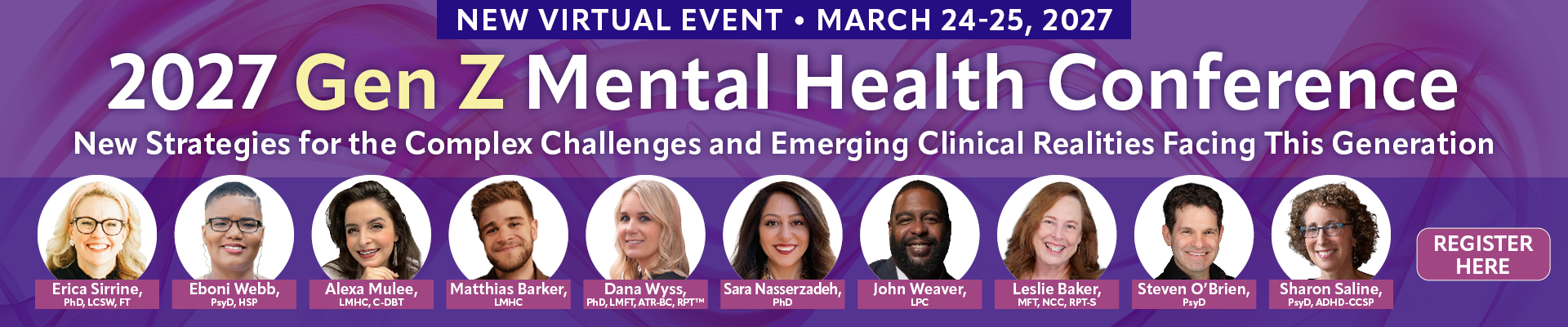
Join leading experts Steve O’Brien, Sharon Saline, Eboni Webb, Matthias Barker, and more at the Gen Z Mental Health Conference for creative therapies, DBT, CBT, ERP, and other approaches adapted for how this generation thinks, feels, and connects:
- Intimacy anxiety and AI companions: real connection when a client’s closest bond is an app
- Suicidality and self-harm: the warning signs you can’t afford to miss
- Neurodiversity- and gender-affirming care: building stronger engagement, trust, and outcomes
- Polarization and righteous anger: channeling it into conviction, empathy, and action
- Distress intolerance and substance use: breaking the cycle of escape
- Family estrangement: protective or avoidant, and how to tell the difference
- And more!
2027 Gen Z Mental Health Conference
New Strategies for the Complex Challenges and Emerging Clinical Realities Facing This Generation(15 live and 3.5 self-study)
Credit approvals may differ per session
Self-study CE hours and approvals may vary from live event
Your registration is 100% risk-free. Cancel at any time for a complete
refund.

Decode Gen Z’s Relational Paradox, AI Attachment & the Modern Therapy Room
We’ve all had that moment in session: a Gen Z client is sitting across from us, describing a sudden breakup over a minor “ick,” struggling with unexplainable intimacy anxiety, or admitting their most reliable emotional connection is an AI companion app.
When we lean on classic 20th-century frameworks, our younger clients often pick up on the disconnect and quietly retreat behind “cultural camouflage”—using therapy jargon like boundaries or attachment trauma to shield themselves from real vulnerability.
Join us and gain practical, somatic interventions, de-camouflaging techniques, and digital titration tools you can use immediately to help your clients navigate risk aversion, build genuine distress tolerance, and move from synthetic safety into deep, fulfilling human connection.

When Digital Natives Face Suicide Risk
Generation Z brings unique strengths into the therapy room, along with unprecedented levels of anxiety, loneliness, uncertainty, and suicide risk.
As the first true digital natives, Gen Z’s experiences with technology, identity, relationships, and mental health require clinicians to rethink traditional approaches to suicide assessment and intervention.
Join expert Leslie W. Baker, author of Suicide Intervention in Kids and Teens and learn:
- Suicide assessment strategies that go beyond outdated checklists
- Safety planning tools that empower clients, caregivers, and support systems
- Tech-informed approaches, including the benefits and limitations of AI in suicide prevention
- Evidence-based interventions including DBT-A, DBT, CAMS/CAMS-4Teens, CBT-SP, and expressive therapies

Engaging Gen Z in Meaningful Change
Many Gen Z clients want absolute certainty before they take action.
They often stick closely to familiar routines, technology, and support systems, expecting the worst and forgetting how capable they really are.
Over time, avoiding challenges can leave them feeling stuck and less confident in themselves.
Traditional exposure approaches can feel too overwhelming, too fast, and too threatening.
After years of helping anxious and avoidant clients, Steve O’Brien, PsyD, found that lasting change starts with something much smaller: micro-exposures. Through clinical examples, you’ll learn how to use these small but powerful interventions to build engagement, reduce avoidance, and help clients grow their confidence one step at a time.

Join Dr. Sharon Saline as she reframes what is often called “failure to launch” as a matter of skills, support, and developmental readiness rather than motivation or character. You’ll gain strategies for reducing family conflict, establishing healthier boundaries, clarifying responsibilities, and supporting a more successful transition to adulthood.
Key takeaways:
- Cognitive and emotional challenges common in neurodivergent emerging adults
- Intersection of gender diversity and neurodivergence
- ADHD, autism, anxiety, family expectations, and their impact
- The Connected Independence Therapeutic Model for supported autonomy and adult-life readiness

Strategies for Helping Gen Z Turn Righteous Anger into Empathy, Conviction, and Action
Gen Z is showing up in therapy with anger that has nowhere to go, cynicism that looks like maturity, and a fatigue that comes from caring about everything at once.
Rising political polarization, resurgent racial hostility, institutional instability, and economic precarity are real conditions Gen Z did not create but must live inside.
This isn’t a generation collapsing into hopeless anxiety. It’s a generation waking up to the mess they’ve inherited and getting angry about it.
You’ll leave with a clinical framework for validating Gen Z’s fear and anger as reasonable responses to real conditions and strategies for channeling that anger into empathy, conviction, and action.

Understanding and Supporting Grief, Connection, and Resilience
Gen Z has experienced unprecedented personal and collective losses, from the deaths of loved ones to disrupted milestones, relationships, traditions, and futures once hoped for. Yet many reached adulthoods without the rituals and community experiences that help people learn to grieve and heal.
In this practical session, you’ll learn how grief uniquely shows up in adolescents and young adults and gain strategies to support emotional expression, meaning-making, connection, and resilience.
You’ll walk away with:
- Insight into death-related, ambiguous, and disenfranchised loss
- Approaches to emotional expression and grief literacy
- Incorporate ritual, connection, and continuing bonds into clinical care
- Strategies for fostering resilience while honoring the reality of loss

When Good Intentions Undermine Resilience
Many clinicians are observing an unintended consequence of today’s highly protective culture: Gen Z clients who feel increasingly overwhelmed by the ordinary challenges of relationships, uncertainty, conflict, and failure.
In this session, Dr. Eboni Webb demonstrates how DBT skills can help Gen Z clients build emotional endurance, navigate discomfort, and respond more effectively to life’s challenges.
You’ll learn:
- Drivers of low distress tolerance in Gen Z
- Patterns of avoidance, accommodation, and reassurance-seeking
- Core DBT distress tolerance and emotion regulation skills
- Validation without reinforcing emotional avoidance
- Practical strategies for building resilience, confidence, and psychological flexibility

DBT Strategies for Gen Z Cannabis Use and Distress Tolerance
For many Gen Z clients, cannabis can become a quick and accessible way to manage anxiety, boredom, overwhelm, and other uncomfortable emotions. But when relief becomes the primary coping strategy, clients may have fewer opportunities to build the resilience needed to navigate discomfort, stay engaged, and move toward meaningful goals.
With DBT-informed approaches, you’ll learn:
- The function cannabis serves for clients and how that understanding can shape intervention planning
- Tools for managing urges, anxiety, overwhelm, and emotional discomfort
- A shift from short-term relief toward willingness, competence, and values-based action
- A “making lemonade” framework that emphasizes capacity-building rather than escape from distress

Helping Clients Find Clarity, Boundaries, and Paths to Reconnection
Parent-child estrangement is becoming an increasingly common reality for Gen Z clients.
Whether clients are questioning contact, maintaining distance, or considering reconciliation, you need tools to help them navigate these complex family dynamics with clarity and confidence.
This session equips you to intervene at three leverage points:
- Mapping the negative interaction cycle that drives disconnection
- Healing the underlying shame and fear that fuel it
- Guiding clients and their families toward conversations grounded in curiosity, accountability, and calm power instead of worry
You’ll be able to spot the subtle moves that widen the gap, teach clients how to own their part without self-condemnation, and scaffold concrete next steps that honor safety while reopening doors to relationships.

Looking for fresh ways to engage Gen Z clients?
Join Dr. Wyss for an interactive workshop featuring her favorite Gen Z-tested expressive arts activities. Experience 10 creative, play, art, game-based, and experiential interventions designed to spark participation, strengthen communication, and deepen self-discovery.
Beyond learning new activities, you’ll explore what makes an intervention resonate with one client and fall flat with another and strategies for adapting activities to fit different personalities, interests, and therapeutic goals, while fostering collaboration, choice, and client voice.
2027 Gen Z Mental Health Conference
New Strategies for the Complex Challenges and Emerging Clinical Realities Facing This Generation(15 live and 3.5 self-study)
Credit approvals may differ per session
Self-study CE hours and approvals may vary from live event
Your registration is 100% risk-free. Cancel at any time for a
complete
refund.

Helping Clients Use Language That Heals
Gaslighting. Trauma bonding. Narcissism. Clients are increasingly arriving with therapy labels shaped by social media, and those labels are often inaccurate, overly pathologizing, or used to avoid deeper emotional exploration.
In this practical training, Dr. Isabelle Morley will show you how to gently correct misused therapy terms, preserve rapport, and uncover what clients are really trying to communicate.
Leave with a clear framework, practical interventions, client handouts, and the confidence to respond to therapy speak with clarity, compassion, and clinical integrity.

Guiding the Smartphone Generation
Psychologist Jean Twenge is one of the foremost researchers exploring the lives of kids and teens today. Her up-to-the-minute studies tying the rise of mental health issues in teens to the explosion of smartphones have widely influenced key cultural figures and educational policy from coast to coast. She has written seven books including Generations: The Real Differences Between Gen Z, Millennials, Gen X, Boomers and Silents.
Twenge will delve into the latest findings about how being the first generation to spend their adolescence with smartphones is affecting today’s teens. Has it really made them more likely to experience unhappiness, anxiety, and depression? And if so, what can therapists do to help?
2027 Gen Z Mental Health Conference
New Strategies for the Complex Challenges and Emerging Clinical Realities Facing This Generation(15 live and 3.5 self-study)
Credit approvals may differ per session
Self-study CE hours and approvals may vary from live event
Your registration is 100% risk-free. Cancel at any time for a
complete
refund.
We’re that confident you'll find this learning experience to be all that's promised and more than you expected.